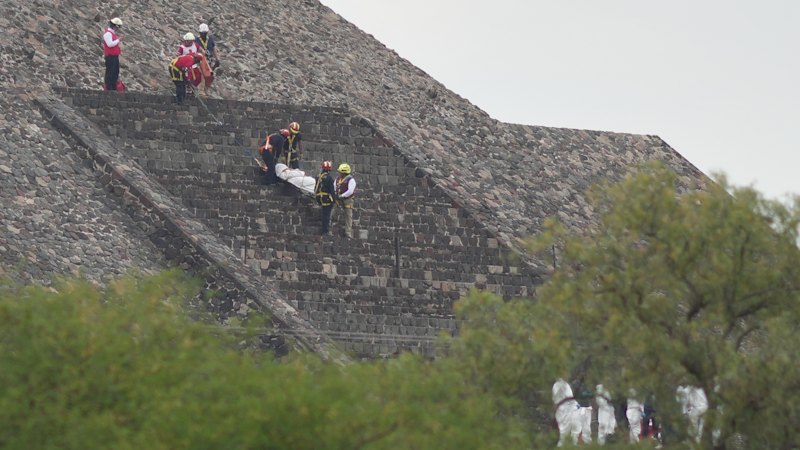
The shadow of the Temple of the Moon is no longer just a marvel of ancient engineering; it is now a crime scene. When a gunman opened fire on a group of tourists at Mexico’s iconic pyramids, the narrative of "safe" high-traffic archeological zones shattered. While official reports focus on the immediate tragedy of the deceased traveler, the event reveals a much more dangerous reality regarding the encroachment of organized crime into Mexico’s federally protected heritage sites. This was not a random act of madness. It was a calculated breach of a zone that was previously considered off-limits to the escalating violence that plagues the surrounding State of Mexico.
The Illusion of Protected Ground
For decades, the National Institute of Anthropology and History (INAH) has maintained a silent pact with the reality of Mexican security. The pyramids of Teotihuacán represent more than history; they are a massive economic engine. Over four million people visit annually. That volume of human traffic creates a bubble where the Mexican government pours resources to ensure international visitors feel insulated from the cartel-driven headlines in other regions.
That bubble has burst. The recent shooting confirms that the territorial wars between local gangs and larger cartels have moved from the outskirts of San Martín de las Pirámides directly into the central plazas of the archaeological site.
Security at these sites is often performative. You see the guards with their radios and the occasional National Guard patrol, but their training is geared toward preventing tourists from climbing restricted ruins or stopping illegal vendors. They are not equipped to handle a professional hit or a crossfire scenario. When the first shots echoed off the stone facades, the lack of a coordinated emergency response was laid bare.
The Cartel Shadow Over Heritage
The State of Mexico (Edomex) has become one of the most volatile regions in the country. It acts as a transit corridor for everything from synthetic drugs to human trafficking. While hotspots like Michoacán or Guerrero get the press, the area surrounding the pyramids has been quietly simmering.
The "why" behind this specific violence is rooted in extortion. Local criminal cells have been tightening their grip on the transport and hospitality sectors that serve the pyramids. When a tourist is killed in such a public and brazen manner, it often serves as a message. It is a display of dominance over a territory that the state claims to control. If the government cannot protect its most famous landmark, it cannot protect the local shopkeeper who refuses to pay "protection" money.
The Breakdown of the Safety Perimeter
In any other major global tourist hub, a shooting would trigger an immediate and total lockdown. At Teotihuacán, the response was fragmented. Witness accounts describe a period of mass confusion where visitors were left to find their own cover among the structures.
- Federal vs. State Jurisdictions: The site is federal land, but the surrounding towns are under state and municipal law. This creates a "no man's land" of intelligence sharing.
- Response Times: The distance from major military barracks means that by the time a heavy response arrives, the perpetrators have disappeared into the dense, disorganized urban sprawl of the neighboring municipalities.
- The Vendor Factor: Thousands of unregistered vendors operate around the perimeter. Intelligence suggests that these informal networks are easily infiltrated by lookouts for criminal groups.
The Economic Fallout for Mexican Tourism
Tourism accounts for nearly 9% of Mexico's GDP. The government knows this. Every time a high-profile incident occurs, the standard operating procedure is to downplay the event as an isolated incident. They call it a "deplorable act" and promise justice that rarely arrives.
However, the "isolated incident" defense is losing its bite. Travelers are increasingly savvy. They look at maps. They see that the violence is no longer confined to border towns or remote mountain ranges. It is on the doorstep of Mexico City. It is at the foot of the Sun Pyramid.
The real danger here is the long-term shift in travel advisories. If the US State Department or European ministries elevate the warning levels for the State of Mexico specifically due to threats at archaeological sites, the economic impact will be measured in billions. The families who rely on the "tianguis" markets and the tour buses will be the first to feel the hunger.
Beyond the Official Narrative
The government will likely announce the arrest of a "material author" of the crime within weeks. They will parade a low-level gunman in front of cameras to signal that the rule of law is intact.
Do not be fooled.
The arrest of a trigger-man does nothing to address the structural failure that allowed a firearm into a high-security cultural zone. It does nothing to sever the ties between local police forces and the gangs that operate in the shadow of the ruins. To truly secure Teotihuacán, the Mexican government would need to admit that the site is no longer an island of peace. It would require a permanent, high-intensity security presence that would, ironically, scare away the very tourists they are trying to protect.
The Modern Risks of Ancient Sites
Travelers must now weigh the historical value of these sites against a changing security environment. The old advice was to avoid the roads at night. The new reality is that even mid-day, in the middle of a crowd of thousands, the risk is non-zero.
The gunman at the pyramids didn't just kill a tourist. He killed the idea that Mexico's history is a sanctuary.
Security experts suggest that if you are planning a visit, you should avoid the weekends when crowds are at their peak and security is most stretched. Use official transport only. Do not linger in the "buffer zones" between the parking lots and the main gates. These are the areas where the state’s authority is at its weakest.
The sun still rises over the Avenue of the Dead, but the light is different now. The silence of the ruins has been replaced by the memory of gunfire. If you go, look at the stones, but keep one eye on the horizon. The ancient gods of this place are no longer the only ones demanding a sacrifice.


