The air in the office smells of stale green tea and cooling circuit boards. Outside the window, Shenzhen is a blur of neon and damp asphalt, but inside, the only light that matters comes from a single 27-inch monitor.
Li Wei rubs his eyes. He is thirty-four, but his posture is that of an old man. On his screen is a labyrinth of geometric lines, a digital blueprint so dense it looks like a microscopic city. This is an Electronic Design Automation—or EDA—workspace. It is the software used to design microchips. Without it, the modern world stops spinning. No smartphones, no data centers, no artificial intelligence.
For decades, engineers like Li used American tools to build these digital cities. Names like Synopsys, Cadence, and Mentor Graphics were the air they breathed. Then, the geopolitical weather changed. The supply lines snapped.
Suddenly, Chinese tech giants found themselves locked out of the very software required to design the future. The response from Beijing was a massive, state-backed rush to build a domestic software ecosystem from scratch. But writing EDA software is not like building an app. It requires coding decades of advanced physics, mathematics, and materials science into a single program.
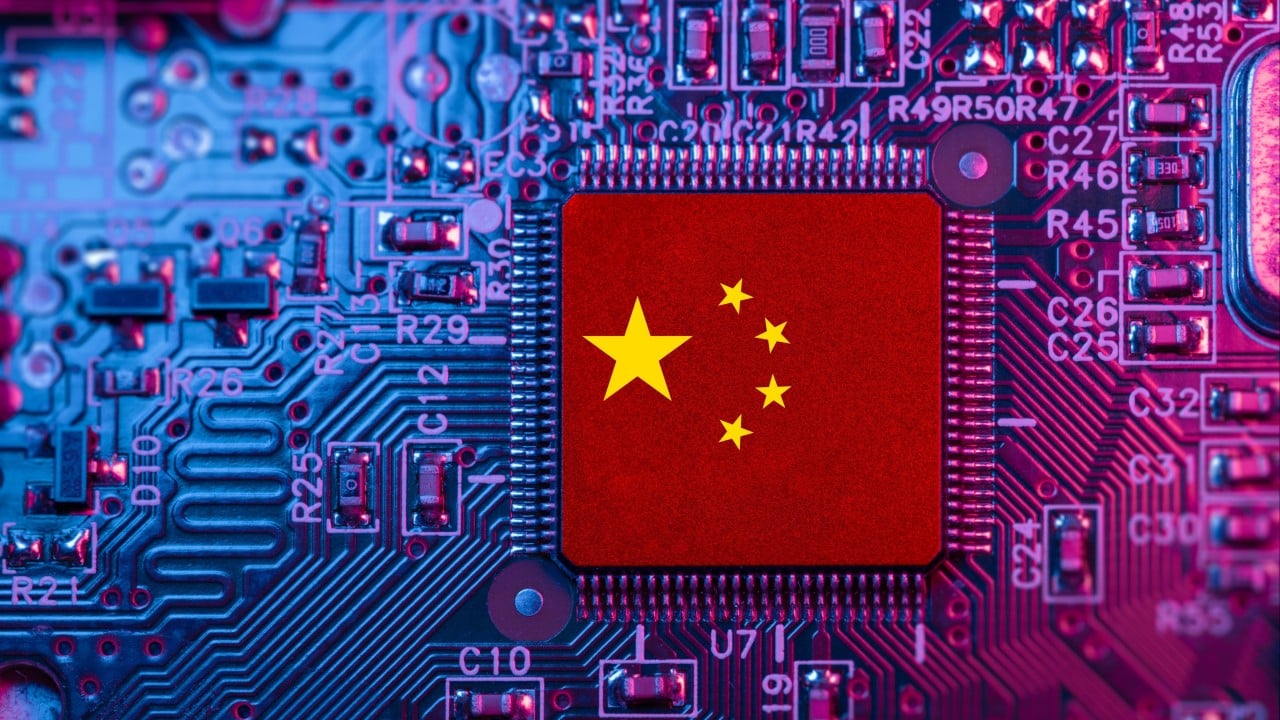
Now, a new theory has emerged from the labs of Huawei, a concept known as a new scaling law for chip design. It promises a shortcut, a way to bypass traditional manufacturing limitations using clever architecture and software tricks. China’s domestic EDA firms are rushing to support it.
Can software engineers in Shenzhen outrun the global supply chain?
The Ghosts in the Silicon
To understand the desperation in Li’s office, you have to understand the sheer absurdity of a modern microchip.
When you look at a processor, you are looking at billions of transistors crammed onto a piece of silicon no larger than a fingernail. To design this by hand is impossible. It would be like trying to draw a map of every street, alley, pipe, and electrical wire in the entire world, using a pencil, on a single sheet of paper.
EDA software does this automatically. It calculates how electrons move through channels that are only a few nanometers wide—quantum territory, where the laws of classical physics break down and electrons begin to teleport through solid walls.
"If the software miscalculates by a fraction of a hair," Li says, pointing to a cluster of red lines on his screen, "the entire chip is just expensive sand. You find out eighteen months and fifty million dollars later."
For twenty years, American firms held a monopoly on this precision. They had the historical data. They had the feedback loops with the factories in Taiwan and South Korea. When the US government restricted Chinese access to advanced EDA tools, it wasn't just a bump in the road. It was a brick wall.
The immediate reaction was panic. The subsequent reaction was an explosion of domestic startups. Today, dozens of Chinese EDA companies are vying for market share, trying to replace the American giants. But they face a compounding problem.
Silicon design has traditionally relied on Moore’s Law—the observation that the number of transistors on a microchip doubles roughly every two years, making computers faster and cheaper. But Moore’s Law is dying. The physics are running out of room. Transistors cannot get much smaller without melting themselves.
This is where Huawei’s new scaling law enters the fray.
The New Map
Huawei’s proposition is born of necessity. If you cannot use the most advanced manufacturing equipment in the world to make smaller transistors, you must make the existing transistors work differently.
The new scaling law focuses on system-level integration. Instead of forcing everything onto a single, impossibly complex chip, the strategy relies on stacking multiple chips together—a method called advanced packaging or chiplets—and using highly optimized software to treat them as a single organism.
It is a brilliant workaround on paper. But it shifts the entire burden of performance onto the software.
Consider a highway system. If you cannot build faster cars, you must build a flawless traffic management system that eliminates every single red light, bottleneck, and intersection delay. The software must predict traffic patterns before the cars even start their engines.
For China’s domestic EDA companies, backing Huawei’s new law is both an opportunity and a trap.
If they can build software that masters this new way of designing chips, they can leapfrog the traditional developmental steps that took American firms thirty years to perfect. They can give Chinese designers a way to produce high-performance AI chips using older, readily available manufacturing nodes.
The domestic industry has rallied behind the flag. Major local software providers are rewriting their codebases to support these new architectural standards. Money is flowing. Engineering talent is migrating.
Yet, the gap remains staggering.
The Twenty-Year Head Start
The problem with software is that it learns from experience.
When an engineer uses an EDA tool to design a chip, and that chip goes to a factory to be manufactured, the factory sends data back to the software company. This line was too close to that one. The heat distribution caused a warp here. This feedback loop has been running between American software firms and global chip factories for decades. Millions of chips, trillions of data points. That data is baked into the code. It is an invisible library of tribal knowledge that cannot be bought or copied.
Domestic alternatives lack this history. They are writing code for factories that are themselves trying to catch up.
"We are building the car while trying to map the road at the same time," Li says. He clicks his mouse, clearing a section of the design. "Sometimes, the tool tells you a design is perfect. Then the factory line tries to print it, and it fails. Why? Because the software didn't know about a specific quirk in the chemical vapor deposition machine. How could it?"
This lack of integration creates a vicious cycle. Chip designers are hesitant to use unproven domestic software because a single mistake can ruin a multi-million-dollar project. But if they don't use the software, the software companies can never get the data they need to improve.
Huawei’s scaling law attempts to break this cycle by providing a unified direction. By focusing the entire ecosystem on a specific set of architectural rules, the hope is to generate a massive amount of shared data quickly.
But the American incumbents are not standing still. They, too, are integrating artificial intelligence into their tools, automating the optimization process at a speed that human engineers can regularize but not match.
The Human Cost of Silicon Independence
The debate over chips is often covered in terms of billions of dollars, trade statistics, and geopolitical chess moves. It is rarely covered in terms of sleep deprivation.
The push for self-reliance has turned the Chinese tech sector into a pressure cooker. The hours are legendary, often referred to as "996"—9 a.m. to 9 p.m., six days a week. In the EDA sector, it is often worse.
Li’s colleague, a young engineer named Chen, walks into the cubicle carrying two cups of instant coffee. Her eyes are bloodshot.
"The pressure isn't just coming from the managers," Chen says, sitting down at the adjacent desk. "It’s the timeline. If a US company updates its software, they are improving a mature product. If we write an update, we are trying to patch a hole in a ship that is already taking on water. People are burning out."
There is a profound sense of patriotism driving many of these engineers, a genuine desire to see their country independent of foreign technology pressures. But patriotism does not debug a million lines of code at dawn.
The stakes are personal. If China’s EDA firms fail to catch up, the domestic hardware industry will slowly suffocate as global standards move forward. If they succeed, they will have pulled off one of the greatest technological pivots in human history.
The current reality is a messy middle ground. Domestic tools are now fully capable of designing chips for home appliances, automobiles, and mid-range smartphones. They are functional. They are reliable.
But at the absolute bleeding edge—the chips that train massive AI models, the processors that power supercomputers—the American software suite remains the gold standard. Huawei’s scaling law is an attempt to alter the definition of the bleeding edge entirely, to move the goalposts to a field where China can compete.
The Screen Goes Dark
Li finishes his coffee. The clock on his desk reads 4:12 a.m.
He runs a final simulation on the new chiplet architecture, utilizing the domestic software plugin designed to support the new scaling protocols. A progress bar appears on the screen.
Processing.
This is the quiet reality of the tech war. It is not fought with ships or missiles. It is fought with simulation algorithms, heat dissipation equations, and the stubborn refusal of engineers to go home.
The progress bar reaches ninety percent. Then ninety-nine.
An error message pops up in red text: Signal integrity failure at interface boundary.
Li does not sigh. He does not curse. He simply reaches for his glasses, adjusts his chair, and zooms in on the digital city, looking for the broken street that he will spend the next three hours fixing.
The monitor reflects in his glasses, a grid of endless possibilities, completely disconnected from the sleeping world outside.