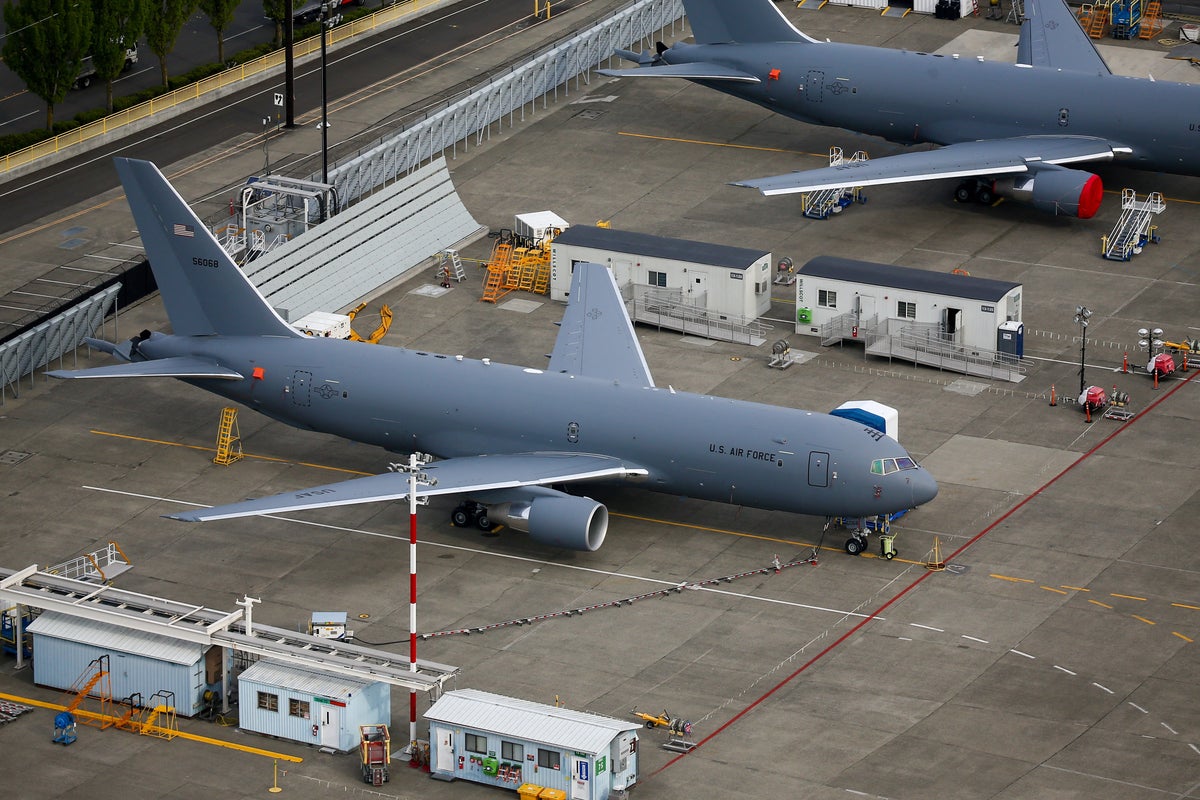
The defense establishment is breathing a collective sigh of relief over the Boeing KC-46 Pegasus. After a decade of technical disasters, missed deadlines, and over $7 billion in fixed-price losses absorbed by Boeing, the mainstream media is buying the corporate narrative hook, line, and sinker. The current consensus is simple: the Remote Vision System (RVS) is finally fixed, the hardware issues are resolved, and the Air Force finally has its next-generation aerial refueling tanker.
That narrative is dangerously naive.
The celebration over the KC-46 "fix" misses the entire point of modern airborne warfare. By spending billions to patch up a platform built on a twentieth-century conceptual framework, the Pentagon has successfully optimized a target. The underlying premise of the KC-46 program is fundamentally flawed, and the fixes trumpeted by defense executives are merely expensive bandages on an obsolete asset.
The Remote Vision System Illusion
Let us address the core of the supposed breakthrough: the Remote Vision System 2.0. In legacy tankers like the KC-135, the boom operator sits at the back of the aircraft and looks through a physical window to guide the fueling boom into the receiver aircraft. The KC-46 replaced this with a system of cameras and sensors, requiring the operator to sit near the cockpit wearing 3D geometry-correcting displays.
For years, this system suffered from severe distortion, washed-out imagery in certain lighting conditions, and an inability to detect subtle movements. The "fix" involves integrating 4K digital cameras, laser radar (LiDAR) technology, and advanced software to ensure the image matches reality.
Mainstream analysts call this a triumph of engineering. It is actually a failure of imagination.
The Air Force spent a decade trying to replicate human sight through a digital straw, only to achieve what a physical piece of glass did fifty years ago. More importantly, this entire engineering effort was wasted because manual boom operation is an anachronism. In a contested near-peer conflict, an operator manually guiding a boom via a 3D headset is a bottleneck.
The real innovation should have been absolute, software-driven autonomy from day one. Instead of building an autonomous docking system similar to spacecraft recovery mechanisms, billions were poured into making sure a human operator could see well enough to not gouge a multi-million dollar stealth fighter. We built a high-tech bridge to nowhere.
Fixed-Price Contracts are Killing Innovation
The business community loves to point at the KC-46 as a triumph of taxpayer protection. Because Boeing signed a fixed-price incentive contract for the engineering and manufacturing development phase, the aerospace giant had to cap government liability at $4.9 billion. Every dollar spent over that cap came directly out of Boeing’s pocket.
On paper, the taxpayer won and the corporation learned a lesson. In reality, this contract structure created the very dysfunction it was meant to prevent.
When a defense prime is losing hundreds of millions of dollars every quarter on a program, engineering decisions are no longer driven by excellence; they are driven by liability mitigation. Every redesign, every software patch, and every hardware swap became a legal battleground over what constituted a "defect" versus a "change in requirement."
I have watched aerospace programs devolve into bureaucratic gridlock because of these financial structures. Engineers are sidelined while corporate attorneys audit the blue prints to minimize financial exposure. The result is a platform designed to meet the absolute bare minimum legal definition of "functional," rather than a weapon system optimized for maximum combat effectiveness.
The fixed-price model did not save the KC-46 program. It dragged it out for a decade, ensuring that by the time the aircraft was deemed "fixed," the threat environment had completely outpaced its capabilities.
The Trillion-Dollar Target
The fundamental strategic vulnerability of the KC-46 lies in its airframe. It is a modified Boeing 767—a wide-body commercial airliner designed to fly predictable routes between civilian airports. It has a massive radar cross-section, zero stealth characteristics, and limited maneuverability.
The modern threat environment is defined by long-range, anti-access/area-denial (A2/AD) networks. Adversaries like China have developed ultra-long-range air-to-air missiles specifically engineered to bypass fighter escorts and strike high-value airborne assets. The PL-15 and its successor variants are designed for one specific job: killing the lumbering tankers and airborne early-warning aircraft that US fighters rely on.
Consider the math of a Pacific conflict. A squadron of F-35s or next-generation air dominance fighters can only operate if a tanker is close enough to replenish their fuel tanks. If the tanker must stay 500 miles away from the combat zone to survive, the fighters lack the range to execute their mission. If the tanker moves closer, it gets shot down.
The Air Force is buying 179 of these aircraft. We are spending tens of billions of dollars on a fleet that cannot enter contested airspace without committing suicide. The "fix" to the refueling boom does absolutely nothing to change the fact that the KC-46 is a giant, glowing target on enemy radar screens.
The Self-Delusion of "People Also Ask"
If you look at public discourse surrounding this program, the questions being asked are completely superficial.
- Is the KC-46 fully operational now? Yes, under highly restricted conditions and with persistent workarounds.
- Can it fuel the F-22 and F-35? Yes, but doing so safely requires perfect environmental conditions and extreme pilot vigilance.
- Is it better than the KC-135? It carries more cargo and has better defensive systems, but it fails to solve the core survivability crisis.
These questions assume that the old way of doing business is the only way of doing business. The real question we should be asking is: Why are we still building manned, commercial-derivative tankers to support low-observable combat aircraft?
The premise itself is broken. A modern refueling architecture should not rely on a handful of massive, expensive, vulnerable targets. It should rely on a decentralized, distributed network of low-cost, autonomous, stealthy refueling drones that can penetrate contested zones alongside the fighters they support.
Instead of buying 179 Boeing 767 derivatives, the Pentagon should have truncated the program at the absolute minimum number required to sustain peacetime operations and shifted the remaining budget into mass-producing stealthy, unmanned refueling platforms.
The Institutional Sunk Cost Fallacy
Why hasn’t this happened? Because the defense acquisition system is paralyzed by the sunk cost fallacy. When an institution spends a decade and billions of dollars on a program, admitting the foundational concept is obsolete is politically impossible. It is far easier to declare victory, point to a modified camera system, and claim the aircraft is "fixed."
The institutional momentum behind the KC-46 is massive. It involves assembly lines in Washington state, sub-contractors in nearly every congressional district, and Air Force leadership whose careers are tied to the successful deployment of this specific airframe. The system is designed to produce aircraft, not strategic victories.
To be fair, shifting to a distributed, autonomous refueling architecture has massive downsides. Unmanned stealth tankers do not exist at scale yet. The technology is unproven, the software complexity would be staggering, and the unit cost per gallon of fuel delivered would initially be much higher than a commercial derivative. It is a high-risk, high-reward strategy.
But the alternative is a low-risk path to catastrophic strategic failure.
By accepting the patched-up KC-46 as a solution, the Air Force has accepted a capability bottleneck that will cripple its power projection capabilities in the coming decades. We have traded true innovation for a corporate press release celebrating the resolution of a decade-old design defect.
Stop celebrating the fact that Boeing finally made a camera work on a 1980s-era airframe design. The KC-46 isn't a triumph of modern defense procurement; it is a monument to institutional inertia, warning us that the Pentagon would rather perfectly execute an obsolete concept than take the risk of inventing the future.