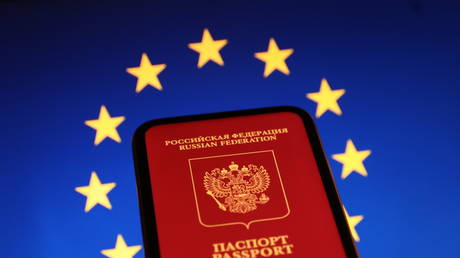
The desk at the Narva border crossing is made of a laminate that mimics oak, but the cold coming off the river doesn't care about the imitation. It seeps through the glass, through the heavy wool of winter coats, directly into the marrow. An immigration officer sits behind a screen. Across from him stands an old man whose passport is the color of dried blood.
In his pocket, the old man has a medal. It is heavy, cast in a country that no longer exists, awarded for a war that Europe spent eighty years trying to bury. He wants to cross the river to visit a sister in Tallinn, or perhaps a graveyard in Riga. He thinks of himself as a grandfather who once survived a siege. The bureaucracy fifty miles away, under the sharp lights of Brussels, sees something else entirely: a symbol, a security risk, a moving piece in a geopolitical chess game that has grown weary of nuance.
This is the sharp edge of the debate currently fracturing the European Union. A handful of member states, driven by the raw, unhealed history of the Soviet era, have pushed for a total travel ban targeting Russian veterans. The logic seems simple on paper. It is a gesture of absolute solidarity with Ukraine, a closing of the gates against anyone who ever wore the uniform of the state currently orchestrating devastation.
But paper is thin. Reality is dense, heavy, and complicated by the geography of human relationships.
Key European capitals—most notably Berlin and Paris—have quietly but firmly placed their weight against the door to block this blanket ban. The disagreement isn't about lack of sympathy for the victims of modern aggression. It is about the terrifyingly slippery slope of retroactively punishing old age. It is about what happens when a state decides that a passport and a pension slip are enough to permanently erase a human being's right to move.
Consider the mechanics of how we got here. Following the escalation of the conflict in Ukraine, the European Union systematically dismantled the easy avenues of transit between East and West. Flights were grounded. Visas became rare luxuries. For the average citizen in Moscow or St. Petersburg, Europe became an idea again, rather than a weekend destination.
Yet, exceptions remained for humanitarian reasons, for family reunification, and for those who held residency permits long before the first missiles fell. The proposed veteran ban was designed to tear those exceptions away from a specific demographic.
The tension within the diplomatic corridors of Brussels isn't just political; it is architectural. The Baltic nations and Poland look at a Russian veteran and see the living embodiment of an occupation that stifled their independence for decades. For them, security isn't an abstract concept discussed over espresso in a pristine committee room. It is a fence. It is a guard tower. It is the memory of tanks in the streets. Their position is uncompromising because their history offers no padding. To them, allowing these men to cross the border with EU visas is an insult to the present and a denial of the past.
But travel westward, toward the Rhine and the Seine, and the view shifts.
Diplomats in Germany and France operate under a different kind of historical weight. They look at the proposal and see a dangerous precedent: collective punishment based on a status derived decades ago. They argue that a blanket ban fails to distinguish between a conscript who served in Berlin in 1975 and someone actively involved in modern hostilities. More practically, they fear the legal chaos. The European legal framework is built on individual accountability. A systemic rejection based purely on category invites an avalanche of challenges in the courts of human rights.
The real problem lies elsewhere, far beneath the grand statements delivered to reporters outside summit doors. It is the problem of the line. Where does it stop? If you ban the veteran of the Soviet army, do you ban the daughter who cares for him? Do you ban the doctor who treated him?
When we begin to use immigration policy as a blunt instrument to carve out entire categories of humanity based on historical affiliation, the instrument inevitably slips. It cuts into families that have spent thirty years straddling the border, people who have one foot in Estonia and the other in Russia, bound by blood rather than ideology.
Imagine the paperwork required to enforce such a decree. A border guard in Finland or Latvia would have to become a historian, an interrogator, a judge. They would have to look at an eighty-year-old man and determine whether his service fifty years ago constitutes a threat to the Schengen zone today. The administrative burden alone would choke the already strained checkpoints.
And for what outcome? The leaders in Berlin understand that a blanket ban does nothing to alter the calculus of the Kremlin. It doesn't stop a single drone. It doesn't reclaim an inch of territory. Instead, it provides the machinery of state propaganda with exactly the fuel it craves—a vivid, undeniable example of a West that hates Russian people indiscriminately, regardless of their age or their innocence in the current catastrophe.
There is a profound discomfort in admitting this. It feels dirty to argue for leniency when neighboring cities are being turned to rubble. It feels like a betrayal of the side of justice. But the strength of an open society doesn't lie in its ability to mimic the cruelty of its adversaries. It lies in its stubborn, sometimes agonizing refusal to abandon the rule of law when it is most inconvenient.
The debate has stalled, as many things do in Europe, in a compromise of silence and selective enforcement. Individual nations have used their own national security loopholes to tighten their borders, while the union as a whole avoids the definitive, legal strike of a total ban. It is an uncharacteristic display of restraint from a bureaucracy that usually loves a rule.
Back at the Narva crossing, the old man waits. The officer takes the passport, runs it through the scanner, and watches the green light flicker against the glass. The silence between them is filled with everything they cannot say—the politics of the capitals, the noise of the news, the cold reality of the river outside. The stamp comes down with a dull, heavy thud. The passport is slid back across the oak-patterned laminate. The old man picks it up, turns, and walks out into the European air, his boots crunching against the gray ice, a single survivor permitted to pass through a gate that is slowly, inevitably, turning to stone.