Ninety miles of blue water is all that separates Key West from the northern coast of Cuba. To a tourist, that distance is a scenic boat ride or a short hop in a puddle jumper. To a biologist, it is a fragile, invisible wall. And to the New World screwworm, it is a gap that is closing with terrifying speed.
While the world watches grander geopolitical shifts, a biological relic of the past is waking up. The screwworm—Cochliomyia hominivorax, a name that literally translates to "man-eater"—has been confirmed just south of the American border. This is not a common housefly buzzing around a kitchen. This is a surgical strike from nature.
The Sound of an Invisible War
Imagine a cattle rancher in the 1950s. Let’s call him Elias. Elias doesn’t look at his herd for their weight or their coat; he looks for the "weep." A single scratch on a calf’s ear from a barbed-wire fence is an invitation. Within hours, a female screwworm lands. She doesn't just lay eggs; she glues a shingle-like mass of two hundred tiny biological ticking clocks to the edge of the wound.
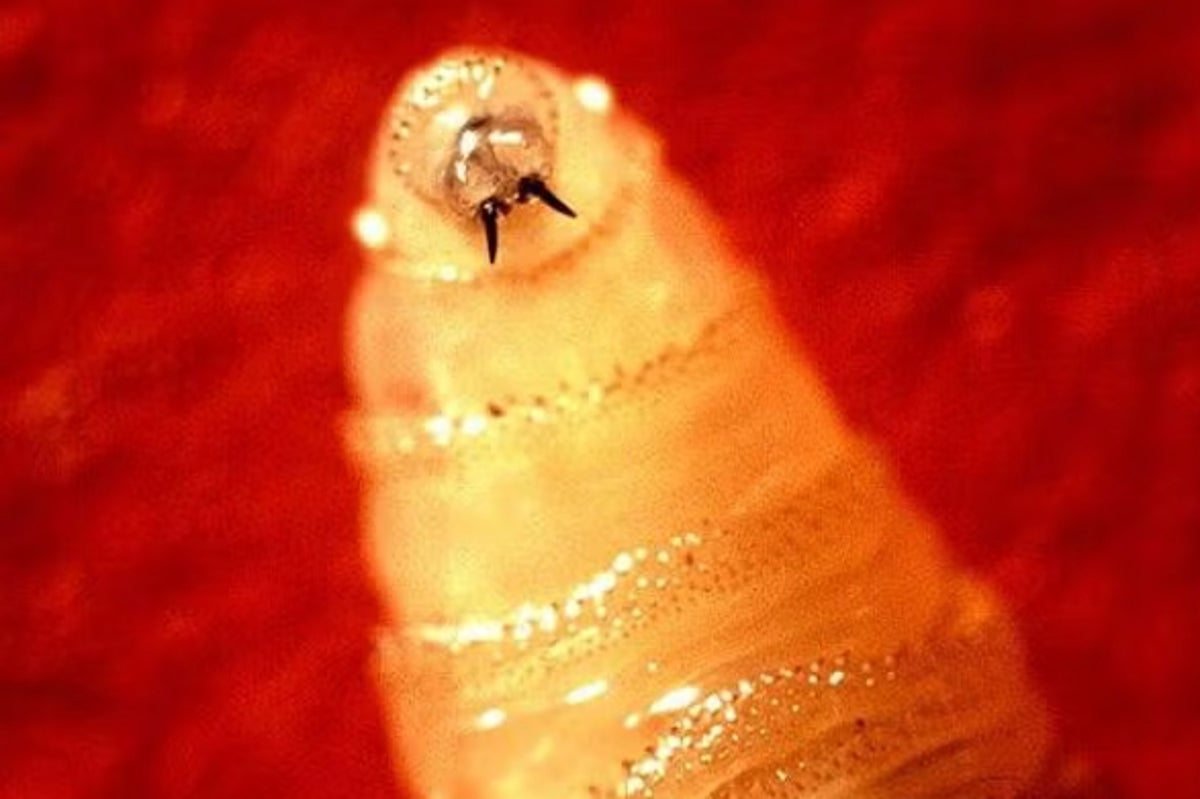
When they hatch, the horror begins. Unlike most maggots, which eat dead, decaying tissue, screwworms hunger for the living. They use jagged, screw-like ridges on their bodies to anchor themselves deep into the muscle. They eat their way inward, expanding the wound into a cavernous pocket while keeping the host alive.
Elias would have known the smell. It’s a sickly, sweet rot that carries on the wind. If he didn't catch it, the calf would be hollowed out from the inside. This was the reality of American agriculture for decades. It cost billions. It broke families. And then, through a miracle of atomic-age science, we won. We thought we had slammed the door forever.
The Sterile Ghost Army
Our victory wasn't won with pesticides or fire. It was won with a bizarre, elegant strategy: sexual sabotage.
In the late 20th century, the United States and its partners built "fly factories." They raised millions of screwworms and blasted them with just enough radiation to make them sterile. Then, they dropped them from airplanes. These sterile males sought out wild females. They mated. The females laid eggs that would never hatch. The population collapsed. We pushed the "biological front" all the way down to the Darien Gap in Panama, maintaining a permanent "buffer zone" of sterile fly drops to keep the nightmare at bay.
But the buffer is fraying.
The recent confirmation of screwworms in the Caribbean and Central American corridors signifies a breach. When officials say they are 90 miles away, they aren't talking about a casual migration. They are talking about a hitchhiker.
A single infested dog in the cargo hold of a plane, a stray cat on a shipping vessel, or an undiagnosed wound on a human traveler can bypass the billions of dollars we spent on the sterile fly barrier. The fly doesn't care about passports. It only cares about the warmth of a wound.
The Human Toll Beneath the Surface
We often talk about these threats in terms of livestock—the economic impact on beef and dairy. That is the "safe" way to discuss it. But the "man-eater" moniker isn't a metaphor.
In regions where the fly is endemic, humans are victims. A child with a skinned knee. An elderly person with a pressure sore. A surgical incision that wasn't dressed perfectly. The fly is opportunistic and incredibly fast. Within twenty-four hours of an egg being laid, the larvae are already submerged in the dermis.
The pain is described as a constant, rhythmic "grinding." Because the larvae have hooked mouthparts, they are nearly impossible to pull out. If you try, they retreat deeper. They are architectural in their destruction, creating tunnels that lead to secondary infections, sepsis, and, if left untreated in sensitive areas like the eyes or ears, death.
Consider the psychological weight of this. We live in a world where we assume we are at the top of the food chain. We have conquered the wolves and the bears. But the screwworm reminds us that we are still made of meat. It is a primal, visceral vulnerability that most Americans haven't had to feel in seventy years.
Why the Wall is Thinning
Climate change is a phrase that has become so politicized it has lost its teeth, but in the world of entomology, it is a map of expansion. Screwworms thrive in heat and humidity. As the frost line moves further north and winters become milder, the "habitable zone" for these parasites creeps upward.
A decade ago, the idea of a screwworm surviving a winter in Georgia or South Carolina was laughable. Today, it is a mathematical probability.
The logistics of our modern world further complicate the defense. We are more mobile than at any point in human history. The "sterile fly" program requires constant funding, international cooperation, and a stable political climate in the countries housing the buffer zones. When those things waver, the flies move.
We are currently relying on a thin ribbon of airplanes dropping sterile insects over a jungle in Panama to protect the entire North American continent. It is a masterpiece of biology, but it is also a house of cards.
The Reality of the Return
If the screwworm establishes a foothold in the Florida Keys or the Gulf Coast, the response will not be subtle. You will see "fly traps" appearing in suburban backyards. You will see mandatory inspections for pets crossing state lines. You will see a sudden, sharp spike in the cost of leather and meat as the industry scrambles to treat millions of animals.
But more than that, you will feel a shift in how we interact with nature. A "small cut" will no longer be something you just wash and forget. It will be something you watch. You will look at a common fly with a new kind of suspicion, searching for the metallic, blue-green sheen of the hominivorax.
The threat is not a "potential" one. It is a documented presence. The officials confirming its proximity aren't trying to cause a panic; they are trying to wake up a population that has forgotten what it’s like to be prey.
We are standing on a porch, looking out at a dark yard, convinced we are safe because the porch light is on. We don't realize that the light is flickering.
The fly is 90 miles away. It is hungry. And it doesn't need an invitation—just an opening.
Imagine the quiet of a Florida evening, the hum of the cicadas, and the sudden, sharp sting of a mosquito. You swat it away. But in the tall grass, something else is circling, guided by the scent of blood, waiting for a scratch that stays open just a second too long.