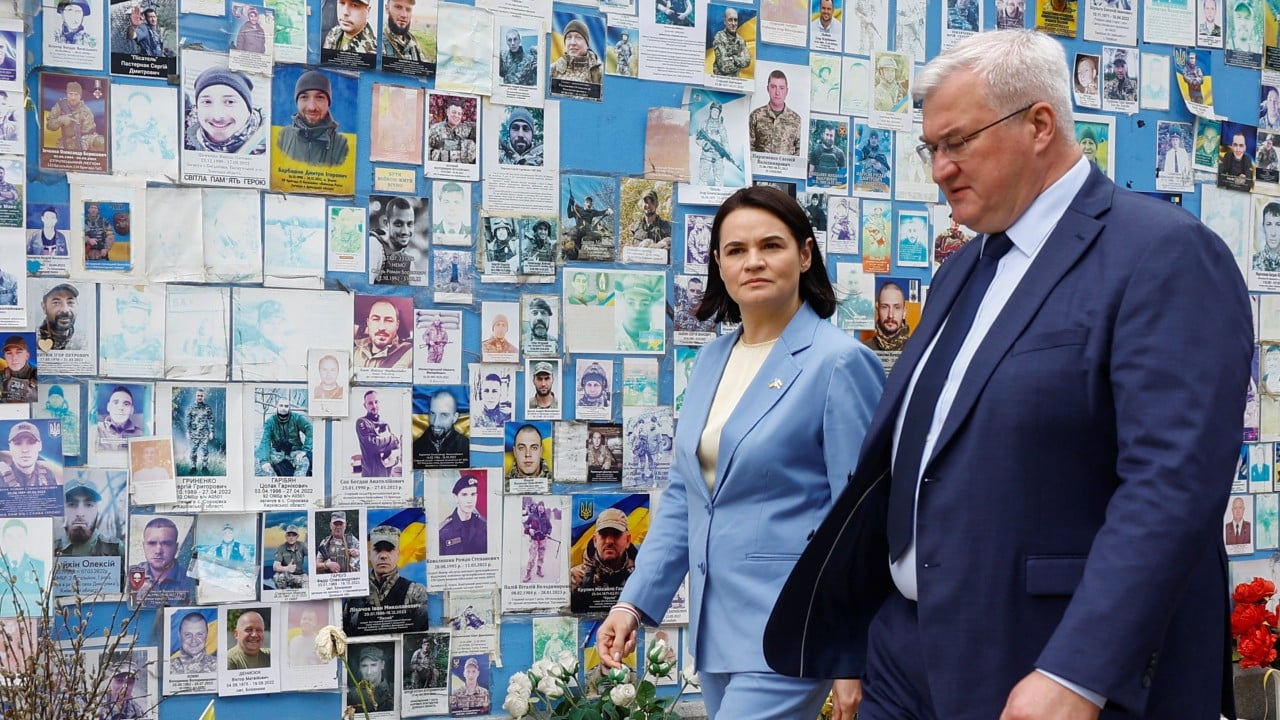
The rain in Kyiv does not wash away the smell of soot. It dampens it, presses it down into the cracked asphalt, making the air taste of old iron and wet concrete. When Sviatlana Tsikhanouskaya stepped into the grey light of the Ukrainian capital, she was not just crossing a geographic border. She was stepping into a mirror.
For years, the story of the Belarusian opposition has been told in the sterile language of diplomatic briefings. We hear of "exiled leaders," "democratic coalitions," and "geopolitical tension." These words are bloodless. They turn a desperate struggle for human dignity into a chess game played by phantoms. But when you stand on the streets of a city that wakes up every morning to the wail of air raid sirens, the abstractions vanish.
Tsikhanouskaya’s arrival in Ukraine was a collision of two distinct lines of suffering. On one side, a nation fighting an open, roaring war for its survival. On the other, a nation living under a quiet, suffocating occupation from within.
Alexander Lukashenko, the man who has held Belarus in a vice grip since 1994, has turned his country into a staging ground. From Belarusian airfields, Russian bombers take flight. Across Belarusian railways, ammunition moves toward the Ukrainian front lines. To the casual observer, Belarus is an accomplice. But to the millions of Belarusians who flooded the streets of Minsk in 2020, only to be beaten, tortured, and forced into flight, their homeland is a hijacked plane.
Tsikhanouskaya is the woman who was forced to fly it.
The Accidental President
Six years ago, she was a teacher, a mother, a woman packing school lunches and worrying about speech therapy for her son. She had no political ambitions. Her husband, Siarhei, was the one with the fire in his belly, a blogger who dared to challenge the dictator. When the state threw him in prison, Sviatlana did something entirely irrational, born of fierce, protective love. She registered to run in his place.
She won. The world knows she won, despite the fabricated official tallies that claimed Lukashenko secured another impossible landslide. What followed was a wave of hope that broke against a wall of systematic brutality. Tens of thousands were arrested. The lucky ones fled with a single suitcase, crossing into Poland, Lithuania, or Ukraine.
Now, her visit to Kyiv comes at a moment of acute terror. The Ukrainian military command has issued stark warnings. Russian forces are consolidating along the northern border. There are whispers of a renewed offensive, a second push toward Kyiv originating from Belarusian soil. The stakes are no longer just about the political future of Minsk. They are about the immediate survival of Ukraine.
Consider the psychological weight of this meeting. For Ukraine, every movement across the northern border is watched through the lens of sniper scopes and satellite imagery. To them, Belarus represents a blade held at their back. For Tsikhanouskaya, every Russian missile launched from her country’s territory is a stain on the national soul, a betrayal committed in her people's name by a regime they despise.
The Anatomy of an Invisible Occupation
To understand why this visit matters, you have to look past the official press releases and examine the machinery of control. Lukashenko is not a strongman acting from a position of power. He is an asset. Since the mass protests of 2020, his survival has been entirely bankrolled by the Kremlin. The price of that survival is the sovereignty of Belarus.
Russian soldiers move through Belarusian cities with the casual arrogance of landlords. The local population watches them in silence. To speak out is to disappear. In Belarus today, liking a social media post critical of the war can land you in a penal colony for five years. The resistance has gone underground, turning into a shadow network of saboteurs who risk everything to disrupt the supply chains feeding the Russian war machine.
They call themselves the railway partisans.
These are ordinary citizens—signalmen, track workers, students—who use DIY explosives and simple tools to short-circuit the transit lines. They do not wear uniforms. They do not get military honors. When they are caught, they are shot in the kneecaps before being dragged into the basements of the KGB, an organization that in Belarus never even bothered to change its Soviet name.
When Tsikhanouskaya speaks to Ukrainian officials, she carries the ghosts of these partisans with her. She is trying to convince a nation under fire that the people of Belarus are not their enemy.
It is a agonizingly difficult argument to make when the sirens are wailing.
The Shared Trench
In Kyiv, the conversations are pragmatic, stripped of diplomatic politeness. Ukraine needs guarantees that its northern flank will not crumble. Tsikhanouskaya needs the world to understand that a free Ukraine is the only path to a free Belarus. The two fates are tied together with barbed wire. If Russia succeeds in breaking Ukraine, the night that has fallen over Belarus will become permanent.
But if Ukraine holds, the cracks in Lukashenko's regime will widen into chasms. He knows this. His generals know this. That is why, despite immense pressure from Moscow, the Belarusian regular army has not yet crossed the border into Ukraine. Lukashenko fears his own soldiers. He knows that if he gives the order to invade, the rifles might just turn around and point the other way.
This is the hidden vulnerability of the dictatorship. It is a house of cards built on fear, but fear is a volatile currency. When people lose everything, they lose their fear too.
The meeting in Kyiv was not about signing treaties or posing for ceremonial photographs. It was an act of defiance against a geography of oppression. It was a declaration that despite the borders drawn by dictators, despite the tanks and the minefields, there is a common front of human resistance that stretches from the Baltic to the Black Sea.
As the dusk fell over Kyiv, the air raid sirens began their rhythmic, mournful scream once more. The city went dark, saving power, waiting for the sky to fall. In that darkness, the distinction between the exile and the besieged faded into nothing. They are both waiting for the dawn, fighting a war where the front line runs directly through the human heart.