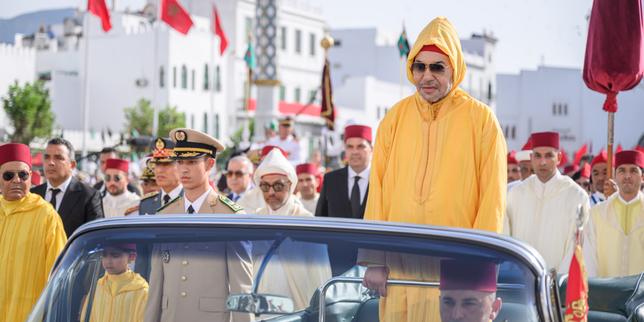
Power operates in silence until a border breaks the quiet. When King Mohammed VI marks another year of his reign, the celebration rarely aligns with the messy reality unfolding at the southern gates of Europe. Across the Strait of Gibraltar, migration pressures swell into a permanent geopolitical instrument. Rabat manages this friction with a cold calculus that few foreign desks dare to fully articulate.
For decades, the monarchy has balanced domestic prestige against external demands from Madrid and Brussels. This balancing act relies on a familiar choreography. Border control tightens when European funds arrive or diplomatic pressure mounts, and it loosens just enough to remind capitals like Madrid who holds the valve on human movement.
The Economics of Transit Politics
To understand why migration flows surge precisely when political anniversaries or diplomatic disputes arise, you have to look past humanitarian rhetoric. Migration is an asset. In the calculus of North African statecraft, controlling the border equals leverage.
European capitals pour billions into North African security infrastructure to keep asylum seekers and economic migrants away from southern Spanish shores or the militarized fences of Ceuta and Melilla. Yet, money alone does not buy permanent stability. Rabat understands that European domestic politics remain hypersensitive to arrival numbers. Every boat crossing the Alboran Sea acts as a direct message to European negotiators.
Consider the mechanics of this dynamic. When Morocco demands European recognition of its sovereignty over the disputed Western Sahara territory, the migration valve adjusts accordingly. When bilateral trade agreements face legal challenges in European courts regarding agricultural and fishing rights tied to the southern provinces, security cooperation at the border suddenly hits logistical bottlenecks.
This is not a conspiracy. It is statecraft practiced by a regime that has survived regional volatility by mastering transactional diplomacy. The European Union treats migration as a humanitarian crisis to be solved with border guards and surveillance tech. Rabat treats it as a structural card in a high-stakes poker game where the stakes are international legitimacy and economic aid.
+-----------------------------------+-----------------------------------+
| European Union Strategy           | Moroccan State Strategy           |
+-----------------------------------+-----------------------------------+
| Focus: Containment and deterrence | Focus: Leverage and sovereignty   |
| Tool: Financial aid and tech      | Tool: Border enforcement pacing   |
| Goal: Zero arrivals               | Goal: Political recognition       |
+-----------------------------------+-----------------------------------+
Inside the Throne Room and the Streets
Publicly, the Moroccan monarchy projects an image of unwavering stability and modernization. Mega-ports, high-speed rail lines, and renewable energy projects dominate state media broadcasts during national holidays. These achievements are real. Casablanca and Tangier hum with genuine commercial ambition, and the country has positioned itself as an indispensable industrial hub connecting sub-Saharan Africa to European markets.
Yet, beneath this polished veneer lies a restless youth population facing high unemployment and limited upward mobility. For thousands of young Moroccans, the European dream is not born of abstract ambition. It is an economic necessity driven by domestic stagnation. When local economic growth fails to absorb university graduates and rural workers alike, the pull of the Spanish coast becomes irresistible.
The palace navigates this internal pressure through a dual approach. Economic modernization absorbs some of the shock, while security forces suppress internal dissent and manage the staging grounds for clandestine departures along the Atlantic and Mediterranean coasts.
Security forces patrol the dunes near Nador and Fnideq with ruthless efficiency when ordered to do so. Makeshift camps are cleared. Boats are seized before they hit the water. But the underlying engine of migration—driven by regional disparities and a lack of economic equity—remains untouched. The state manages the symptoms while preserving the structural conditions that make emigration the primary aspiration for a generation.
The Madrid Factor
Spain occupies a uniquely complex position in this architecture. Historical ties, economic interdependence, and security cooperation bind Madrid and Rabat together, even as deep friction periodically ruptures the relationship.
Madrid needs Moroccan intelligence cooperation to monitor radicalization networks and manage irregular migration paths. In exchange, Spanish diplomacy has gradually shifted toward accommodating Moroccan positions on regional territorial disputes, occasionally drawing sharp rebukes from neighboring Algeria and the Polisario Front.
When diplomatic alignment fractures, the consequences are immediate. In May 2021, the passive stance of Moroccan border guards allowed more than ten thousand people to swim or walk across the breakwaters into the Spanish enclave of Ceuta. The provocation was unmistakable: Madrid had hosted the leader of the Sahrawi independence movement for medical treatment. The message was delivered not through formal diplomatic notes, but through an open gate.
Diplomacy resumed shortly after, with Spain endorsing Morocco's autonomy plan for Western Sahara as the most serious and credible basis for resolving the conflict. The border tightened once more. The transaction was complete.
Beyond the Rhetoric of Crisis
Labeling these recurring events as a sudden humanitarian crisis misdiagnoses the situation. What the Mediterranean witnesses year after year is not an accidental breakdown of order, but the regularized rhythm of border management as foreign policy.
As long as the economic gap between the southern and northern shores of the Mediterranean persists, and as long as migration remains the most potent diplomatic lever available to Rabat, the cycle will repeat. Anniversary speeches will praise national unity while young men watch the horizon from the beaches of Tangier, waiting for the wind to drop and the guards to look away.