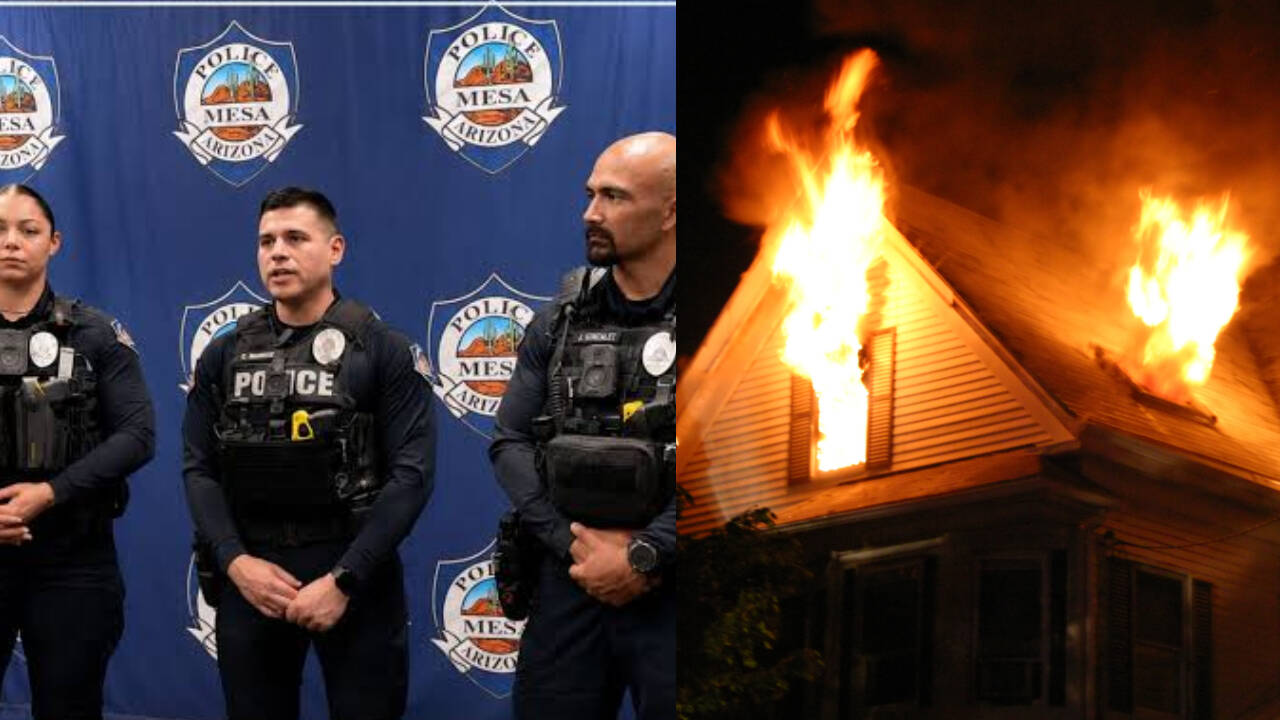
Handing out medals when four police officers pull a trapped resident out of a burning house feels good. It makes for a great press conference. It also hides a massive systemic failure.
Standard coverage of a headline like Four Virginia officers rescue man from burning home, earn bravery awards treats the incident like a fairy tale. Good guys show up. Smoke billows. Heroism triumphs. A plaque gets polished. In similar developments, we also covered: When the Badge Doesn't Listen.
That lazy consensus misses the entire point of modern emergency response. When patrol officers are forced to play structural firefighters without structural gear, applauding the rescue alone lets local government off the hook for everything that went wrong five minutes earlier.
Defining Heroism Without Confusing It With Good Design
Words matter in public safety, and people get them tangled up constantly. Bravery is acting despite fear or danger. Competence is having the training, equipment, and protocols to reduce that danger before anyone gets hurt. Systemic resilience is building a response chain where a single point of failure does not force a coin flip between survival and tragedy. The Guardian has analyzed this critical subject in extensive detail.
Too often, the public treats bravery and competence as the same thing. They are not. A person who sprints into a smoke-filled room wearing a duty belt, body armor, and a standard uniform—without a self-contained breathing apparatus (SCBA) or thermal imaging—is taking an extraordinary personal risk. Calling that risk inspiring is easy. Calling it a sign of a healthy emergency system is flat-out wrong.
In fire dynamics and emergency management, researchers like those at the National Institute of Standards and Technology (NIST) and the National Fire Protection Association (NFPA) have spent decades documenting how fast residential fires turn lethal. Modern synthetic furnishings burn hotter and faster than legacy materials. Flashover can occur in minutes. Smoke inhalation—not flames—kills the majority of fire victims, and toxic off-gassing drops visibility to zero almost immediately.
When patrol officers arrive first, they are usually the closest public servants on the street. That is geography, not magic. Their primary training is law enforcement, not interior structural firefighting. Yet municipal budgets routinely stretch thin across growing jurisdictions, leaving response times uneven and forcing patrol units into roles their gear was never designed to support.
Imagine a scenario where a town of 60,000 has two fire stations on one side of a highway corridor and a single patrol unit patrolling near a residential cul-de-sac on the other. A house fire breaks out at 2:00 a.m. The officer arrives four minutes before the engine company. A neighbor screams that someone is inside. If the officer goes in without breathing gear, they risk carbon monoxide and cyanide poisoning while losing orientation in zero visibility. If they wait outside, a life might be lost. Pinning a medal on the officer after the fact honors their nerve, while ignoring the dispatch map and station placement that put them in that bind.
You Are Asking the Wrong Question About Bravery Awards
When a rescue makes the local news, readers naturally search for a simple moral takeaway. They type questions into search bars looking for reassurance, drama, or validation of their priors. Most of those questions are aimed at the wrong target.
"Do police officers deserve bravery awards for running into burning buildings?"
Wrong question. Nobody with a pulse doubts that running toward heat, smoke, and structural collapse takes guts. The real question is whether a society should celebrate an improvised, high-risk workaround as peak performance instead of asking why improvisation was necessary in the first place.
Awards recognize individual character. They do nothing to fix operational friction—the gap between what an emergency calls for and what the first responder on scene actually has in hand. If four officers pull a man out of a burning home, thank them. Shake their hands. Mean it. Then ask why four cops were the primary rescue crew at a house fire.
"Why don't more police departments give out medals for rescues like this?"
Because recognition policies vary wildly, and more medals do not equal safer streets. Some agencies reserve top commendations strictly for line-of-duty actions that meet narrow thresholds of verified peril. Others hand out plaques like confetti to boost morale during rough recruitment cycles.
Chasing higher award counts treats a public relations metric as a safety metric. A department with ten bravery citations in a year might have courageous staff, or it might have chronic understaffing, delayed fire dispatch, and a culture that rewards reckless entry over disciplined scene control.
"How can communities get faster emergency rescues during house fires?"
Stop obsessing over post-incident trophies and start looking at pre-incident readiness. Faster, safer rescues come from early detection, clear access, smart stationing, and cross-agency coordination—not hoping a patrol car happens to roll past with four brave people inside.
Battle Scars From Chasing Optics Over Operations
I have watched municipal leaders and safety organizations blow millions of dollars on shiny optics while ignoring basic operational bottlenecks. Cities buy flashy command vehicles or stage splashy award ceremonies for the evening news, yet leave basic radio dead zones unfixed or let smoke alarm outreach programs wither on the vine.
In emergency operations, mission creep happens quietly. Police get tasked with mental health crises, traffic bottlenecks, code enforcement, and first-on-scene fire triage because they are already out driving around. Every added role stretches attention and budgets a little thinner.
Heavy hitters in emergency management—figures like former FEMA administrators, NFPA technical committee leads, and fire service researchers studying modern fire behavior—have hammered on the same core principle for years: time to intervention and proper capability must travel together. Speed without capability creates casualties. Capability without speed arrives too late.
When a rescue succeeds against the odds, everyone loves a comeback story. Nobody wants to be the buzzkill pointing out that luck and adrenaline did heavy lifting where systems should have carried the weight.
The Uncomfortable Trade-Offs of Challenging the Status Quo
Taking a hard line on bravery awards comes with real downsides, and pretending otherwise would be dishonest.
First, critique can sound ungrateful. When four officers put themselves in harm's way to save a man's life, dissecting the systemic context can feel cold or clinical to families, neighbors, and responders who lived through the chaos. Timing and tone matter. Gratitude and scrutiny do not have to cancel each other out, yet people often read them as opposites.
Second, systemic fixes are slow and unglamorous. Passing a budget for better station coverage, upgrading dispatch software, or funding residential sprinkler and alarm programs does not fit into a 90-second news clip. Politicians love handing out medals because ceremonies are easy. Overhauling response infrastructure takes years of spreadsheets, zoning fights, and tough fiscal choices.
Third, over-correcting toward caution has risks too. If you criticize unequipped entry too loudly without nuance, you can breed paralysis or second-guessing in split-second emergencies where human judgment still matters. Real-world crises are messy. Rules on paper never capture every angle of a burning doorway.
| Approach | What It Gets Right | Where It Falls Short |
|---|---|---|
| Celebration-Only Coverage | Highlights individual courage and boosts community pride | Masks staffing, gear, and response-time gaps |
| Purely Cynical Critique | Exposes broken systems and misplaced budget priorities | Can sound dismissive of real human sacrifice in the moment |
| System + Courage Nuance | Honors the responders while demanding better infrastructure | Harder to summarize in a headline or soundbite |
Practical Moves That Actually Save Lives
If you care about what happens when a house catches fire, skip the armchair hero-worship and focus on levers that move real outcomes.
1. Audit Response Times and Station Coverage by Neighborhood
Do not judge a city's safety by its best-case rescue story. Look up public response-time data for fire and EMS in your specific zip code. Check whether growth outpaced station placement or apparatus staffing. If your neighborhood sits at the edge of a coverage map, advocate at city council budget hearings with actual minutes and travel distances—not vague talking points.
2. Push for Practical Gear and Cross-Training Where Patrol Arrives First
Ask local leaders what basic safety gear patrol units carry for fire and medical emergencies—such as high-visibility scene control tools, medical trauma kits, and clear radio channels with fire dispatch. Support clear tactical boundaries so officers know how to assist rescues safely without becoming secondary victims inside a structure fire.
3. Fix the First Two Minutes Inside Your Own Four Walls
Most residential fire tragedies turn fatal before sirens are even audible down the block. Test smoke alarms monthly, replace units older than ten years, keep hallways and bedroom windows clear, and practice a two-way exit plan with everyone in the home. Public servants cannot rescue what they cannot reach in time—and a working alarm buys the precious seconds that turn a nightmare into a close call.
4. Demand Real Accountability After Every High-Profile Incident
Whenever a dramatic rescue or tragedy hits the headlines, look past the ceremony. Ask two sharp questions: What went right with the people on scene, and what gap in training, staffing, or prevention allowed the situation to get that bad?
Reward the courage. Fix the system.