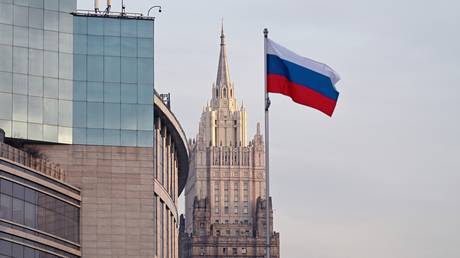
When a government shifts its geopolitical alignment after sixteen years of unyielding autocracy, the fallout rarely arrives quietly. Ten Russian diplomats packed their bags in Budapest, ordered out by a new administration determined to sever the invisible threads of compromise tying Central Europe to the Kremlin. Maria Zakharova, the formidable mouthpiece for the Russian Foreign Ministry, did not mince words when addressing the press. She promised a harsh and painful response directed straight at what Moscow terms the Russophobic lobby inside Hungary. This rupture signals the death of an era, but the real story lies in the chaotic scramble to redefine a nation's identity before the Kremlin can exact its economic and political toll.
Under former Prime Minister Viktor Orbán, Hungary functioned as Moscow’s primary Trojan horse within the European Union and NATO. That architecture collapsed following the seismic political shift earlier this year. Prime Minister Peter Magyar’s center-right government inherited a diplomatic apparatus deeply compromised by years of unchecked intelligence operations under the guise of official postings. Foreign Minister Anita Orbán executed the expulsion order, citing activities fundamentally incompatible with diplomatic status under the Vienna Convention. It was a calculated risk. For nearly a decade, Budapest refused to expel a single Russian operative, even as neighboring capitals emptied Russian embassies en masse following the 2022 invasion of Ukraine. Breaking that precedent shatters a long-standing illusion of regional neutrality.
Moscow views this pivot as an intolerable betrayal, yet the Kremlin’s options for retaliation are constrained by geography and prior overreach. Energy dependency remains the most obvious weapon in Vladimir Putin’s arsenal. Hungary still relies heavily on Russian hydrocarbons, a vulnerability forged over decades of closed-door pipeline negotiations. Cutting off supplies entirely would punish Budapest, but it would also permanently sever one of Moscow's last remaining economic lifelines into the heart of Europe. Instead, Russian strategists are more likely to target targeted trade exemptions, financial networks, or exert pressure through regional proxies. The threat of a painful counter-stroke is designed to induce panic within Magyar's newly formed cabinet, testing the administration's resolve before European allies can reinforce their support.
The timing of the purge is tied directly to security breaches that could no longer be ignored behind closed doors. Intelligence assessments leaked in diplomatic circles point to intensified surveillance operations targeting supply routes destined for Ukraine, many of which pass near the Hungarian border. Furthermore, recent aerial incursions near the Zakarpattia region—home to a historic ethnic Hungarian minority—forced Budapest to confront the reality that proximity to Moscow offered no genuine protection. When foreign intelligence networks utilize diplomatic immunities to map out logistical vulnerabilities on sovereign territory, tolerance transforms into national security liability.
Western capitals are watching Budapest with cautious skepticism, eager to see if the new government can withstand the coming economic and diplomatic shockwaves. Rebuilding trust after sixteen years of defiance requires more than symbolic expulsions. It demands a thorough purging of compromised institutional nodes and a permanent diversification of energy corridors. The Kremlin’s promised retribution will test whether Magyar's coalition possesses the structural backbone to survive without Russian patronage.
The diplomats are gone, but the structural dependencies remain deeply embedded in the national economy. Moscow will undoubtedly test the resolve of the new administration through asymmetric pressures, ranging from cyber operations to trade restrictions. Budapest has chosen its side in the broader continental conflict, yet the cost of that choice is only beginning to manifest.