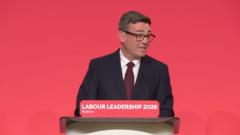
Political leaders love the word plan. It suggests order, foresight, and a steady hand on the wheel. When Labour’s leadership declares they have a strategy to fix the structural rot in the British state, voters want to believe them. But the grim reality of modern governance is that policy blueprints rarely survive their first encounter with the Treasury or civil service inertia. The current administration promises a sweeping overhaul of public services and economic growth, yet the machinery of Whitehall is designed to resist sudden movement. Without a fundamental restructuring of how government spends money, any new political roadmap is dead on arrival.
We have seen this script play out across decades of political history. A fresh leadership team arrives with a mandate, a thick stack of policy papers, and a collection of carefully tested slogans. They promise to unlock productivity and repair broken infrastructure. Then they meet the reality of departmental silos and fiscal constraints.
The Fiction of the Blank Slate
Every new political era begins with the illusion that the incoming team can simply wipe the whiteboard clean. Ministers arrive at their desks believing that clear intentions guarantee effective execution. They are wrong. The British state is not an organism that responds instantly to commands from the top. It is a massive, slow-moving ecosystem driven by decades of accumulated statutory duties, legal precedents, and institutional risk-aversion.
When a leader says they have a plan, they are usually talking about a list of desirable outcomes. They want shorter NHS waiting lists, higher regional growth, and a modernized energy grid. These are goals, not mechanisms. The mechanism is where the intent goes to die.
Consider the standard process for implementing a major policy shift. A cabinet committee discusses the proposal. Officials draft a green paper, followed by a white paper, followed by primary legislation that takes months to crawl through Parliament. By the time the bill receives Royal Assent, the original concept has been chipped away by interest groups, backbench rebellions, and legal challenges. Then comes the secondary legislation, where the civil service writes the actual rules. This hidden layer of administration is where radical ideas are quietly smothered by caution.
The structural friction is immense. If a government wants to build a new railway line or a cluster of clean energy projects, it must fight its way through a planning system designed to block development. A single judicial review can delay a project for years, draining budgets before a single shovel touches the ground. The plan becomes a hostage to procedural litigation.
The Treasury Treasury Orthodoxies and Fiscal Traps
No prime minister, regardless of their parliamentary majority, can escape the gravitational pull of the Treasury. This institution functions as a government within a government, operating on a deeply ingrained orthodoxy that prioritizes short-term fiscal discipline over long-term capital investment.
The core tension is simple. A strategy for structural national renewal requires massive, upfront capital injections that may not yield economic returns for a decade or more. The Treasury, however, operates on tight fiscal rules that look at debt-to-GDP ratios over a rigid three-to-five-year window. If a project does not show a return within that electoral cycle, the spending watchdogs view it with deep suspicion.
- Capital rationing: High-return infrastructure projects are routinely chopped into smaller, inefficient phases to fit annual spending limits.
- Departmental hoarding: Ministries protect their core operational budgets by sacrificing long-term investment funds whenever the fiscal climate hardens.
- The maintenance trap: Money is diverted from preventing infrastructure decay to patching up immediate emergencies, which costs far more in the long run.
This creates a systemic bias against preventative policy. It is always easier for the system to approve emergency funds to stop a hospital roof from collapsing than it is to secure capital for a brand-new facility that would reduce long-term regional health costs. The political leadership promises the latter, but the institutional machinery forces them to settle for the former.
To make matters worse, the financial markets act as an external disciplinary force. Any plan that suggests significant borrowing without an immediate, ironclad path to growth risks spooking bond traders. The memory of recent fiscal shocks remains fresh in the minds of permanent secretaries. The result is a self-censoring political class that scales back its ambitions before the public even sees the drafts.
The High Cost of Delivery Failures
The true measure of a political plan is not the applause it receives at a party conference. It is what happens when that plan collides with regional authorities and local delivery agents. For the past twenty years, central government has consistently stripped power away from local councils while simultaneously outsourcing complex public services to a handful of massive corporate contractors.
This created a delivery deficit. When a government department wants to execute a nationwide program, it no longer possesses the in-house technical expertise to manage the work directly. Instead, it relies on complex procurement frameworks that prioritize the lowest bidder over the most competent operator.
"When government loses the internal capability to understand its own projects, it becomes a captive customer to private consultancies that profit from complexity and delay."
When these contracts inevitably run over budget or fail to deliver, the political fallout hits the ministers, but the systemic flaws remain untouched. The public sees a broken promise. The politicians blame the contractors, the contractors blame changing specifications from Whitehall, and the cycle repeats.
A genuine plan for national renewal would require rewriting the rules of public procurement from scratch. It would mean taking risks on smaller, local suppliers and accepting that some projects will fail. But modern political culture is entirely allergic to risk. A single negative headline about a failed pilot scheme is enough to make a junior minister cancel an entire line of policy inquiry.
The Missing Piece of the Economic Strategy
The current political narrative focuses heavily on planning reform as the silver bullet for growth. The argument goes that if you ease restrictions on building houses, laboratories, and electricity pylons, private capital will flood in and solve the productivity puzzle. This is a comforting theory, but it ignores the fundamental issue of domestic supply chains and labor shortages.
You can grant planning permission for a dozen new gigafactories or high-speed rail links tomorrow, but you cannot conjure the skilled engineers, project managers, and specialized materials out of thin air. Decades of underinvestment in technical education and an over-reliance on volatile global supply networks have left the domestic economy structurally incapable of handling a sudden surge in capital construction.
[Project Approval] -> [Supply Chain Bottlenecks] -> [Wage Inflation] -> [Budget Overruns] -> [Project Downscaling]
This bottleneck creates an immediate inflationary pressure. When multiple massive infrastructure projects compete for the same limited pool of domestic talent and materials, costs skyrocket. The government is then forced to scale back the scope of its plans to stay within its fiscal limits. The grand vision of a transformed nation shrinks down to a few modest upgrades to existing facilities.
Furthermore, the assumption that private investors are simply waiting for the government to get out of the way is overly optimistic. International capital is highly mobile. Fund managers look at the long-term political stability, energy costs, and regulatory clarity of a nation before committing billions. A plan that can be reversed by the next government after an election is not an attractive investment proposition.
Institutional Memory and the Loss of Civil Capability
Behind the grand announcements lies an uncomfortable truth about the civil service itself. The elite tier of policymaking has become increasingly detached from operational reality. Fast-stream civil servants rotate through different departments every eighteen months to secure promotions, meaning that the individuals designing complex long-term policies rarely stay around long enough to see them implemented or face the consequences of their mistakes.
This constant churn destroys institutional memory. A department will spend two years designing an initiative, only for the entire team to disperse just as the rollout begins. The new team arrives with no ownership of the project, leading to poor oversight and a lack of accountability.
To break this cycle, a government must change the incentives within the bureaucracy. It must reward deep, specialized expertise and long-term commitment to specific delivery outcomes. It must value the manager who successfully runs a regional infrastructure upgrade as highly as the policy adviser who writes an elegant briefing note for the Secretary of State.
Without these deep institutional reforms, any declaration of a new plan is merely an exercise in political communications. It is a performance designed to reassure the public that someone is in control, while the underlying machinery continues to drift in the same direction. The true test of leadership is not the capacity to formulate a vision, but the willingness to wage a quiet, exhausting war against the structures that prevent that vision from becoming a reality. The current platform has laid out the targets, but the battle for delivery has barely begun.