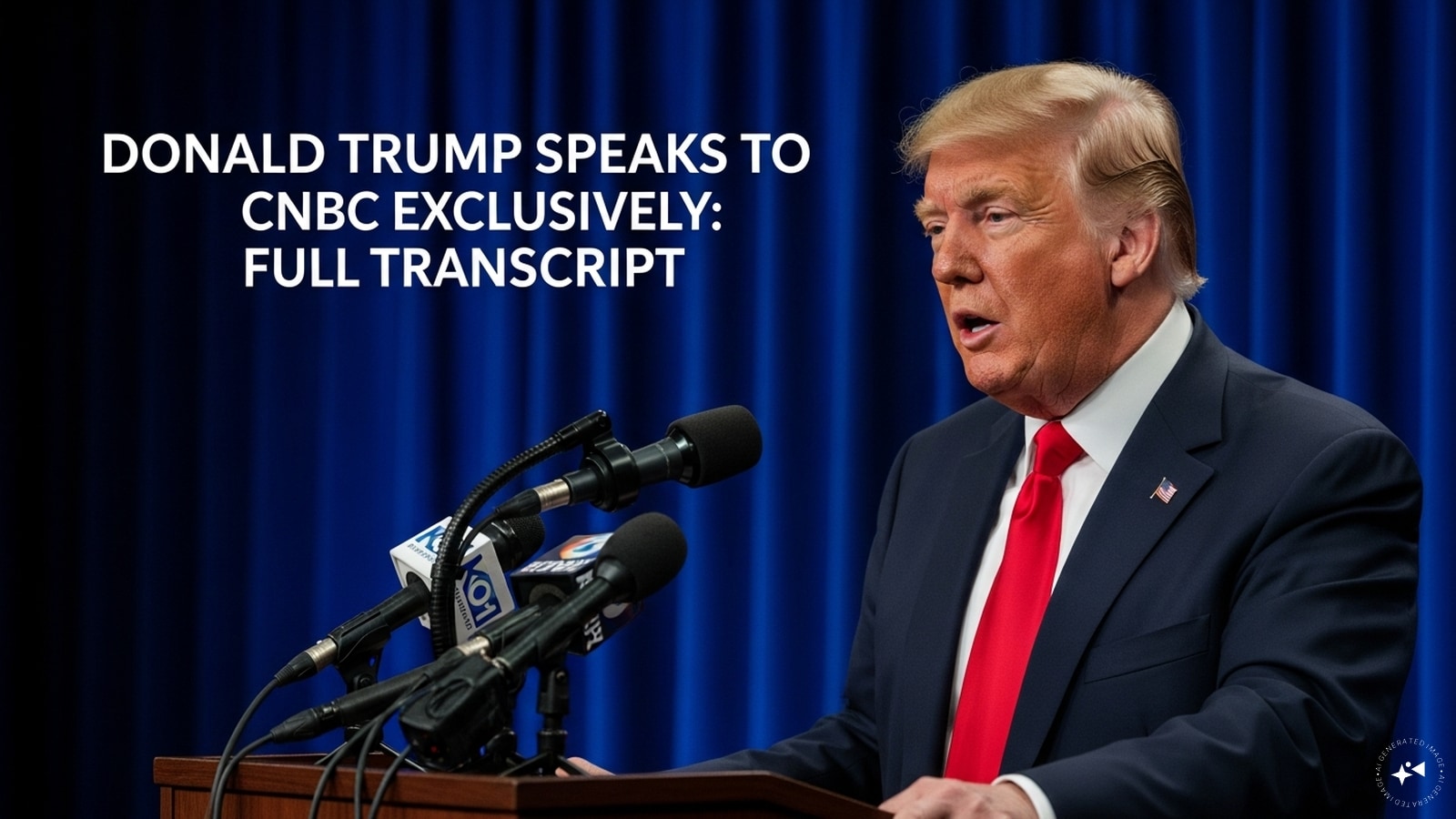
Donald Trump uses the financial press like an instrument, but the music rarely matches the sheet music of actual economic data. His recent, freewheeling broadsides on business networks are treated by the financial press as breaking policy declarations. They are not. They are calculated psychological operations designed to bully markets, intimidate central bankers, and project absolute dominance over global trade. Transcripts show a leader governing entirely by instinct, but a deeper inspection reveals a high-stakes gamble where executive whim replaces institutional stability. The real story isn't the rhetoric; it is the structural instability left in its wake.
The Myth of Total Economic Control
A recurring theme in the executive's economic worldview is the idea that global markets can be micromanaged through sheer force of will. He repeatedly claims credit for stock market highs while dismissing any underlying inflationary pressures or structural deficits. When confronted with complex realities—such as the sticky nature of service-sector inflation or the long-term fiscal consequences of sweeping corporate tax cuts—the response is almost always an assertive pivot back to his own popularity or the perceived weaknesses of his predecessors.
The numbers tell a more complicated story than the soundbites suggest. While equity markets frequently rally on the promise of deregulation and protectionist measures, bond markets tell a different tale. Yield curves reflect deep anxiety over the fiscal trajectory of a government that simultaneous demands lower interest rates while pursuing policies that could easily reignite inflation. You cannot force borrowing costs down by executive decree without consequences. The Federal Reserve, despite intense political pressure, operates within a framework governed by mathematical realities, not political loyalty.
The Tariffs Gambit and Corporate Realities
Protectionism remains the bedrock of the administration's industrial policy. The promise to slap massive, unilateral tariffs on foreign goods—ranging from European automobiles to Chinese electronics—is framed as a win for the domestic workforce. In the official narrative, foreign nations bear the entire financial burden of these levies.
+-------------------+----------------------------+----------------------------+
| Proposed Policy   | White House Narrative      | Market/Economic Reality    |
+-------------------+----------------------------+----------------------------+
| Broad Tariffs     | Foreigners pay the cost;   | Domestic importers pay;    |
|                   | revives domestic factories | costs passed to consumers  |
+-------------------+----------------------------+----------------------------+
| Forced Rate Cuts  | Sparks massive growth;     | Risk of runaway inflation; |
|                   | weakens weaponized dollar  | devalues long-term bonds   |
+-------------------+----------------------------+----------------------------+
Any seasoned supply chain analyst knows that tariffs are a tax paid by the importing companies, not the exporting nation. When a 20% levy is placed on intermediate goods, domestic manufacturers face an immediate choice. They can absorb the hit and watch their margins evaporate, or they can pass the cost directly to the American consumer.
For example, consider a hypothetical domestic appliance manufacturer that relies on imported specialized steel components. If a steep tariff is suddenly imposed, that business cannot overnight rebuild a local supply chain that took twenty years to establish. The immediate result is higher prices at the retail counter, directly contradicting the administration's vocal claims that it is actively cooling the cost of living.
Institutional Erosion as a Management Style
The ongoing public campaign against the independence of the central bank represents a fundamental shift in American governance. By openly berating monetary policymakers and dangling the names of potential loyalists to fill vacancies, the administration is treating the nation's financial architecture like a corporate boardroom.
This approach ignores why institutional independence matters to global capital markets. The United States dollar enjoys its status as the global reserve currency precisely because international investors trust that the rule of law and predictable monetary policy override short-term political cycles. Once that trust is compromised—once foreign central banks suspect that American monetary policy is being dictated via late-night social media posts or morning television appearances—the premium placed on American debt begins to erode.
The Geopolitical Transaction
The administration views foreign policy through a strictly commercial lens. Alliances are not seen as strategic partnerships built on shared values or long-term security arrangements. Instead, they are treated as transactional balance sheets. European allies are openly castigated as bad actors for failing to meet arbitrary defense spending targets, while traditional adversaries are alternately threatened with total economic isolation or offered sweeping deals.
This unpredictability is not accidental; it is a core strategy. By keeping allies and adversaries alike in a state of perpetual uncertainty, the executive believes he maintains the upper hand in negotiations. However, international commerce detests volatility. Multinationals are hesitant to commit capital to long-term infrastructure projects when a single executive action can completely alter the tariff environment or upend a decades-old trade agreement overnight.
The strategy delivers short-term political victories and commands the daily news cycle. Yet, it ignores the structural friction it introduces into the broader economic engine. The true measure of an economic policy is not the immediate reaction of a television host or a brief surge in intraday trading, but whether it builds a stable foundation for sustained, predictable growth. On that front, the theater of executive dominance remains unproven.