European tariffs didn't force Chinese carmakers into Europe. Physics, labor economics, and grid bottlenecks did.
Read the standard press coverage on this story and you get the exact same recycled script. Brussels slaps countervailing duties on battery electric vehicles shipped from China. Import quotas tighten. Suddenly, Chinese automakers rush to bolt together factories in Hungary, Spain, or Poland to hop the tariff wall. Case closed, right?
Wrong. That narrative treats automotive manufacturing like a drop-shipping trick. It assumes a car factory in central Europe is just a Chinese assembly line rotated ninety degrees on a map.
I have spent years inside automotive supply chains and plant turnarounds across North America, Europe, and Asia. I have watched OEMs blow tens of millions of dollars trying to transplant low-cost manufacturing models into high-cost industrial economies without fixing the underlying cost structure. Tariffs are a visible political punch in the mouth, which makes them easy for headlines to quote. The real killers of margin—industrial power prices, union rigidity, fragmented Tier-2 supplier networks, and local-content rules—are far quieter and far more brutal.
The Lazy Consensus About Tariff Dodging
The conventional wisdom says Chinese carmakers are building European plants purely to evade import duties and quotas. If a vehicle leaves a port in Shenzhen with a steep tariff attached, building the car inside the European Union supposedly wipes out the penalty.
That logic confuses customs classification with unit economics.
First, tariffs are only half the story. Rules of origin dictate whether a car built in Europe actually counts as "European" or merely looks like a knocked-down kit wearing a local badge. Customs authorities look closely at where high-value components—battery cells, drive units, power electronics—are manufactured and assembled. Simply bolting battery packs onto a chassis in a rented hall does not turn an export model into a localized vehicle overnight.
Second, look at the cost trade-off. Shipping a completed vehicle on a roll-on/roll-off vessel from East Asia to Rotterdam or Antwerp costs money and ties up capital in transit. Yet Chinese OEMs built their competitive edge on extreme scale in Shenzhen, Hefei, and Changzhou, where stamped panels, castings, packs, and sub-assemblies sit within a tight industrial radius. Splitting that production across an ocean destroys part of the very vertical integration that made those cars cheap in the first place.
If tariffs were the sole driver, every Chinese brand with European ambitions would be racing to open full-scale stamping and cell plants tomorrow. Instead, many are moving cautiously—staggering timelines, leasing existing capacity, testing joint ventures, or sticking to hybrid and plug-in models where customs math looks different. Why? Because dodging a tariff only works if the plant inside the fence can actually make money.
What People Actually Get Wrong About European Car Plants
When readers search for answers around this shift, they usually ask three predictable questions: Will European factories make Chinese cars cheap again? Will local workers get the same high-volume jobs as domestic brands? And will European legacy automakers get crushed either way?
Every one of those questions rests on a flawed premise.
- Will local assembly bring back bargain-basement prices? Unlikely in the short run. Industrial electricity prices in parts of Europe remain stubbornly higher than in many Chinese manufacturing hubs. Labor costs, environmental compliance, permitting delays, and regulatory overhead are higher too. You cannot import Chinese electricity rates or Chinese supplier density inside a shipping container.
- Will these plants replicate legacy mass-employment factories? Modern automotive assembly—especially EV assembly—is heavily automated. Final assembly lines require far fewer direct line workers than legacy powertrain plants did decades ago. A flashy ribbon-cutting in a regional industrial zone creates headlines and political goodwill, not a miracle cure for regional employment.
- Are legacy European automakers automatically doomed? Not automatically. Legacy brands have deep weaknesses in software velocity and cost discipline, yes. Yet they still hold real advantages in dealer networks, fleet relationships, regulatory navigation, brand trust, and high-margin models. A Chinese brand with a half-finished supply chain in Europe does not instantly become Volkswagen or Stellantis.
The real question is not whether Chinese automakers can clear customs in Europe. The real question is whether they can survive European unit economics without their home-field supply chain.
The Mechanics of Localizing an Auto Supply Chain
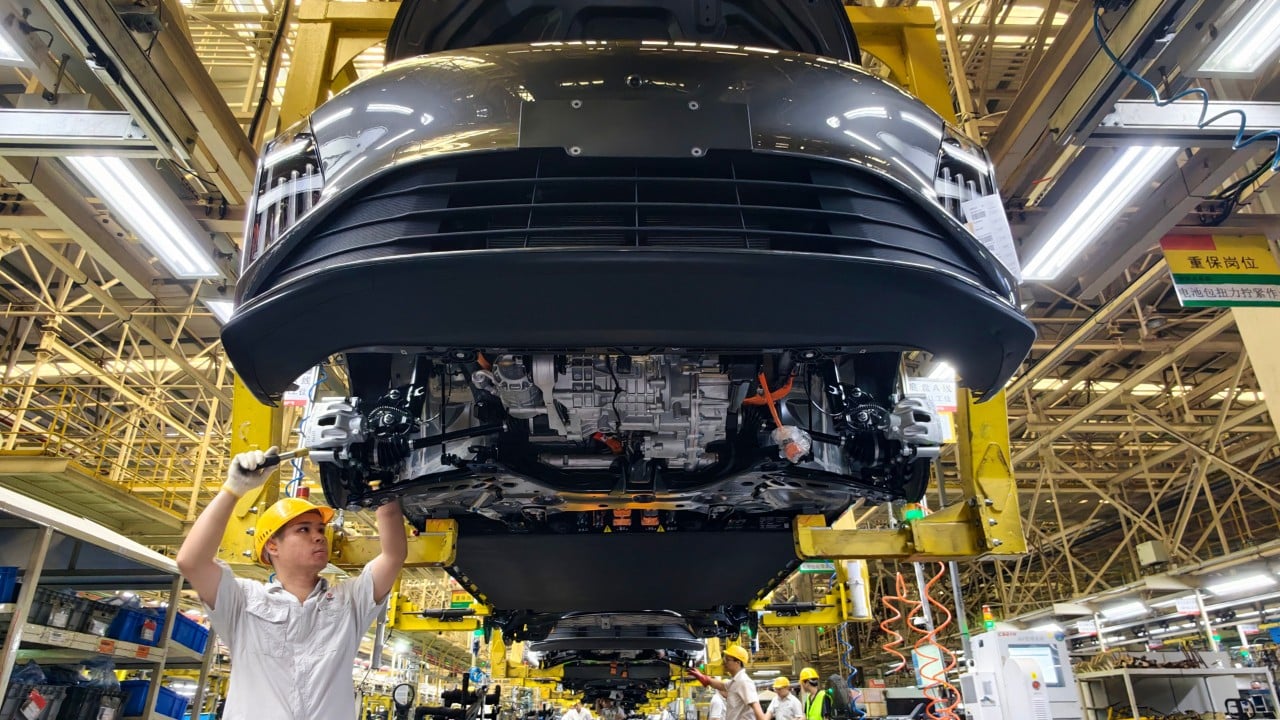
Building a car is not like assembling flat-pack furniture. A vehicle contains thousands of parts, strict safety homologation requirements, tight tolerances, and relentless takt-time pressure. Every minute a line stops costs real money.
Imagine a scenario where a Chinese automaker opens a new assembly plant in Eastern or Southern Europe with plans to scale to 150,000 units a year. On paper, the math looks clean: lower freight per unit, shorter delivery times to dealers, and relief from import duties. In practice, three bottlenecks hit at once.
- Tier-2 and Tier-3 supplier gaps: Automakers do not stamp every bracket, mold every trim piece, or wind every harness alone. They rely on dense webs of specialized suppliers. If your key sub-suppliers are still in China, you face long lead times, ocean freight exposure, and inventory buffers that eat cash. If you try to source locally, you face higher tooling costs, longer qualification cycles, and unfamiliar vendor quality systems.
- Battery and powertrain localization: In an electric vehicle, the battery pack is the heart of the cost and weight equation. Shipping bare cells or finished packs across continents carries weight, safety rules, and origin scrutiny. Building localized pack assembly—let alone full cell manufacturing—requires massive capital expenditure and strict utility power availability.
- Aftermarket and service reality: Selling cars in Europe requires parts availability when a bumper is cracked in Lyon or a sensor fails in Munich. A localized footprint helps shorten parts distribution, yet building a dependable European spare-parts network takes years of disciplined execution, not just a factory launch event.
Analysts who track global supply chains—from automotive economists at major research houses to seasoned plant directors who have run greenfield launches—know the same hard rule: the first two years of a new auto plant are almost always a margin drag. Learning curves are real. Scrap rates climb before they fall. Line speeds ramp in stages.
Where My Contrarian Thesis Could Be Wrong
Being contrarian is easy when you write from the sidelines. Being honest means admitting where the counter-argument has teeth.
My argument assumes that pure cost efficiency and supply-chain purity govern decisions over the medium term. That could fail in three ways:
- Political and strategic overrides: State-backed or heavily subsidized players sometimes prioritize market share, geopolitical positioning, or long-term footholds over near-term plant profitability. A plant that loses money on paper can still serve a strategic goal if leadership is willing to fund the bleed.
- Regulatory shifts and trade deals: Trade policy in Brussels is not static. Quotas, tariff rates, minimum import price undertakings, or bilateral negotiations can shift faster than a multi-year factory build. If trade rules loosen or target specific powertrains differently, a plant built around one tariff assumption faces a moving target.
- Faster-than-expected localization: Some Chinese OEMs move with blistering speed on engineering and execution. If a brand manages to lock in local component partners, streamline assembly, and scale volume rapidly, early cost disadvantages could narrow sooner than skeptics expect.
Even with those caveats, banking on a European factory to magically fix every trade and cost headache is a bet with sharp teeth.
What Smart Operators Should Do Instead
If you are an executive, supplier, investor, or policy watcher looking at Chinese automakers moving into Europe, stop staring at tariff headlines and start watching execution signals.
- Track localization depth, not press releases: Anyone can announce a plant or sign a memorandum of understanding. Watch where stamping, body-in-white, painting, pack assembly, and component sourcing actually happen. True localization shows up in bill-of-materials origin and supplier commitments, not podium speeches.
- Audit total landed cost per vehicle: Do not compare factory-gate cost in China against sticker price in Germany. Model ocean freight, port handling, local energy costs, labor, warranty reserves, financing, and dealer margins side by side.
- Diversify supplier exposure early: If you run a European Tier-1 or Tier-2 supplier, treat incoming OEMs as a commercial opportunity—but demand clear volume commitments, payment discipline, and realistic tooling amortization before cutting steel. Never chase volume at negative contribution margin just to win a logo.
- Watch hybrids and software monetization: Tariff rules and buyer preferences are shifting across full EVs, plug-in hybrids, and internal-combustion models. Brands that pair flexible powertrains with strong software and tight cost control will adapt far better than rigid single-bet plants.
Tariffs got Chinese carmakers talking about Europe. Cold, unforgiving manufacturing math will decide who actually stays.