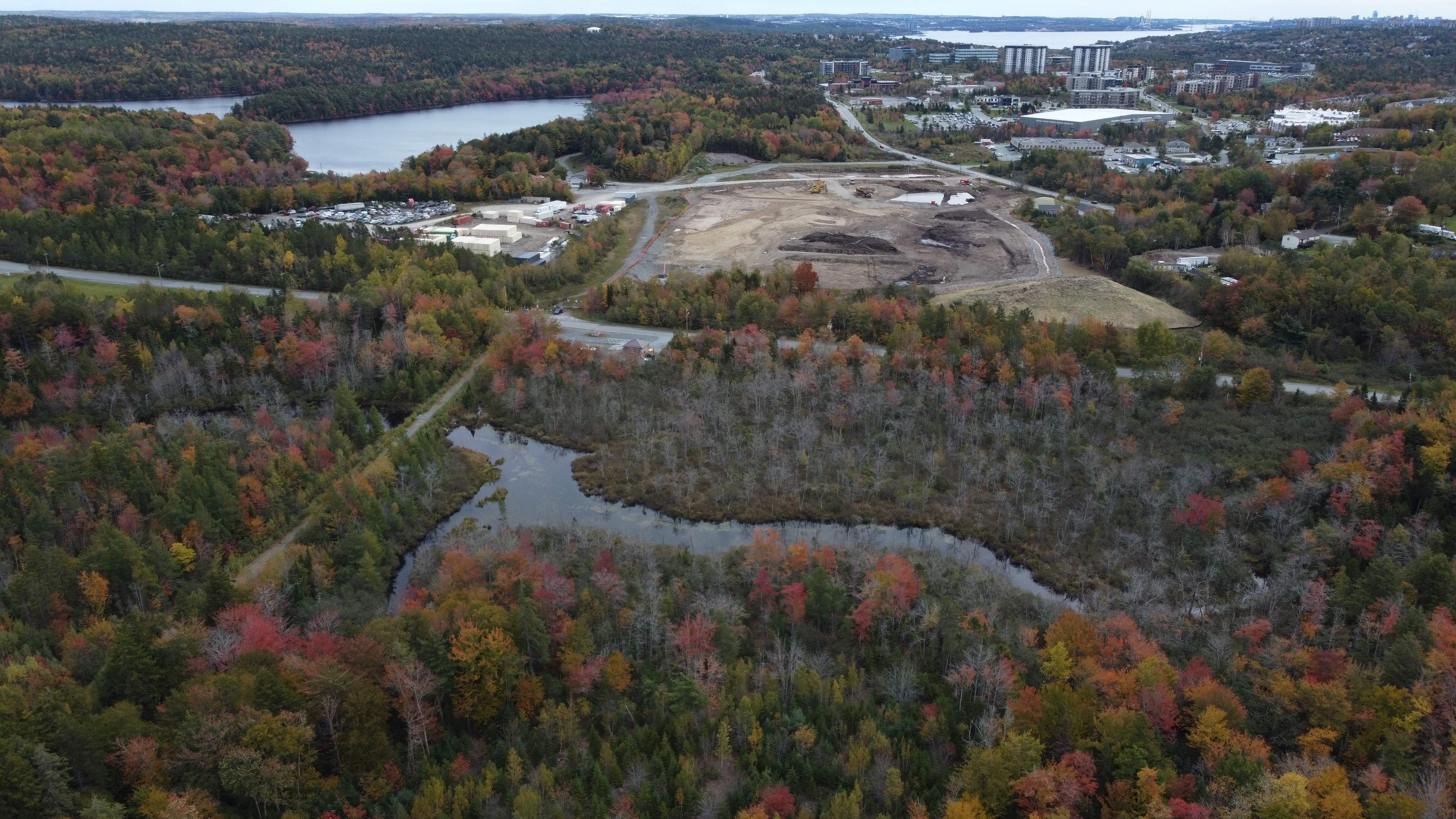
In the Halifax Regional Municipality (HRM), developers are legally clearing forests, blasting bedrock, and altering watersheds before receiving final municipal approval for the buildings they intend to put there. Known locally as site preparation permits, this regulatory mechanism allows heavy machinery onto raw land prior to the approval of a final development agreement or building permit. Critics call it putting the cart before the horse. City officials and builders call it a necessary response to an acute housing shortage and brutal Nova Scotia winters.
The core friction comes down to a simple, irreversible reality. Once an excavator strips away top soil and blasts through slate bedrock, you cannot put the ecosystem back together if the overarching development plan gets rejected or scaled down. Yet across the municipality—from suburban expansion zones to infill lots near the urban core—this exact sequence has become standard operating procedure.
The Mechanics of Pre-Approval Land Clearing
To understand why trees are falling before blueprints are stamped, you have to look at how municipal permitting is bifurcated in Nova Scotia. Under the Halifax Regional Municipality Charter and local land-use bylaws, land alteration and structural construction are treated as separate regulatory hurdles.
A developer looking to build a multi-unit residential complex or a sprawling subdivision faces a labyrinth of reviews. Traffic impact studies, municipal servicing capacity checks, public consultations, and council votes can stretch out for years. However, the municipality separates early-stage earthworks from vertical construction through grading permits, blasting permits, and tree-clearing authorizations.
If a parcel of land is already zoned "as-of-right" for a certain type of development, or if a project is moving through the early stages of a development agreement, property owners can apply to prepare the site. On paper, these permits are strictly limited. They cover erosion and sedimentation control, tree removal, rock breaking, and rough grading. They do not grant the right to pour a foundation or frame a single wall.
In practice, securing a site prep permit changes the psychological and political gravity of a project. When a developer spends millions of dollars turning a forested hillside into a flat gravel pad, the pressure on municipal planners and regional councillors to approve the subsequent building plans increases exponentially. Saying "no" to a proposal on untouched woods is one thing; saying "no" to a scarred, empty lot that represents a massive sunk capital cost is another matter entirely.
Why Builders Push for Early Earthworks
It is easy to paint developers as rogue actors trying to force the city's hand, and in some cases, that cynicism is warranted. Facts on the ground create leverage. Still, ignoring the legitimate operational pressures of building in Atlantic Canada misses half the story.
Construction in Halifax is governed by the calendar and the weather. Ground frost, spring thaw weight restrictions on heavy trucks, and unpredictable Atlantic storms dictate when heavy civil work can actually happen. If a developer waits until October to get final sign-off on a building permit, they lose an entire construction season. By breaking ground in the spring or summer under a site prep permit, crews can blast rock and install stormwater management ponds before the ground freezes, allowing vertical construction to begin the moment final approvals clear.
Financing structures also drive this urgency. Construction financing relies on strict milestones and tight interest rate windows. Carrying millions of dollars in vacant land debt while waiting 18 months for a municipal planning department to review architectural elevations can sink the financial viability of a mid-sized housing project. Demonstrating physical progress on-site reassures lenders and keeps capital flowing.
Then there is the housing crisis itself. Halifax has experienced unprecedented population growth over the past several years, driving vacancy rates to historic lows and pushing rents skyward. Both provincial and municipal governments have faced relentless public pressure to cut red tape and accelerate housing starts. Separating site preparation from final building approvals was championed by industry groups as a common-sense efficiency measure—a way to let civil contractors work in parallel with municipal planners rather than forcing them to stand idle in a linear queue.
The Environmental and Community Toll
Efficiency for builders often translates into irreversible disruption for surrounding neighborhoods and local ecosystems. The backlash against premature site prep in HRM isn't coming out of nowhere; it is rooted in tangible, visible damage across several high-profile sites.
Consider what happens when a forested parcel is clear-cut and graded months—or sometimes years—before actual construction begins.
- Stormwater runoff and siltation: Intact forests act as massive natural sponges. Stripping the canopy and topsoil exposes bare earth and fractured bedrock to heavy rain. Even with silt fences and retention ponds in place, severe weather events frequently overwhelm temporary erosion controls, sending mud and sediment into nearby lakes, brooks, and municipal storm drains.
- Urban heat and habitat loss: Removing mature tree stands eliminates carbon sinks and displaces local wildlife immediately, regardless of whether the housing project ever breaks ground. If financing falls through or market conditions shift, the community is left staring at a fenced-off gravel wasteland instead of a forest.
- Blasting vibrations and noise: Halifax sits on notoriously hard granite and pyritic slate. Preparing a site almost always involves months of rock breaking and blasting. Residents living adjacent to these sites endure daily tremors, dust, and noise long before they have even seen the final, approved design of the building going up next door.
For community groups and environmental advocates, the sequence feels fundamentally dishonest. Public engagement sessions lose their meaning when the physical landscape has already been obliterated. Residents invited to comment on a proposed development's density, setbacks, or green space buffers quickly realize the trees they hoped to preserve were chipped into mulch three weeks prior.
The Pyritic Slate Wildcard
There is a uniquely Nova Scotian geological hazard that makes premature excavation particularly risky in Halifax: pyritic slate.
Much of the bedrock underlying the Halifax peninsula and surrounding mainland contains iron sulfide minerals. As long as this rock remains buried underground, away from oxygen and water, it stays chemically stable. The moment an excavator digs it up or blasts it open during site preparation, exposure to air and rain triggers a chemical reaction that produces sulfuric acid.
This phenomenon, known as acid rock drainage, can devastate local freshwater lakes and kill aquatic life within days if not meticulously managed. Because of this risk, disturbing bedrock in HRM is tightly regulated under provincial environment statutes.
When site prep permits are issued before final building designs are locked in, engineers are sometimes forced to estimate the volume and depth of rock disturbance based on preliminary layouts. If the final approved building requires a deeper underground parking garage or a shifted footprint, crews have to re-excavate and manage additional acidic slate, compounding environmental risks and driving up remediation costs.
Where Regulatory Accountability Breaks Down
If the risks are so obvious, why does the system allow it? The answer lies in a fragmented governance structure where responsibility bounces between municipal planning staff, municipal engineering departments, and provincial environmental regulators.
In HRM, a Land Use By-law dictates what can be built, while a Lot Grading By-law governs how water flows off a property. Meanwhile, the Nova Scotia Department of Environment and Climate Change oversees wetlands, watercourses, and sulfide-bearing slate. Each department evaluates its specific slice of the application against narrow technical criteria.
If an applicant meets the technical requirements for erosion control and blasting safety, municipal engineers often have no legal grounds to withhold a site prep permit—even if the overarching planning application is still mired in public controversy or awaiting a regional council vote. Planners and engineers operate in separate silos, executing their specific mandates without a unified mechanism to pause physical alteration until the broader public interest is settled.
Regional councillors frequently find themselves caught in the crossfire. Constituents call their offices furious that bulldozers are tearing up a beloved neighborhood green space, only to be told by the councillor that the work is entirely legal under existing bylaws. By the time the development agreement actually reaches the council floor for a vote, the land has already been transformed, turning a substantive policy decision into a rubber-stamp exercise.
Hypothetical Case Study How the Sequence Plays Out
To see how this friction unfolds on the ground, consider a hypothetical example involving a 15-acre wooded parcel on the outskirts of Dartmouth.
A developer purchases the land, which is zoned for medium-density residential use, and submits a concept plan for 300 apartment units alongside a request for a development agreement to allow slightly higher building heights. While municipal planners begin reviewing traffic studies and shadow analyses—a process estimated to take 14 months—the developer applies for a tree-clearing and rough grading permit.
Because the developer's civil engineers submit a compliant erosion control plan and pay the requisite fees, the site prep permit is granted within six weeks. Within a month, clear-cutting crews level all 15 acres. Blasting rigs move in to flatten a rocky ridge.
Six months later, a shift in interest rates and soaring construction costs prompt the developer to shelve the apartment project indefinitely. The site prep permit was legally executed, so no laws were broken. Yet the surrounding neighborhood is now stuck with a barren, fenced-in moonscape for the next five years, complete with dust storms in the summer and muddy runoff every time a tropical storm brushes the coast.
The Search for a Middle Ground
Fixing this disconnect requires confronting an uncomfortable trade-off. If Halifax bans all site preparation until final building permits are issued, housing timelines will stretch out, carrying costs will rise, and fewer units will get built during a severe housing crunch. Conversely, maintaining the status quo erodes public trust, damages watersheds, and allows physical alteration to dictate planning outcomes.
Several targeted policy adjustments could restore balance without grinding construction to a halt:
- Tying site prep to substantive milestones: Instead of issuing clearing and blasting permits at the very beginning of an application, the municipality could require projects to pass key preliminary hurdles—such as initial public consultation and verified municipal water/sewer capacity—before heavy machinery is allowed on site.
- Mandatory restoration bonds: Before stripping topsoil or blasting rock prior to final development approval, developers should be required to post substantial financial securities. If the project is abandoned or rejected, the municipality could draw on those funds to re-grade, hydroseed, and stabilize the land so communities aren't left with abandoned gravel pits.
- Strict tree-retention corridors: Site prep permits should explicitly prohibit clearing within designated buffer zones and potential green spaces until final architectural footprints are locked in, ensuring builders don't level an entire lot just to make staging equipment easier.
- Integrated departmental sign-off: Breaking down the wall between engineering permits and land-use planning would ensure that no rough grading permit is issued if the underlying zoning or development agreement faces unresolved structural objections from planning staff.
Urban development is inherently disruptive, and growing cities cannot preserve every stand of trees while simultaneously housing tens of thousands of new residents. What residents expect, however, is a transparent process where rules are applied in a logical order. Until Halifax aligns its permitting sequence so that final architectural approval precedes irreversible landscape destruction, every rumble of a bulldozer will continue to sound less like progress and more like a fait accompli.