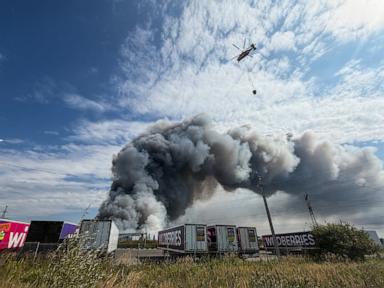
Every headline screamed about the burning Wildberries fulfillment hub outside Moscow. Analysts rushed to their glowing map terminals to measure blast radii, count charred square meters, and debate the kinetic payload of long-range Ukrainian drones. They missed the actual story entirely.
Focusing on the fire is amateur hour.
I have watched supply chains snap under far less pressure during my years consulting on high-risk Eurasian logistics. When a drone hits a military barracks, a general shrugs, writes off a tent, and moves a platoon. When a drone hits a privatized logistics beast like Wildberries, the friction bleeds directly into the civilian economy, grinding the gears of everyday consumption to a sudden, screeching halt.
The lazy consensus in the mainstream press treats this strike as a standard military escalation. That framing is profoundly obsolete. Modern warfare does not care about the front line because the supply chain is the front line.
The Myth of the Hardened Megacity
For three years, the narrative insisted that Moscow was a fortress insulated from the conflict. Air defense batteries bristled on rooftops. Electronic jamming fields supposedly turned the skies into an impenetrable dome.
Then a low-cost, propeller-driven delivery mechanism bypassed the crown jewel of Russian air defense and turned millions of dollars worth of consumer goods into ash.
People ask how the drone penetrated the Moscow air defense grid. The wrong question. The real question is why anyone expected an air defense grid designed for Cold War ICBMs to stop a distributed network of commercial inventory.
Urban centers are not monolithic shields. They are dense, interdependent webs of civilian infrastructure. When you hit a distribution center handling hundreds of thousands of third-party sellers, you do not just destroy cardboard and cheap electronics. You break the social contract of convenience that keeps a restless urban populace pacified.
Imagine a scenario where the state can no longer guarantee next-day delivery of diapers, auto parts, or pharmaceuticals to a city of thirteen million people. The psychological fallout of missing consumer goods outweighs the loss of a radar installation every single time.
Why Wildberries Is More Critical Than a Oil Depot
Refineries make good television. Fireballs rise high, crude oil burns black, and stock markets twitch. But oil is a macro-commodity. It moves through heavy, resilient pipelines and state-controlled valves. It bounces back.
Retail logistics are different. They rely on hyper-efficient, fragile software ecosystems, just-in-time inventory tracking, and localized distribution nodes that operate on razor-thin margins.
Wildberries is not just a retailer. It is the backbone of Russia's domestic consumer market, operating on a scale that dwarfs traditional brick-and-mortar retail in the region. When you incinerate a hub of that magnitude, you trigger a cascade failure:
- Thousands of small and medium enterprises suddenly lose their primary sales channel.
- Regional delivery routes choke as inventory gets rerouted through crippled secondary nodes.
- Consumer trust in digital commerce plummets, causing panic-buying runs on remaining non-digital retail infrastructure.
I have seen companies blow millions trying to build redundant systems for precisely this kind of black swan event, only to realize that true redundancy is economically impossible at scale. You cannot duplicate a billion-dollar logistics network just in case someone drops a guided munition down your skylight.
The Logistics of Attrition
We are witnessing a fundamental shift in how modern states wage economic exhaustion. Physical territory matters less than economic velocity.
For the past decade, tech bros and logistics gurus preached the gospel of frictionless commerce. They optimized warehouses down to the square millimeter, outsourced last-mile delivery to gig workers, and eliminated safety stock to drive down holding costs. They built a masterpiece of efficiency, completely forgetting that efficiency is the exact opposite of resilience.
By targeting hubs like the one in Alexin or the mega-warehouses circling the Moscow oblast, the strategy is brilliantly straightforward. You force the adversary to choose between two equally miserable options:
- Spend billions hardening civilian supply chains against asymmetric aerial threats.
- Accept regular, catastrophic disruptions that erode domestic economic stability.
Neither option is viable. Hardening a warehouse means turning a distribution center into a literal concrete bunker, which destroys the speed advantages that made it profitable in the first place. Leaving it exposed invites recurring annihilation.
The Real Fallout
Grounding flights at Vnukovo, Domodedovo, and Sheremetyevo during the raid was not merely a precautionary measure for civilian safety. It was a calculated demonstration of airspace sovereignty degradation.
When civilian air traffic has to halt because homemade drones are buzzing the capital's perimeter, the aura of invincibility evaporates. It forces the domestic audience to look past the sanitized evening news and smell the smoke drifting across the ring road.
Stop looking at this as a localized fire or a tactical skirmish. It is a preview of how modern conflict dissolves the boundary between the home front and the combat zone. As long as retail empires act as the logistics engines for national endurance, their distribution hubs will remain primary targets.
Efficiency without defense is just an invitation to burn.