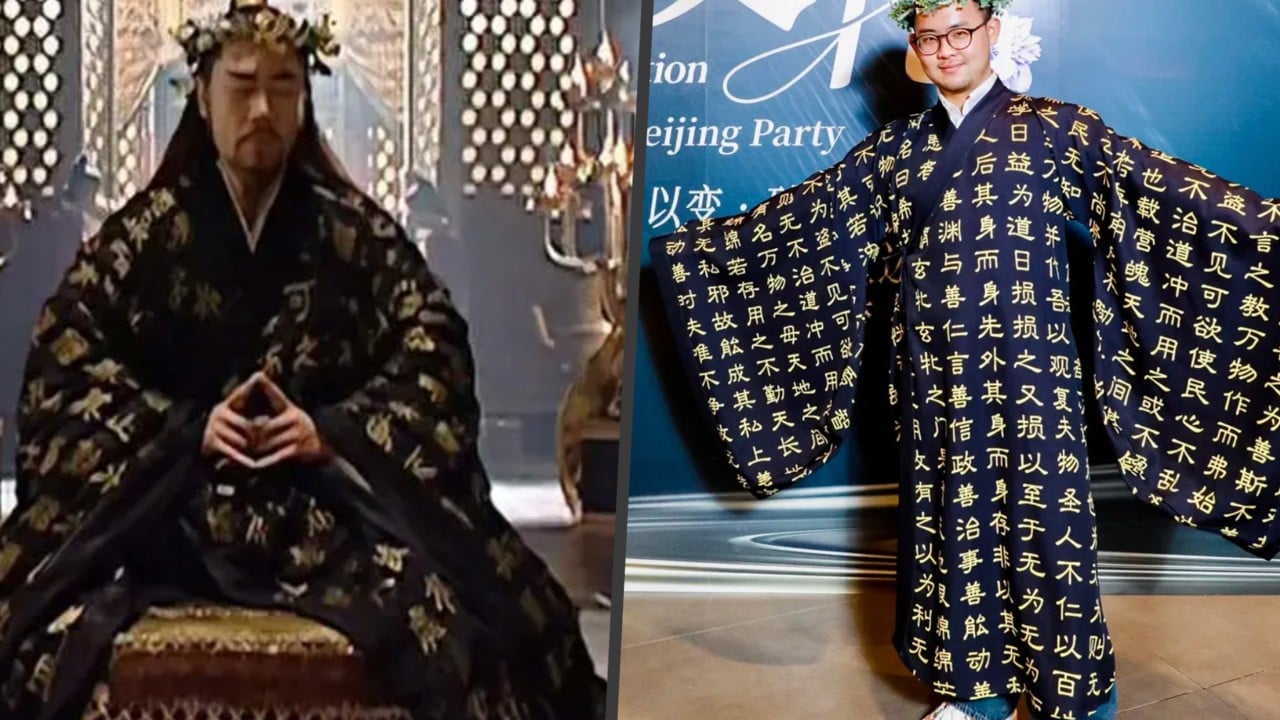
Walk into a coffee shop in Shanghai or Beijing at 8 PM on a Tuesday, and you might spot someone sitting behind a glowing laptop dressed like a Qing dynasty ruler. They aren't filming a historical drama. They're just working overtime.
When burnt-out Chinese youth wear a laid-back emperor’s robe to resist overtime, they're making a loud statement without saying a single word to their bosses. It looks absurd on the surface. A bright yellow silk robe covered in embroidered dragons, draped over a pair of sweatpants and battered sneakers, sitting in a sterile corporate cubicle or a cramped apartment. Yet this bizarre fashion trend has exploded across Chinese social media platforms like Xiaohongshu and Douyin, turning historical royal garments into the ultimate uniform for modern workplace rebellion. Read more on a related issue: this related article.
You can't understand this trend without looking at the sheer exhaustion driving it. For years, young professionals in China have been crushed by the infamous "996" work culture—working from 9 AM to 9 PM, six days a week. Even after China's Supreme People's Court and the Ministry of Human Resources and Social Security officially declared the 996 schedule illegal in 2021, the reality on the ground barely budged. Managers still expect instant replies on WeChat at midnight. Layoffs loom over anyone who dares to log off at 6 PM sharp.
So, what do you do when quitting isn't an option because the youth unemployment rate makes finding another job a nightmare, and fighting your boss directly gets you blacklisted? You put on a dragon robe. Further analysis by Cosmopolitan highlights similar perspectives on this issue.
The Psychology Behind the Laid-Back Emperor’s Robe
Putting on a costume changes how your brain processes stress. Psychologists call this "enclothed cognition," a concept explored by researchers Hajo Adam and Adam D. Galinsky in the Journal of Experimental Social Psychology. Their studies show that the symbolic meaning of the clothes we wear directly alters our psychological state and behavior. When a stressed-out junior analyst slips on a replica of an imperial longpao (dragon robe), they aren't playing pretend. They're creating an immediate mental barrier between their actual self and the soul-crushing demands of their job.
Think about the historical irony here. In imperial China, the emperor held absolute power. Nobody told the emperor to revise a PowerPoint deck at 11 PM. Nobody asked the emperor to hop on a "quick sync" call during dinner. By wearing the robes of supreme authority while doing menial corporate tasks, young workers are engaging in a dark, hilarious form of roleplay. They're reminding themselves that their boss doesn't own their soul, even if the company owns their evenings.
Honestly, it's a brilliant coping mechanism. Instead of crying in the bathroom stall over another unpaid overtime shift, you drape yourself in gold silk, lean back in your ergonomic chair, and review spreadsheets like a bored monarch surveying a mildly disappointing harvest. The absurdity breaks the tension. It turns a moment of helplessness into a private joke.
From "Lying Flat" to Dressing Like Royalty
This isn't the first time Chinese youth have invented passive-aggressive ways to push back against toxic work expectations. Over the past few years, an entire vocabulary of quiet resistance has emerged online.
First came tangping, or "lying flat." Started around 2021, lying flat was all about doing the bare minimum to survive—rejecting the rat race, skipping marriage, avoiding homeownership, and refusing to work yourself to death for a promotion that never comes. The government quickly censored online discussions around lying flat, worried it would tank economic productivity.
Then came bailan, which translates to "let it rot." If lying flat was passive acceptance, letting it rot was actively embracing the decline. When a project is doomed to fail because management set impossible deadlines, you stop trying to save it. You let it rot.
More recently, young workers embraced "gross outfits" for the office—showing up in baggy pajamas, mismatched socks, and unwashed hair because they refused to waste personal time and money looking presentable for a job that paid pennies.
The laid-back emperor’s robe is the logical next step in this evolution. It takes the apathy of "gross outfits" and upgrades it with theatrical flair. You aren't just dressing badly to spite your employer; you're dressing like a sovereign ruler to mock the entire corporate hierarchy.
Why the Dragon Robe Beats Regular Loungewear
You might wonder why an emperor's robe specifically caught on instead of, say, a superhero costume or a regular bathrobe. The answer comes down to cultural weight and sheer comfort.
- Unmatched Comfort: Traditional Chinese robes are loose, flowing, and breathable. When you're stuck at a desk for twelve hours, tight blazers and stiff button-downs feel like a prison. A silk or polyester-blend robe feels like wearing a cloud.
- Instant Visual Impact: If you turn on your webcam for a late-night meeting wearing a hoodie, nobody blinks. If you appear on screen wearing a bright yellow imperial robe with roaring dragons on the chest, the entire dynamic of the call shifts instantly. It forces everyone to acknowledge how ridiculous it is to be working at that hour.
- Affordable Rebellion: On e-commerce platforms like Taobao and Pinduoduo, mass-produced emperor robes cost anywhere from 50 to 200 yuan (roughly $7 to $28 USD). For the price of two fancy coffees, any entry-level worker can buy a symbol of ultimate authority.
How Companies and Managers Are Reacting
Corporate leadership in China doesn't quite know how to handle this. You can't easily fire someone for wearing a traditional garment, especially when the government actively promotes Guochao—a cultural movement encouraging young people to embrace traditional Chinese heritage and fashion.
That's the genius trap these workers have set. If a manager reprimands an employee for wearing a Qing or Ming dynasty robe, the employee can simply claim they're celebrating traditional culture. It's the ultimate bureaucratic checkmate.
In many tech startups and creative agencies in cities like Shenzhen and Hangzhou, managers have actually started leaning into the joke to avoid looking out of touch. Some teams have even bought matching robes for crunch periods, turning a symbol of individual resistance into a weird team-building exercise.
Still, the underlying friction hasn't disappeared. When a junior designer wears an emperor's robe at 10 PM, they aren't saying "I love working late with my fun team." They're broadcasting a silent distress signal. They're telling the world that the workload is unreasonable, the pay isn't worth the sacrifice, and humor is the only thing keeping them from burning out completely.
What Global Workers Can Learn From This Trend
You don't need to live in Beijing or buy a silk dragon robe on Taobao to recognize the burnout driving this movement. Hustle culture is a global problem. Whether it's "quiet quitting" in the United States, "act your wage" movements in Europe, or young Chinese workers draping themselves in royal yellow, the core issue is identical: people are tired of giving their entire lives to companies that view them as replaceable cogs.
The emperor robe trend highlights a crucial truth about modern work. When employees feel powerless to change their hours or their pay, they will always find ways to reclaim their dignity. Sometimes that looks like setting strict boundaries on Slack. Sometimes it looks like logging off at 5 PM sharp. And sometimes, it looks like putting on a ridiculous costume to remind yourself that your job title isn't who you are.
If you're currently drowning in unpaid overtime and feeling like your personal life is slipping away, take a page out of this playbook. You might not wear a dragon robe to your next Zoom call, though honestly, nobody's stopping you. Instead, start building your own psychological armor against overwork.
- Create a hard physical boundary at the end of your workday. Change your clothes the second you finish your last task. Take off the work shirt, put on something completely different, and let your brain register that the shift is over.
- Stop apologizing for offline hours. Remove work messaging apps from your personal phone if your contract doesn't explicitly pay you to be on call.
- Refuse to internalize bad planning. When management creates an artificial emergency through poor scheduling, do your normal shift calmly and log off. Don't set yourself on fire to keep a poorly managed project warm.
- Use humor to deflate toxic urgency. Most corporate "emergencies" don't involve life or death. Treating a late-night formatting request with the detached amusement of a bored emperor keeps your cortisol levels from spiking.
Work should fund your life, not consume it. Whether you reclaim your sanity through strict digital boundaries or a $15 silk robe from the internet, stop letting overtime convince you that you're powerless.