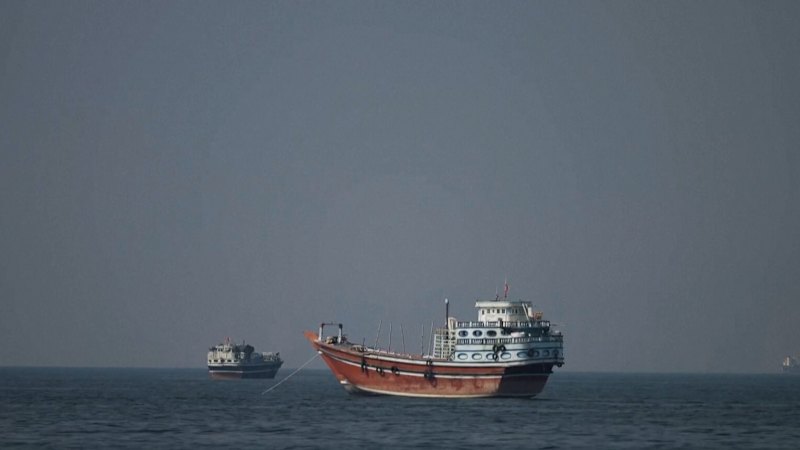
The United States has launched coordinated military strikes against Iranian-backed assets following a severe missile attack on a commercial container ship in the Red Sea. This kinetic response marks a significant escalation in Washington’s efforts to restore deterrence along vital global shipping lanes. However, while the immediate objective is to punish the network behind the maritime assault, the underlying strategy faces severe structural friction. Decades of asymmetric warfare show that standard naval bombardment rarely deters decentralized militias who operate with low overhead and deep ideological backing. The current strategy risks locking the US into an expensive, open-ended game of whack-a-mole while failing to address the primary supply lines feeding the instability.
To understand why the White House ordered these strikes, one must look at the specific geography of global trade. The Bab el-Mandeb strait is a narrow chokepoint. Nearly twelve percent of global seaborne trade passes through this corridor, connecting the Indian Ocean directly to the Mediterranean via the Suez Canal. When a commercial vessel is struck by a low-cost drone or an anti-ship cruise missile, insurance premiums for every transit pass spike instantly. Major shipping conglomerates have already begun rerouting their fleets around the Cape of Good Hope. That detour adds ten to fourteen days to a journey, inflates fuel costs by hundreds of thousands of dollars per voyage, and ultimately drives global consumer inflation.
Washington’s operational logic is straightforward on paper. By eliminating launch sites, radar installations, and ammunition depots, the US military aims to degrade the physical capability of the attackers. Yet, this approach treats a deeply rooted political and regional alliance as a localized military problem. The groups launching these weapons do not operate like traditional standing armies. They do not rely on centralized command bunkers or massive, easily targeted industrial complexes. Their infrastructure is mobile, hidden inside civilian areas, and easily replaced by external patrons.
The Asymmetry of the Modern Arsenal
The cost curve of this conflict is unsustainably skewed against Western navies. A standard commercial drone modified for military use can cost less than twenty thousand dollars. The anti-air missiles used by US destroyers to intercept them cost upwards of two million dollars per shot. This disparity is not just a financial headache. It is a mathematical vulnerability that a prolonged campaign will inevitably expose. Shipboard magazine capacities are finite, and reloading a guided-missile destroyer requires returning to a specialized port, temporarily removing a multi-billion-dollar asset from the theater of operations.
This reality exposes the core limitation of defensive naval pickets. You cannot play defense forever when the opponent's ammunition is effectively free.
+--------------------------+-------------------------+
| Attack Vector            | Intercept Mechanism    |
|--------------------------+-------------------------|
| Iranian-Designed Drone   | SM-2 / SM-6 Missile     |
| Cost: ~$20,000           | Cost: ~$2.1 - $4.3M     |
|                          |                         |
| Anti-Ship Cruise Missile | ESSM / Phalanx CIWS     |
| Cost: ~$100,000          | Cost: ~$500K - $1M      |
+--------------------------+-------------------------+
Western planners are fully aware of this math, which is precisely why the decision shifted from passive interception to active, offensive strikes. The goal is to destroy the arrows before they leave the bow. But finding the bows in a rugged, heavily militarized landscape is an intelligence nightmare that requires constant, high-fidelity surveillance.
The Limits of Stand-off Air Power
Air strikes create the illusion of decisive action. Precision-guided munitions make for compelling briefing footage, but historical precedent suggests their long-term efficacy against asymmetric networks is marginal. During the multi-year Saudi-led campaign in Yemen, thousands of air strikes failed to break the operational capacity of the Houthi movement. In fact, the group grew more sophisticated, transitioning from local insurgent tactics to deploying long-range ballistic missiles and advanced sea-skimming drones.
The intelligence architecture required to map these mobile targets is incredibly fragile. A launcher can be rolled out of a cave, fired from the back of a civilian flatbed truck, and hidden back underground within minutes. Unless the US is willing to commit to a persistent, high-risk intelligence, surveillance, and reconnaissance network—coupled with the willingness to strike targets with seconds of notice—most ordnance will end up hitting empty dirt or abandoned storage facilities.
The Regional Patrons and the Gray Zone
The primary driver of this conflict sits hundreds of miles away from the launch pads. Tehran has perfected the art of gray-zone warfare, a strategy designed to achieve strategic objectives while remaining just below the threshold of triggering a direct state-on-state war. By supplying advanced telemetry, components, and training to local proxies, Iran exerts immense leverage over international trade routes without ever having to risk its own naval vessels or domestic infrastructure.
This proxy model provides plausible deniability. It forces the United States and its allies to expend political capital and military readiness fighting the symptoms of Iranian foreign policy rather than the source.
The strategic dilemma for the White House is acute. Striking targets inside Iran proper would represent an unprecedented escalation that could ignite a broader regional war, decoupling energy markets and forcing a closure of the Strait of Hormuz. Conversely, ignoring the state-level sponsorship ensures that whatever equipment is destroyed in the current air campaign will be replenished via covert maritime smuggling routes within months.
The Smuggling Pipelines That Never Sleep
Interdicting the flow of weapons across the Arabian Sea is an immense logistical challenge. The waters are vast, heavily trafficked by regional fishing dhows, and difficult to police effectively.
- Dhow traffic acts as a natural screen, allowing small, wooden vessels to blend into legitimate trade.
- Component-based shipping means missiles are rarely shipped fully assembled; instead, guidance chips, engines, and fuel tanks are smuggled separately and assembled locally.
- Transshipment points in poorly governed coastal sectors provide easy staging grounds for offloading illicit cargo before it reaches its final destination.
Without a comprehensive maritime blockade—an operation that would require a massive commitment of international naval hulls—the supply lines will remain functional.
The Economic Consequences of Deterrence Failure
Global supply chains are built on the assumption of friction-free transit. When that assumption breaks, the compounding effects are felt across multiple industries simultaneously. The current naval deployment is not merely an exercise in freedom of navigation; it is an emergency intervention to prevent a systemic gridlock of Western manufacturing.
Just-in-time inventory systems mean that European factories depend on regular, weekly arrivals of components from Asia. When ships are forced to bypass the Red Sea, those parts do not arrive on time. Assembly lines stall.
[Normal Route: Asia -> Suez -> Europe]  === 30 Days ===> Low Cost / Stable
[Current Route: Asia -> Cape -> Europe] === 44 Days ===> High Cost / Inflationary
Furthermore, the pressure on alternative routes creates a secondary bottleneck. Air freight rates are rising as desperate shippers attempt to bypass the ocean entirely for high-value goods. Rail networks through Central Asia are facing capacity constraints. The longer the Red Sea remains a contested combat zone, the deeper these structural shifts will embed themselves into global corporate planning, permanently raising the baseline cost of moving goods around the earth.
The Political Reality of Coalition Warfare
The United States has attempted to frame its maritime security efforts as a broad international coalition. Yet, a closer examination reveals deep reluctance among key global players to fully align with American kinetic operations. Major European and Asian powers rely heavily on the Suez route, but their willingness to participate in offensive strikes is constrained by domestic political realities and fear of regional blowback.
Some allies have contributed staff officers or signed joint statements, but few have placed their warships directly under US operational command for offensive missions. This hesitation stems from a fundamental disagreement over the end state. While Washington views the issue through the lens of countering Iranian influence, many international capitals see it as a volatile byproduct of the broader Middle East political crisis that cannot be solved via naval gunfire alone.
The Problem of Divergent Allied Interests
For nations like China, the calculus is entirely different. Beijing maintains a massive naval base in Djibouti, right at the mouth of the Red Sea, yet its warships have largely avoided active participation in Western-led security operations. Instead, Chinese state-backed shippers have occasionally secured safe passage by virtue of Beijing's diplomatic ties with Tehran. This creates a deeply fractured security environment where some nations pay the premium to police the commons while others use diplomatic backchannels to bypass the risk entirely.
This imbalance erodes the long-term viability of international maritime norms. If freedom of navigation becomes an exclusively Western burden to enforce, the economic benefit of that security will be enjoyed by competitors who bear none of the operational or political costs.
The Mirage of a Clear Exit Strategy
The history of modern military interventions in the region demonstrates that entering a conflict is far simpler than establishing a stable equilibrium that allows for a departure. Air strikes provide immediate political optics, showing a domestic audience that provocations will not go unanswered. They do not, however, alter the political conditions that made the attacks viable in the first place.
The groups executing these maritime strikes operate on an entirely different timeline than Western political cycles. They do not need to win a conventional naval engagement. They merely need to survive, maintain the capacity to fire an occasional missile, and prove that a multi-nation coalition cannot completely secure a vital trade lane. For an asymmetric actor, avoiding defeat is equivalent to victory.
This leaves the United States with few good options. Halting the strikes without achieving a verifiable cessation of maritime attacks would signal weakness and invite further disruption. Continuing the bombardment indefinitely turns a targeted response into an open-ended attritional campaign that drains resources away from other global priorities, particularly the Indo-Pacific theater. The current kinetic campaign may clear the radar screens for a few days, but it leaves the structural engines of this crisis completely untouched.