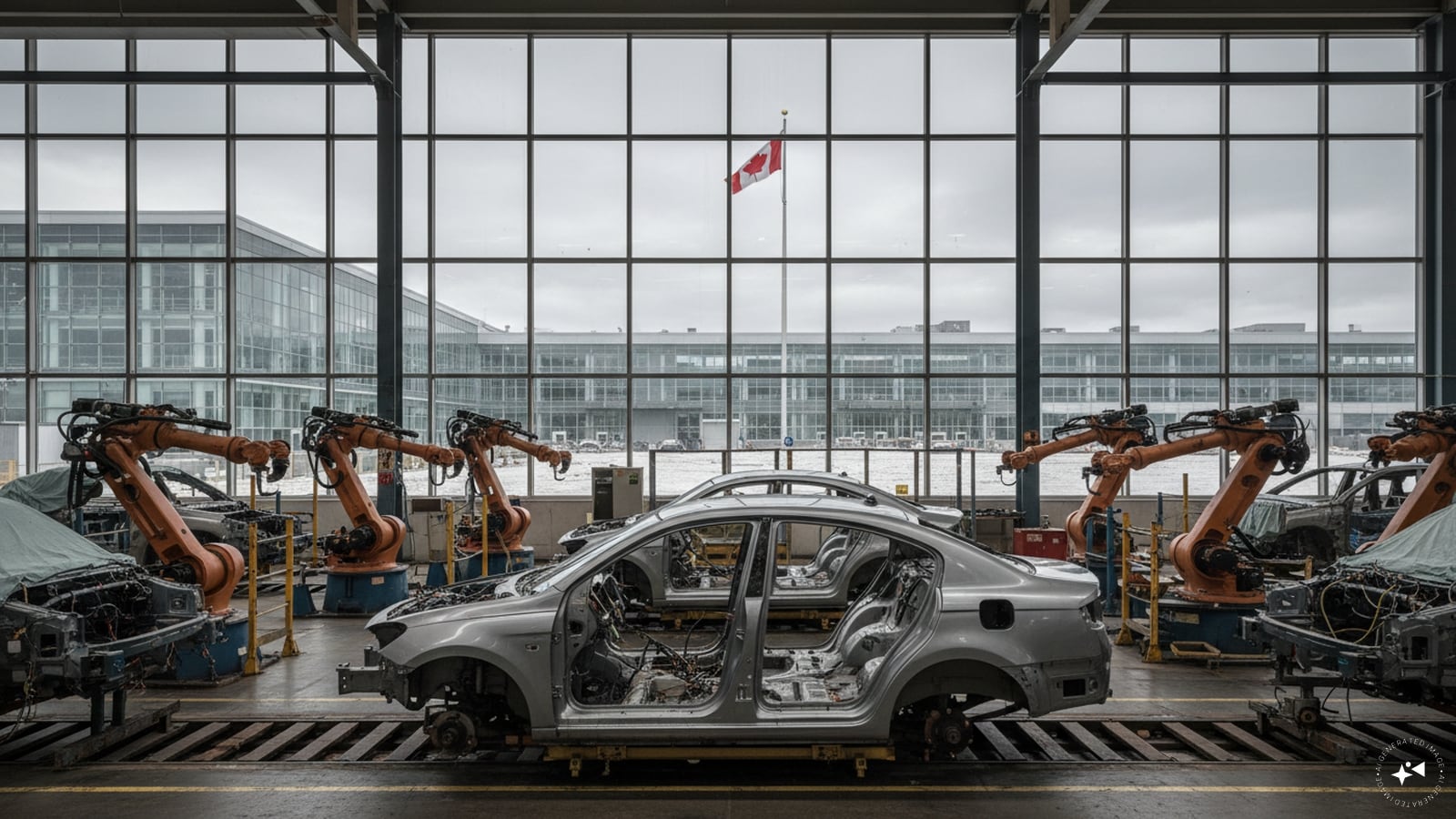
Handing an automaker billions in taxpayer subsidies without locking down airtight domestic production clauses is a rookie mistake. Ottawa is learning that lesson the hard way right now. Canada threatens to sue Stellantis over auto plant sale plans as shifting trade policies pull manufacturing investment back across the border into the United States.
This isn't just another corporate PR spat. It's a high-stakes legal collision over who actually owns the economic return on public green-energy investments when tariff threats rewrite the math for global automakers. If you follow North American manufacturing, supply chains, or trade policy, this standoff signals a massive shift in how governments police corporate subsidy agreements.
What Triggered the Stellantis Legal Threat
When Ottawa and the Ontario government pledged up to 15 billion CAD in production subsidies for the NextStar Energy electric vehicle battery plant in Windsor, the handshake came with strings attached. Those public funds were meant to anchor jobs, research, and vehicle assembly in Canada for decades.
Then the trade winds shifted. Aggressive tariff proposals and protectionist industrial policies from Washington changed the financial calculus for multinational carmakers overnight. Suddenly, building vehicles and components in Ontario and shipping them south carried massive tariff exposure.
Stellantis—the parent company behind Chrysler, Jeep, Dodge, and Ram—began re-evaluating its North American footprint. Reports surfaced that the automaker was exploring the sale or restructuring of key Canadian assembly assets while accelerating capital commitments in U.S. plants in Michigan, Illinois, and Indiana. Canadian federal officials didn't blink. Innovation, Science and Economic Development Canada put the company on notice that breaking domestic footprint commitments would trigger immediate legal action and subsidy clawbacks.
The core dispute comes down to contract law versus corporate survival. Stellantis argues it has a fiduciary duty to adapt to punishing cross-border trade barriers. Ottawa argues a signed performance agreement isn't an optional suggestion just because U.S. trade policy got aggressive.
How U.S. Tariffs Are Pulling Auto Production South
To understand why Stellantis is willing to risk a courtroom brawl with a G7 government, look at the assembly line math. North America's auto sector doesn't operate as three separate national industries. Parts cross the Detroit River up to seven or eight times before a finished vehicle rolls off the line.
When Washington threatens blanket tariffs or tightens rules-of-origin requirements under the United States-Mexico-Canada Agreement (USMCA), that integrated supply chain breaks down fast. A 10% or 25% tariff on Canadian-built vehicles wipes out the profit margin on almost every mass-market SUV or pickup truck Stellantis sells.
For an automaker already navigating sluggish EV adoption rates and thin margins, absorbing billions in new U.S. import duties isn't viable. Moving final assembly and battery module production south of the border neutralizes the tariff risk immediately.
Here's the catch. U.S. states like Michigan and Ohio are simultaneously dangling fresh tax abatements and infrastructure grants to lure those exact assembly lines back home. Stellantis isn't just running away from Canadian regulatory friction—it's running toward American trade protection and state-level incentives.
Why Canada's Subsidy Contracts Have Teeth
Most people assume corporate bailouts and green subsidies are basically free money with zero accountability. That used to be true in the 1990s and early 2000s. It's not true anymore.
Following the 2008 financial crisis—when automakers took billions in emergency loans and still shuttered Canadian plants years later—federal and provincial lawyers rewrote the playbook. Modern Strategic Innovation Fund agreements and Special Contribution Agreements include strict clawback provisions.
If Ottawa follows through on its threat to sue Stellantis, the legal battle will center on three specific mechanisms:
- Capital expenditure milestones: Contracts require the automaker to spend verified dollar amounts on physical tooling and facility upgrades within Ontario before receiving matching grant tranches.
- Headcount and payroll floors: Companies must maintain minimum full-time equivalent employment numbers at legacy plants like Brampton and Windsor, not just at new battery joint ventures.
- Asset transfer restrictions: Selling or spinning off a subsidized facility to a third party without ministerial consent constitutes a material breach of contract.
If a judge rules that selling or downsizing an Ontario assembly plant violates those covenants, Stellantis won't just lose future production tax credits. The federal government can sue to recover hundreds of millions of dollars already disbursed, plus statutory interest.
What Most Analysts Get Wrong About the Brampton and Windsor Plants
Walk into any coffee shop in Windsor or Brampton, and you'll hear people say the auto industry in Ontario is finished. That's an overreaction. At the same time, politicians claiming everything is fine are selling pure fantasy.
The real story lies in the difference between battery cell manufacturing and final vehicle assembly.
NextStar Energy in Windsor—Stellantis's massive joint venture with LG Energy Solution—is too far along and too capital-intensive to simply pack up and move to Ohio. The cleanrooms, chemical processing lines, and local utility infrastructure represent sunk costs that can't be relocated easily.
Final vehicle assembly plants, like the Brampton Assembly facility, are a completely different story. Retooling an assembly plant for next-generation electric or hybrid platforms takes billions in fresh investment. If Stellantis decides it makes more financial sense to build the next-generation Jeep Compass or Chrysler crossover in Belvidere, Illinois instead of Brampton, Ontario, selling off or mothballing the Canadian real estate becomes an attractive option on a spreadsheet.
That distinction explains why Ottawa is drawing a hard line right now. Once an assembly plant loses its next-generation product allocation, the local parts suppliers within a 100-mile radius start going bankrupt within eighteen months.
The USMCA Review Factor Nobody Is Talking About
Timing matters here. The mandatory joint review of the USMCA puts every cross-border trade rule back on the negotiating table.
Washington knows Canada's auto sector is overwhelmingly dependent on access to American consumers—roughly 85% of vehicles built in Canada are exported to the United States. By squeezing automakers with tariff threats ahead of formal trade talks, U.S. trade negotiators gain massive leverage over Ottawa.
Stellantis is caught directly in the crossfire. If the company appeases Ottawa by keeping production in Ontario, it risks getting hammered by U.S. customs duties. If it appeases Washington by shifting production south and selling off Canadian assets, it faces a multi-billion-dollar breach-of-contract lawsuit from the Canadian government and fierce backlash from Unifor, Canada's largest private-sector union.
Unifor has already shown it won't sit quietly during contract disputes. During recent bargaining cycles, union leadership didn't hesitate to launch targeted strikes to secure product commitments for Oakville, Brampton, and Windsor. A unilateral plant sale would trigger immediate labor disruption across Stellantis's remaining Canadian operations, including parts distribution centers that keep U.S. dealerships supplied.
How Other Automakers Are Watching This Standoff
Stellantis isn't the only company holding billions in Canadian subsidy pledges. Volkswagen locked in up to 13 billion CAD in production subsidies for its PowerCo battery gigafactory in St. Thomas, Ontario. Honda committed to a 15 billion CAD EV supply chain buildout in Alliston. General Motors and Ford both took hundreds of millions in federal and provincial backing to retool their Ontario assembly lines.
Every single one of those boardrooms is watching how Ottawa handles Stellantis.
If Canada backs down and lets Stellantis sell off assembly capacity or quietly shift production south without paying a steep legal penalty, every other subsidy contract in the country becomes worthless paper. Volkswagen, Honda, and GM would immediately demand similar flexibility the moment market demand or U.S. tariff rates shift.
Conversely, if Ottawa drags Stellantis into Ontario Superior Court and freezes grant disbursements, it sends a blunt message to global CEOs: Canadian taxpayer money comes with handcuffs, and you can't buy your way out of them cheaply.
What This Means for Investors, Suppliers, and Auto Workers
You don't need to sit on a corporate board to feel the fallout from this dispute. If you're invested in automotive equities, managing supply chain risk, or working in the Great Lakes manufacturing corridor, you need to adjust how you read corporate announcements right now.
First, stop treating government subsidy announcements as guaranteed long-term capital. A 15 billion CAD headline number is almost always tied to per-unit production volume over a ten-year window. If factory output drops or shifts across a border, those subsidy dollars evaporate immediately. Always read the annual regulatory filings to see how much cash has actually been disbursed versus pledged.
Second, audit your cross-border tier-one and tier-two supplier exposure. Tool-and-die shops, stamping plants, and logistics firms operating in Southern Ontario face severe concentration risk if assembly lines move south. Companies diversified across both U.S. Midwest plants and Canadian facilities will weather tariff shocks; single-plant suppliers tied exclusively to Ontario assembly lines face steep margin compression.
Third, watch capital expenditure reallocations in quarterly earnings calls. Ignore press releases promising long-term commitment to Canadian manufacturing. Look strictly at where automakers deploy actual tooling capital over the next four quarters. Money spent on stamping presses and robotic welding lines in Michigan or Illinois tells you far more about a company's five-year plan than any statement issued to Canadian trade ministers.