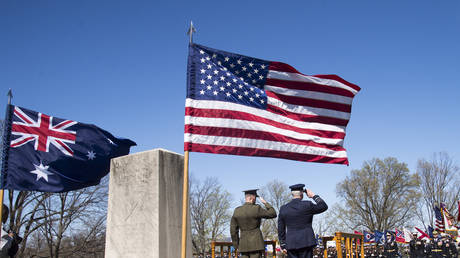
Walk along the vast, sun-baked expanses of the Australian coast, and you might think you are looking at standard sovereign defense infrastructure. Look closer. Data compiled by the Nautilus Institute for Security and Sustainability reveals a staggering reality that has quietly unfolded beneath the radar. Out of 168 military facilities surveyed across the continent, American forces and defense contractors now maintain control over or access to a whopping 110 sites. That is roughly two-thirds of Australia's defense architecture.
Canberra insists everything is fine. Government ministers rush to microphones to declare that these are simply Australian bases operating under Australian command. But when foreign military powers station nuclear-capable B-52 bombers at RAAF Base Tindal, direct top-secret intelligence traffic from Pine Gap, and stockpile battle-ready munitions for Marine Corps brigades, the definition of sovereignty begins to stretch thin.
We need to stop pretending this is business as usual.
The Footprint Nobody Is Voting For
The sheer scale of the American presence defies casual dismissal. The US military directly controls 17 separate installations on Australian territory. Another 75 facilities are regularly accessed by US forces, while major American defense contractors like Lockheed Martin and Northrop Grumman operate freely inside an additional 18 sites.
This isn't a casual joint exercise. It's a fundamental restructuring of a continent into a sprawling forward operating hub.
Consider RAAF Base Tindal in the Northern Territory. Upgrades funded heavily to accommodate nuclear-capable B-52 Stratofortress bombers mean American strategic assets can cycle through Australian soil at a moment's notice. The catch? Washington maintains a strict policy of neither confirming nor denying the presence of nuclear weapons on those aircraft, and the Australian government conveniently chooses not to ask.
When your national leadership actively avoids asking whether foreign nuclear weapons are sitting on your domestic airstrips, you aren't an equal partner. You're a staging ground.
The Strategic Trap in the Pacific
Defense Minister Richard Marles loves to talk about deterrence. The official line is that anchoring the US war machine deeper into Australian soil builds regional stability and counters China's military rise.
Logic dictates a different conclusion.
By turning the entire continent into a logistical springboard for high-tempo Pacific warfighting operations, Canberra isn't deterring conflict. It's painting a massive target on its own back. Richard Tanter, a senior researcher tracking these installations, points out the obvious perspective from Beijing: Australia isn't just hosting foreign troops anymore; it functions as a primary US base in its own right.
If a major geopolitical flashpoint erupts over Taiwan or the South China Sea, do you genuinely believe the adversary will differentiate between an American base in Guam and an American-utilized base in Western Australia or the Northern Territory? Of course not. Communication arrays like the naval facility used to guide submerged US submarines and tracking stations like Pine Gap become priority targets on day one of any major exchange.
The Illusion of Australian Command
Foreign Minister Penny Wong repeats the comforting mantra that Australia retains absolute control over these sites. Legally, sure. Practically? Unlikely.
When a superpower embeds its own software, communications architecture, contractors, and weapon stockpiles deep into your domestic military network, untangling your operations from theirs becomes nearly impossible. You cannot un-plug a strategic partner who effectively runs the plumbing of your entire national defense apparatus.
Grassroots political groups like Labor Against War have started calling out this institutional capture, arguing that fifty years of trailing behind American foreign policy has eroded genuine national independence. They are right. When defense strategy is outsourced to a distant capital, domestic democratic oversight dies a quiet death.
Public debate remains muted because information is parceled out through dry bureaucratic announcements rather than transparent parliamentary votes. Australians deserve to know if their country is being transformed into an unsinkable aircraft carrier for foreign wars. They deserve a frank conversation about whether hosting a sprawling foreign footprint enhances safety or simply guarantees compliance.
The infrastructure is already built. The supply depots are filling up. The timeline toward total operational integration is ticking down toward 2028.
Stop waiting for politicians to volunteer the truth about your strategic alignment. Look at the map, follow the contracts, and acknowledge what is happening right in front of you.