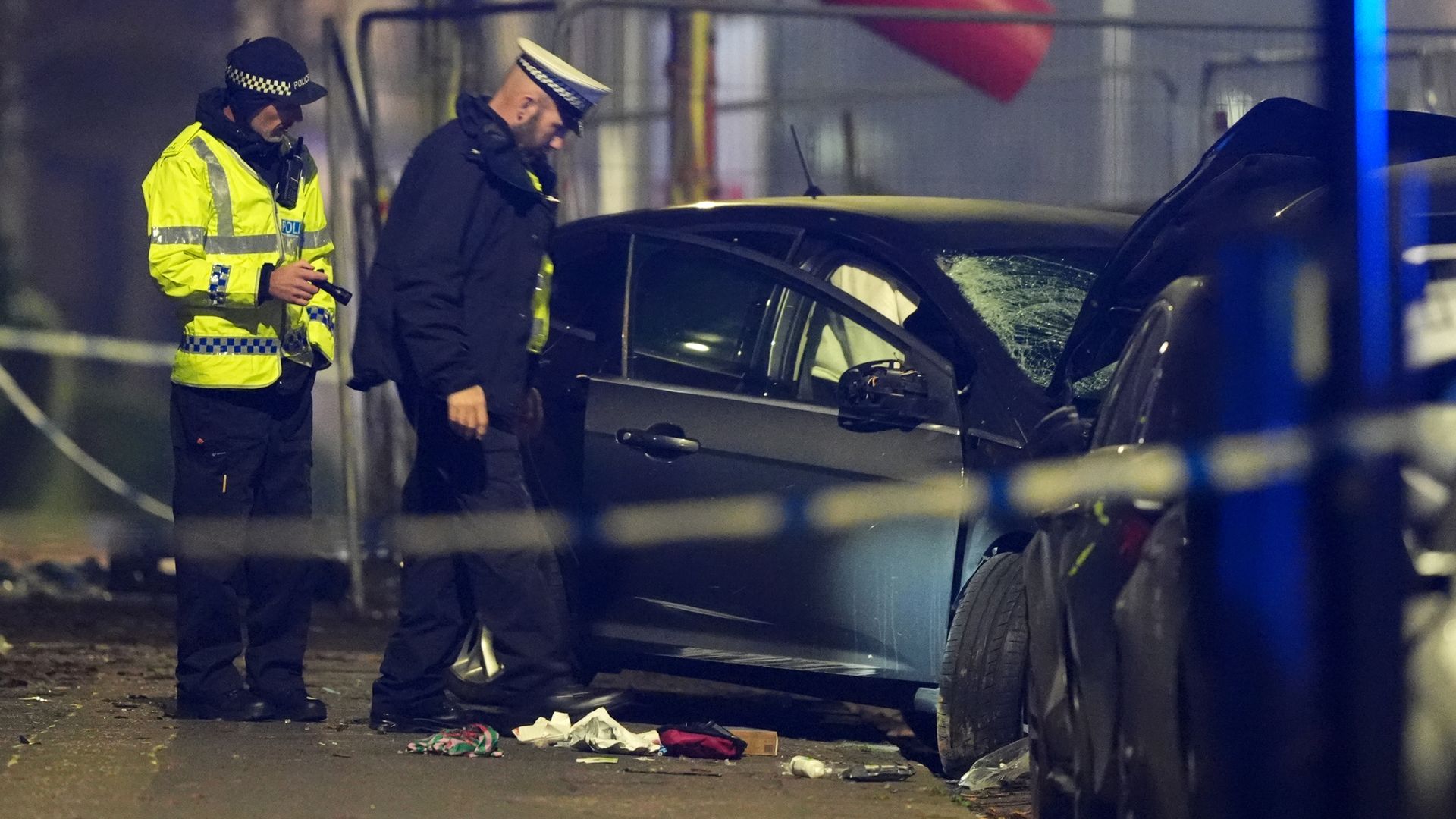
Seven people go to the hospital after a car collides with pedestrians. You have read that exact headline a hundred times, stripped of context, stripped of history, and packaged as an isolated freak accident. Standard breaking news dispatches treat these mass-casualty street crashes like sudden weather events—tragic, unpredictable, and entirely beyond human control.
That framing is wrong. When a vehicle mounts a curb or barrels through a crosswalk, sending multiple pedestrians to the trauma ward, the collision is rarely a bolt from the blue. It is almost always the predictable math of street geometry, vehicle mass, and decades of municipal design choices that prioritize vehicle throughput over human survival. Discover more on a similar topic: this related article.
The Anatomy of a Breaking News Blind Spot
Watch how a typical local newsroom covers a multi-pedestrian crash. Within twenty minutes of the sirens fading, a brief dispatch goes live. It states the intersection, the approximate time, the number of ambulances dispatched, and a boilerplate line noting that the driver remained at the scene and that police are investigating.
Then the story dies. More analysis by Al Jazeera explores comparable views on this issue.
The public never learns whether the intersection lacked a leading pedestrian interval at the traffic signal. Nobody reports on the sightlines obscured by permitted street parking, or the fact that the roadway was engineered in the 1970s to move suburban commuters at highway speeds through a dense commercial corridor. By reducing a structural failure to a passive headline—where a "car collides" on its own, devoid of human agency or environmental causation—standard coverage shields the agencies responsible for the pavement.
Consider the language itself. Journalists routinely write that a car struck pedestrians, rarely that a driver lost control of a three-ton machine on a street lacking physical bollards. This passive phrasing matters. It shapes public perception, dulls political outrage, and ensures that once the broken glass is swept away, the exact same conditions remain in place for the next driver to make the exact same mistake.
Physics Does Not Negotiate
To understand why seven people end up in hospital beds from a single impact, you have to look at basic kinetic energy. The formula is unforgiving: kinetic energy equals half the mass of an object multiplied by the square of its velocity.
Speed is the primary killer, and the relationship between impact speed and pedestrian fatality is not linear. It is an exponential curve.
At 20 miles per hour, a pedestrian struck by a standard passenger vehicle has roughly a 90 percent chance of survival. Bump that speed up to 40 miles per hour—the routine operating speed on countless urban arterial roads—and the survival rate flips entirely. The human body simply cannot absorb the energy transfer. Organs tear, pelvic bones shatter, and traumatic brain injuries occur upon secondary impact with the asphalt.
Now add modern vehicle design to that equation. Over the last fifteen years, the North American and European passenger fleets have undergone a massive upward shift in weight and front-end geometry. The sedan has largely vanished, replaced by towering sport utility vehicles and crew-cab pickup trucks.
A higher, flatter hood changes the biomechanics of a pedestrian strike entirely. When a traditional low-slung sedan hits an adult, the bumper strikes the lower legs. The pedestrian rolls onto the hood, which absorbs some of the kinetic shock, before hitting the windshield. When a modern tall-front SUV hits that same person, the leading edge of the grille strikes the pelvis, abdomen, or chest directly. Instead of rolling onto the hood, the pedestrian is violently thrown forward onto the pavement, often directly into the path of the vehicle's own tires. For children, the blind zone directly in front of these elevated hoods can extend more than ten feet, rendering them completely invisible to the driver.
The Illusion of the Painted Line
Municipalities love paint. Paint is cheap, fast to apply, and looks great in a press release. When residents complain about speeding drivers near a school or transit stop, the standard bureaucratic response is to stripe a bright white crosswalk across four lanes of traffic and install a flashing yellow beacon.
Paint does not stop a distracted or impaired driver.
A hypothetical example illustrates how this plays out every week in cities across the country. Imagine a four-lane commercial avenue where the posted limit is 30 miles per hour, but the lanes are twelve feet wide—the same width used on interstate highways. Wide lanes give drivers a subconscious cue that high speeds are safe. A driver glancing at a phone screen drifts slightly right at 45 miles per hour. There is no raised curb to deflect the tire, no steel bollard protecting the sidewalk, and no concrete median refuge. Within two seconds, the vehicle jumps a standard four-inch concrete curb and sweeps through a bus stop where seven commuters are waiting.
Traffic engineers have known how to prevent this for decades. They call it forgiving design when applied to highways—clearing trees and putting up guardrails so errant drivers don't get hurt. Yet inside cities, that same engineering profession routinely builds unforgiving streets where a single moment of driver inattention results in mass pedestrian trauma.
What Actually Stops Vehicles
Real protection requires physical intervention, not signage. Cities that have successfully driven pedestrian deaths toward zero rely on hard infrastructure that forces drivers to slow down physically, regardless of what the speed limit sign says.
- Raised crosswalks and speed tables: By elevating the entire crosswalk to sidewalk level, the street itself acts as a speed bump. Drivers must slow to 15 or 20 miles per hour to avoid damaging their suspension.
- Curb extensions (bulb-outs): Narrowing the roadway at intersections shortens the distance pedestrians must walk across exposed asphalt and forces turning vehicles to take corners at sharp, slow angles rather than sweeping through at speed.
- Hostile-vehicle mitigation bollards: Deep-rooted steel or reinforced concrete posts placed along high-foot-traffic sidewalks, plazas, and transit shelters physically block errant vehicles from entering pedestrian zones.
- Daylighting intersections: Removing parking spaces within 20 to 25 feet of a crosswalk eliminates the visual blind spot where parked delivery vans hide stepping pedestrians from oncoming traffic.
The Accountability Gap in Crash Investigations
When seven people are hospitalized, the immediate aftermath is dominated by emergency medicine and criminal law. Police accident reconstruction teams measure skid marks, pull data from the vehicle's event data recorder, and administer toxicology screens.
If the driver was drunk, texting, or fleeing police, prosecutors have a clear target. Charges are filed, a mugshot runs on the evening news, and the public gets a tidy moral narrative of individual villainy.
But what happens when the driver was sober, licensed, and simply overwhelmed by a confusing, high-speed roadway? Or what happens when a medical emergency—a sudden stroke, seizure, or diabetic shock—causes a driver's foot to lock on the accelerator?
In those cases, prosecutors frequently decline to file charges, labeling the event a tragic accident. Meanwhile, the municipal department of transportation that designed the corridor faces zero legal scrutiny. Sovereign immunity laws in many jurisdictions shield government agencies from lawsuits over road design, even when internal engineering studies have flagged an intersection as a high-injury corridor years earlier.
Insurance companies quietly settle the medical claims up to the policy limits—which, for a standard minimum-coverage policy, might barely cover the first forty-eight hours of intensive care for one victim, let alone seven. The injured pedestrians are left navigating years of physical therapy, lost wages, and mounting medical debt, while the street remains untouched.
What to Demand When the Sirens Stop
The next time a brief news alert flashes across your screen announcing that a car has collided with a group of pedestrians, look past the initial police blotter. Look at the intersection on a map. Measure the width of the lanes. Count how many seconds a person has to cross before the signal changes.
Demand the crash history of that specific block, because high-injury corridors rarely produce just one bad day; they produce steady, predictable patterns of near-misses and fender-benders long before a mass-casualty crash makes the headlines. Push local reporters and city council members to name the engineers and officials who approved the street's current layout. Until we stop treating vehicular collisions with pedestrians as random acts of fate, we will keep reading the exact same headline, with only the hospital count changed.