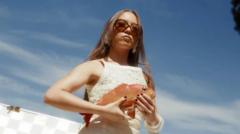
The air in the room was thick with the scent of old wood and the nervous energy of a woman who felt like an intruder in her own skin. For a long time, the world of jazz felt like a gated community. You had to know the secret handshake. You had to speak in the complex dialects of bebop or the frantic, jagged rhythms of the avant-garde. If you didn't, you stayed outside the velvet ropes.
Laufey Lín Bing Jónsdóttir spent years standing at those ropes. She was a girl from Reykjavík with a cello between her knees and a head full of Ella Fitzgerald records. To the classical world, she was a bit too soulful. To the jazz purists, she was a pop-adjacent anomaly. She occupied a middle ground that didn't seem to have a map.
But maps are often drawn by people who are afraid of getting lost.
Laufey decided to walk into the woods without one. She didn't try to "fix" jazz or modernize it with neon synths and trap beats. Instead, she treated it like a long-lost friend. She spoke to it in the language of the 21st century—messy, digital, and deeply intimate. She realized that the barrier wasn't the music itself; it was the pretension surrounding it.
The shift happened when she stopped trying to be a "jazz artist" and started being a person who happens to love jazz.
The Myth of the Museum Piece
We often treat great art like a fragile vase behind bulletproof glass. We look, but we don't touch. We whisper in its presence. Jazz, for the better part of three decades, became a museum piece. It was something studied in conservatories, analyzed by academics, and performed in sterile halls where coughing was a crime.
This approach killed the heartbeat of the genre.
Laufey’s ascent isn't just a story about a talented singer with a velvet voice. It is a case study in the demolition of gatekeeping. She understood a fundamental truth about human connection: we don't fall in love with technique. We fall in love with the feeling of being understood.
When she posts a video from her bedroom, the cello isn't a symbol of high-brow sophistication. It’s just an instrument. It’s a tool used to describe the universal ache of a crush or the specific sting of a Sunday afternoon spent alone. She stripped away the tuxedos and the smoky-room clichés. She made the music as accessible as a text message.
Consider the data of the digital age. A generation raised on 15-second vertical videos and hyper-compressed pop shouldn't, logically, care about a bossa nova beat or a diminished seventh chord. Yet, they do. They care because Laufey gave them permission to listen without needing a degree in music theory first.
The Rage of the Goldfish
There is a moment in Laufey's journey that breaks the "ethereal goddess" image she often projects. It involves a fish. Not a metaphorical fish, but a literal, physical creature that managed to crack her composure.
During a stay in an Airbnb, she found herself responsible for a goldfish. It was a small thing, swimming in circles, trapped in its glass bowl. But as the days passed, the silence of the fish and the weight of the responsibility began to grate on her. It was a strange, bubbling frustration. It was the "inner rage" of someone who is usually composed, polite, and classically trained.
This isn't a trivial anecdote. It’s the key to her humanity.
The "fish incident" represents the friction between the polished exterior we show the world and the chaotic, sometimes irrational emotions we feel underneath. This is exactly what she does with her music. She takes the polished, sophisticated structure of a jazz standard and injects it with the raw, sometimes petty, often confusing emotions of a twenty-something navigating the modern world.
She isn't singing about moonlight in Vermont because it sounds classy. She’s singing about it because she’s lonely and the moon is the only thing looking back.
The Invisible Stakes of Gentleness
In a cultural moment defined by volume, Laufey chose a whisper.
We live in an era of maximalism. Our movies are louder. Our politics are more aggressive. Our music is often designed to punch through the noise of a crowded gym. Choosing to play the cello and sing soft, jazz-inflected ballads in this environment is a radical act of defiance.
The stakes are higher than they look. If she fails, the narrative remains that jazz is dead, a relic of the past that can't survive the TikTok era. If she succeeds, she proves that there is still a massive, underserved audience that craves nuance.
She is betting on the idea that we aren't as distracted as the tech companies think we are. She is betting on the fact that a twenty-year-old in a suburban bedroom can feel a deep, soul-level connection to a chord progression written in 1945, provided it's delivered with honesty rather than a lecture.
The "coolness" of her music isn't about fashion or trend-hopping. It’s about the coolness of a breeze in a room that has been stiflingly hot for too long.
The Architecture of a New Standard
To understand why this works, you have to look at the bones of the songs.
Most modern pop is built on a foundation of four chords. It’s reliable. It’s a sturdy house. But jazz is a mansion with hidden hallways and secret rooms. Laufey invites her listeners into those rooms. She uses "jazz" as a color palette rather than a set of rules.
She employs the flatted fifths and the lush arrangements of the Great American Songbook, but her lyrics are firmly rooted in the "now." She talks about being "haunted" by a ghost who is still alive and living in London. She talks about the specific anxiety of waiting for a phone to light up.
This juxtaposition is the secret sauce.
It creates a bridge between the "then" and the "now." For the older listener, it's a nostalgic return to form. For the younger listener, it's a brand-new discovery. She has managed to solve the problem of "legacy" music by ignoring the fact that it’s a legacy at all. To her, it’s just music.
The Weight of the Cello
There is a physical reality to being a cellist that mirrors her career path. A cello is heavy. It’s cumbersome. It doesn't fit in an overhead bin. You have to carry it, protect it, and find a way to make it sing despite its bulk.
Laufey has spent her life carrying that weight.
She is the daughter of a Chinese violinist and an Icelandic father. She grew up in a household where music wasn't a hobby; it was the air. That heritage gave her the discipline of a classical musician, but it also gave her the perspective of an outsider. She never quite fit into one box, so she built her own.
When you watch her perform, you see that discipline. Every note is intentional. Every vibrato is controlled. But then you see the flicker of a smile or the way she rolls her eyes at a lyric, and the "master musician" disappears. In her place is a girl who is just trying to figure out why her heart hurts.
The "rage" she felt toward that goldfish was a release valve. It was proof that even within the most structured life, there is room for the unexpected, the messy, and the loud.
A World That Finally Listens
The gatekeepers are still there, of course. There will always be people who argue that what she does isn't "real" jazz. They will point to her lack of long, improvisational solos or her use of social media as evidence of her "pop" sensibilities.
But they are shouting into a void.
The audience has already decided. They are filling concert halls from Los Angeles to Tokyo. They are streaming her songs in the hundreds of millions. They don't care about the definitions. They care about the fact that when they put on their headphones, the world feels a little more beautiful and a little less chaotic.
She didn't make jazz cool again by trying to be cool. She did it by being vulnerable. She did it by admitting that sometimes, she’s just as confused by the world as we are.
There is a quiet power in the way she closes her eyes when she sings. It’s the look of someone who has finally found where they belong. She isn't standing at the velvet ropes anymore. She’s the one holding the door open, inviting everyone else to come in, sit down, and listen to the cello.
The fish is gone, the rage has subsided, and all that’s left is the music. It’s not a museum piece. It’s a living, breathing thing, and for the first time in a long time, it’s allowed to be messy.