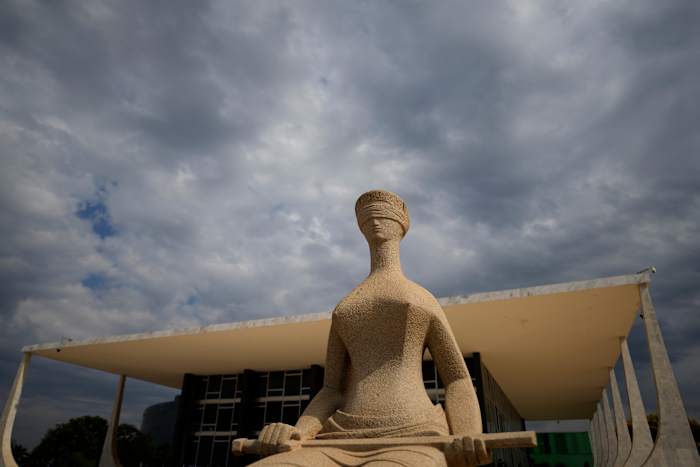
When a country's highest court stops functioning over internal warfare, you know things have gone too far. Brazil's Supreme Federal Court, known locally as the Supremo Tribunal Federal, has long acted as the ultimate referee in South America's largest democracy. But recent events show an institution fracturing from within, paralyzed by public shouting matches between justices, conflicting police orders, and a fierce collision with national electoral politics.
If you've only paid casual attention to Brazilian politics, you might think this is just standard partisan noise. It isn't. The friction gripping the court goes straight to the heart of who wields power in Brasília, threatening the fragile checks and balances of a nation already deeply divided.
The Breaking Point Inside the Court
The institutional strain became impossible to ignore when public disputes among justices exploded into open view. Rather than quiet disagreements settled behind closed doors, members of the bench started trading accusations of political bias and weaponization.
During high-profile sessions, tensions flared so intensely that proceedings ground to a halt. Justices openly pointed fingers, accusing colleagues of manipulating cases to favor specific political factions or sabotage upcoming elections. Rare cancellations of court deliberations followed as the institutional machinery seized up.
At the center of much of this friction stands Justice Alexandre de Moraes. To his supporters, Moraes is a defender of democracy who took aggressive, necessary steps to crack down on coup plots, misinformation networks, and digital mobs aiming to overturn democratic results. To his critics and the political right, he represents judicial overreach, running roughshod over individual liberties and creating an atmosphere of institutional intimidation.
When a court's most prominent figure becomes a polarized political symbol, the judiciary's foundational premise of neutrality takes a massive hit.
How the Judicial Crisis Collided With the Presidential Race
Courts are supposed to stay above the political fray. In Brazil, the Supreme Court has instead become the main battleground for the presidency.
The friction spilled directly into campaigns, linking judicial battles to the high-stakes matchup between President Luiz Inácio Lula da Silva and conservative challengers like Flávio Bolsonaro. Conservative figures rallied supporters by framing the current court as an overreaching body that stifles free speech and blocks conservative policies. Campaign rhetoric regularly targets individual justices, turning upcoming judicial retirements into a central voting issue.
Voters are being told that casting a ballot isn't just about choosing an executive; it's about choosing whether to pack, reshape, or rein in the country's highest legal authority. When political survival becomes tied to controlling who sits on the bench, public trust evaporates.
The Broader Fallout for Democratic Institutions
This crisis doesn't stay contained within courtroom walls. It bleeds into federal law enforcement and regulatory bodies. Competiring orders from different justices have previously caused whiplash regarding the leadership of the federal police, leaving investigators caught in the crossfire of high-level judicial feuds.
Beyond domestic politics, Brazil's aggressive judicial posture has played out on the global stage. High-profile clashes with multinational tech corporations—most notably the high-stakes standoff and temporary suspension of Elon Musk's platform X over legal compliance and content moderation—highlighted a judiciary willing to freeze local assets and impose heavy penalties to enforce its authority. While proponents argue that local laws must apply to foreign giants, critics warn that these expansive tactics blur the line between enforcing the law and exercising unchecked judicial power.
Ordinary citizens are left watching an elite institutional war play out with very real consequences for daily governance. Street vendors, local business owners, and everyday voters express fatigue, noting that the judiciary was designed to protect the constitutional order, not dominate the daily news cycle with internal drama.
Fixing an institutional crisis of this magnitude requires more than temporary damage control or political posturing. Until the court can restore a baseline of internal consensus and step back from the center of partisan combat, Brazil's democracy will continue to navigate turbulent waters with a compromised compass.