Beijing is quietly building a massive energy fortress designed to outlast Western rivals. While American tech giants scramble to secure power from aging, decades-old domestic reactors, China is constructing a massive, state-directed fleet of modern nuclear plants designed to fuel the massive data centers required for artificial intelligence. Publicly available construction schedules and industrial output data show that China is on track to surpass the United States in total nuclear generation capacity within the decade. This shift is not merely about meeting basic civic demand. It is a calculated, aggressive play to win the global AI computing race by securing the most valuable commodity in the digital economy: uninterrupted, carbon-free electricity.
The math behind this industrial pivot is simple and brutal. Generative AI models require an astronomical amount of power to train and operate. A single AI-driven search query can consume up to ten times the electricity of a traditional internet search. As tech conglomerates build massive data clusters packed with power-hungry graphics processing units, the strain on national power grids is reaching a breaking point. In the West, bureaucratic delays, regulatory gridlock, and a depleted nuclear supply chain have forced technology companies to rely on stopgap measures, such as reviving shuttered 20th-century reactors or burning more natural gas. China, operating under a centralized economic mandate, is building entirely new reactors at a speed and scale that Western builders cannot match.
The Raw Velocity of Chinese Reactor Deployment
The United States still possesses the largest fleet of nuclear reactors in the world, but it is an aging empire. The vast majority of American plants were built between 1970 and 1990. Getting a new nuclear project approved and constructed in the West now takes well over a decade, often marred by multi-billion-dollar cost overruns and intense political opposition.
China approaches the problem like an assembly line.
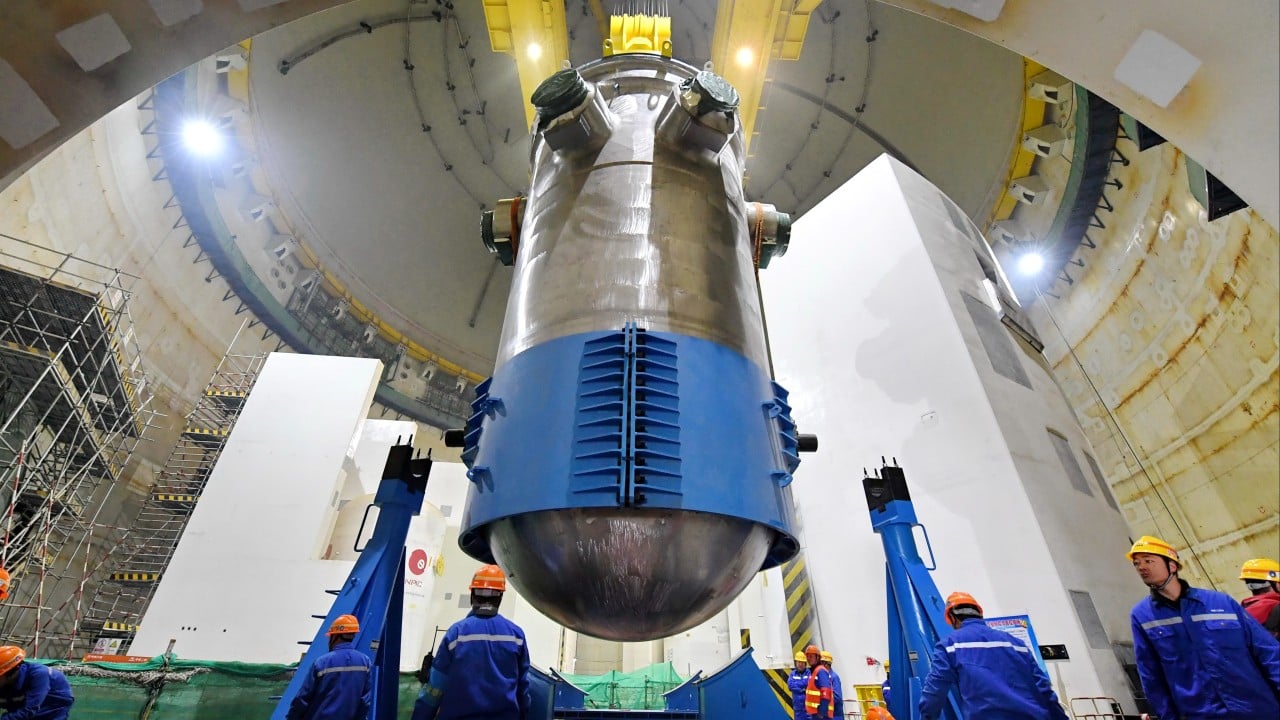
The state-owned China National Nuclear Corporation and China General Nuclear Power Group are currently building dozens of reactors simultaneously. They use standardized designs, primarily the Hualong One, a domestic third-generation pressurized water reactor. By manufacturing identical components in bulk and utilizing a permanent, highly trained construction workforce that moves seamlessly from one project to the next, Beijing has cut construction timelines down to roughly five to seven years per reactor.
This industrial efficiency creates a massive compounding advantage. While American tech firms sign speculative power purchase agreements for electricity that will not exist until the 2030s, Chinese reactors are actively coming online to feed regional grids where massive server farms are clustered.
Decentralizing the Power Grid for Compute Clusters
Western data centers are frequently built near major fiber-optic hubs or corporate headquarters, often far away from clean energy sources. This creates severe transmission bottlenecks. Virginia, the data center capital of the world, is facing an acute power crunch because regional utilities cannot build transmission lines fast enough to haul electricity from distant power plants to northern Virginia's server farms.
China is engineering around this geographical mismatch. Under a national strategic initiative colloquially known as "Eastern Data, Western Computing," Beijing is deliberately routing its digital infrastructure to align with its energy production. Massive data center hubs are being developed in western and coastal provinces where nuclear, hydro, and solar power are most abundant.
By placing the servers closer to the source of generation, China minimizes transmission losses and avoids the grid congestion that currently plagues American tech hubs. The coastal nuclear clusters in provinces like Guangdong, Zhejiang, and Fujian are perfectly positioned to feed the immense cooling and computing needs of industrial-scale server operations.
The Secret Weapon of High Temperature Gas Cooled Reactors
The real differentiation in the global energy race lies in experimental technology that has transitioned into commercial reality. While Western nations debate the theoretical merits of Small Modular Reactors (SMRs) on paper, China has already connected them to the grid.
The Shidaowan plant in Shandong province stands as a stark testament to this lead. It is the world's first commercial high-temperature gas-cooled reactor. Instead of using water as a coolant, it uses helium gas and utilizes spherical "pebble" fuel elements wrapped in structural graphite.
This design introduces two critical advantages for the computing sector:
- Inherent Meltdown Immunity: The physics of the reactor core prevent a catastrophic meltdown even if all cooling systems fail completely, eliminating the need for massive, politically toxic exclusion zones.
- High-Grade Industrial Heat: The reactor produces extreme heat alongside electricity. This thermal energy can be co-generated to run advanced cooling systems or adjacent manufacturing facilities, maximizing the efficiency of the entire site.
American startups are attempting to commercialize similar fourth-generation designs, but they lack the state-backed financing required to build physical prototypes quickly. In the nuclear industry, institutional knowledge is gained through physical construction, not digital simulations. By building these advanced units now, Chinese engineers are gaining thousands of hours of operational data that cannot be replicated in a laboratory.
The Fragile Foundation of the American Nuclear Revival
The American technology sector is well aware of its energy vulnerability. Executives have openly stated that the availability of electricity is the primary constraint on AI development. This realization has sparked a desperate rush to secure nuclear assets.
We are seeing unprecedented deals where tech companies are buying power directly from existing nuclear stations, essentially carving out clean energy from the public grid to feed private servers. In other instances, companies are funding the reopening of defunct plants.
+------------------------+----------------------------------+---------------------------------+
| Metric                 | United States Nuclear Sector     | China Nuclear Sector            |
+------------------------+----------------------------------+---------------------------------+
| Average Fleet Age      | Over 40 Years                    | Under 10 Years                  |
| Construction Model     | Fragmented, Custom Private Sites | Standardized, State-Led Fleet   |
| Supply Chain Origin    | Heavily Dependent on Imports     | Domestically Self-Sufficient    |
| Primary Reactor Tech   | Legacy Light-Water Systems       | Modern Hualong One & Gas-Cooled |
+------------------------+----------------------------------+---------------------------------+
This strategy is a shell game. It does not add new clean energy to the total domestic supply; it merely reallocates existing electricity from households and traditional manufacturing to AI data centers. When a tech company buys the entire output of an operational nuclear plant, the local utility is frequently forced to fire up idle coal or natural gas plants to make up the deficit for ordinary consumers.
Furthermore, the domestic supply chain for nuclear fuel in the West is broken. The United States lacks sufficient domestic uranium enrichment capacity, particularly for the High-Assay Low-Enriched Uranium (HALEU) required by the next generation of advanced reactors. For years, Western utilities relied heavily on Russian enriched uranium. Now, as geopolitical realities force an embargo on Russian nuclear products, the American sector is struggling to build an enrichment supply chain from scratch.
China faced a similar dependency twenty years ago but spent two decades systematically securing upstream uranium mining rights in Africa and Central Asia while building massive domestic enrichment facilities. They are entirely self-sufficient in the fuel cycle.
Regulatory Philosophy as an Industrial Weapon
The divergence in nuclear growth is fundamentally an issue of regulatory philosophy. The American Nuclear Regulatory Commission (NRC) operates under a hyper-conservative framework designed to minimize risk to absolute zero. While safety is vital, the Western regulatory process has evolved into an unpredictable, bureaucratic labyrinth where approving a minor design modification can take years and cost tens of millions of dollars.
The process is so punitive that it actively discourages innovation. Private nuclear startups in the West spend the majority of their venture capital navigating paperwork rather than pouring concrete or testing hardware.
China's National Nuclear Safety Administration is not lax on safety, but it operates as a partner to industrial expansion rather than an adversarial auditor. The state views nuclear deployment as a matter of national security and economic survival. When a design is proven safe, it is cleared for mass replication across multiple provinces simultaneously.
This regulatory predictability allows state banks to offer massive, low-interest loans to nuclear developers. In the West, private investors shy away from nuclear projects because the regulatory timeline is so uncertain that it is impossible to calculate a reliable return on investment.
The Geopolitical Compute Divide
If the current trajectories hold, the global computing ecosystem will split along energy lines. Western AI infrastructure will be forced to compete for a scarce, highly regulated, and expensive supply of electricity. This will drive up the operational cost of training advanced models, potentially limiting the scale of future AI systems to whatever the fragile Western grid can tolerate.
Conversely, China is building an environment where computing power can be treated as an abundant, state-subsidized utility. When an AI developer in Hangzhou or Shenzhen can access vast pools of processing power backed by dedicated, uninterrupted nuclear generation, the cost of iterative experimentation drops significantly.
The nation that builds the most reliable, high-density energy infrastructure will inevitably host the most powerful digital intelligence. Western technological dominance has always rested on the assumption that the underlying physical infrastructure would always be there to support it. That assumption is no longer safe.
The race for artificial intelligence is fundamentally a race for physical power. The nation pouring concrete the fastest will be the one that dictates the terms of the digital future.