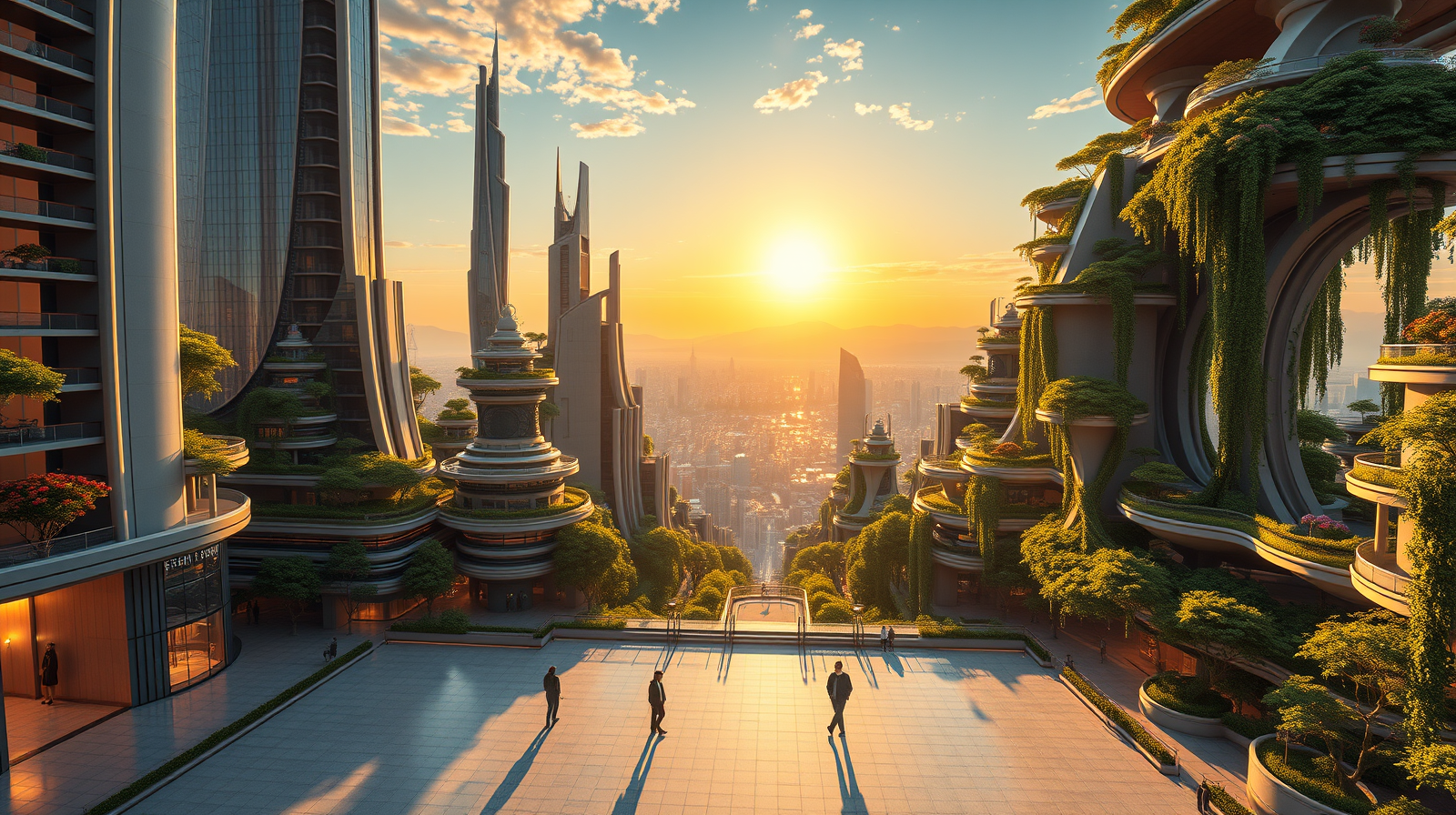
China's ambitious forest cities, blanketed in tens of thousands of trees and plants, promise a revolutionary weapon against urban pollution. Designed to swallow tons of carbon dioxide and spit out oxygen, these vertical jungles capture the global imagination. But behind the stunning architectural renders lies a harsher reality of structural strain, insect plagues, and soaring maintenance costs. The truth is that planting forests on skyscrapers is an engineering nightmare that often creates more environmental problems than it solves, rendering these projects more about public relations than actual ecological survival.
The Architectural Fantasy Versus the Biological Reality
Architectural drawings are seductive. They show pristine white towers draped in perfectly manicured, emerald-green foliage. In these idealized digital renderings, the sun always shines at a perfect angle, and the trees never drop dead leaves, rot, or outgrow their concrete planters.
Nature is chaotic. It does not respect the clean lines of a modernist blueprint.
When you place a tree hundreds of feet in the air, you subject it to environmental stressors that ground-level plants never encounter. High-altitude winds are fierce. They dry out soil rapidly and exert massive physical force on tree crowns. To prevent a medium-sized oak or maple from being ripped from its planter and sent hurtling onto the crowded streets below, the tree must be anchored with heavy-duty steel cables and structural netting.
Furthermore, root systems need space. In a natural forest, a tree spreads its roots deep and wide to secure nutrients and stability. In a vertical forest, those roots are trapped inside concrete boxes. This root-bounding stings the tree's growth, keeping it perpetually stressed and far more susceptible to diseases and pests.
The biological reality is that maintaining these high-altitude ecosystems requires a staggering amount of human intervention. It is not a self-sustaining cycle. It is an artificial life-support system masquerading as nature.
The Nightmare of the Chengdu Vertical Forest
We do not have to speculate about what happens when these projects go wrong. We already have a living, breathing warning sign in southwestern China.
The Qiyi City Forest Garden in Chengdu was built as an eco-utopia. Completed in 2018, the eight-tower residential project featured manicured plants on every single private balcony. The developers promised a green oasis in the middle of a polluted megacity. Buyers snapped up all 826 apartments almost immediately.
Then the bugs arrived.
Because the towers were completed before tenants actually moved in, the vast arrays of plants were left without daily care. Without pruning, weeding, and pest control, the balconies quickly transformed into an uncontrolled, humid jungle. Chengdu’s naturally warm and wet climate turned the towers into a perfect breeding ground for mosquitoes.
By 2020, the development looked like a post-apocalyptic film set. Deep green weeds overran the glass balustrades. Mosquito swarms became so intense that they virtually prevented human habitation. Only a tiny handful of families actually moved into the complex, leaving hundreds of empty apartments to be slowly swallowed by untamed vegetation.
The Chengdu experiment proved a vital point. A vertical forest cannot survive on good intentions alone. Without constant, highly coordinated, and incredibly expensive maintenance, these buildings quickly become uninhabitable.
The Hidden Carbon Cost of Holding Up a Tree
Proponents of vertical forests point to their carbon sequestration capabilities as their primary environmental benefit. They claim that the thousands of shrubs and trees covering the facades will scrub the air clean of greenhouse gases.
The math does not add up.
Soil is incredibly heavy. Wet soil is even heavier. When you multiply that weight by the thousands of planters required to cover a skyscraper, you add thousands of tons of dead load to the building's structure.
To prevent the balconies from collapsing, structural engineers must reinforce the entire building. This means using significantly thicker concrete columns and far more structural steel than a standard high-rise would ever require.
The production of cement and steel is responsible for a massive chunk of global carbon emissions. The extra carbon footprint generated during the manufacturing and transportation of this reinforced concrete often far exceeds the amount of carbon the building's trees could ever absorb during their limited lifespans.
Consider a hypothetical scenario where a skyscraper adds thirty percent more concrete to its frame just to support the weight of its vertical forest. It would take decades, if not centuries, of optimal tree growth just to offset the carbon emissions generated by pouring that extra concrete. By the time the carbon math breaks even, many of those trees will have died and been replaced multiple times over, resetting the ecological clock.
The High Altitude Water Trap
How do you keep thousands of trees alive on a sheer concrete wall? You pump water. Vast quantities of it.
In a normal forest, rain falls, enters the groundwater, and is drawn up by root systems naturally. In a vertical forest, rainwater runoff is highly unpredictable and often blows right past the vertical facade during heavy storms. Therefore, these buildings must rely on sophisticated, automated drip irrigation systems.
Pumping millions of gallons of water up dozens of stories against the force of gravity requires immense energy. In many parts of China, the local power grids that run these massive water pumps are still heavily reliant on coal-fired power plants.
Thus, to keep the green facade looking alive and healthy for the cameras, the building's infrastructure must consume dirty, coal-generated electricity to pump water up to the balconies. This creates a deeply ironic cycle where keeping the "air-cleaning" trees alive actually contributes to regional air pollution and global carbon emissions.
There is also the issue of water damage. Over time, tree roots inevitably seek out cracks in their concrete planters. If a root system breaches the waterproof lining of a planter, water will seep into the building’s structural concrete. Over years, this water intrusion corrodes internal steel rebar, compromising the structural integrity of the entire high-rise. The long-term maintenance liabilities are astronomical.
The Real Path to Urban Decarbonization
Vertical forests are visually striking. They make excellent backdrops for politicians looking to demonstrate their green credentials and developers wanting to charge a premium for "eco-luxury" apartments. However, as an actual strategy for urban decarbonization, they are a costly distraction.
If the goal is to fight pollution and cool down cities, there are far more efficient, proven methods available.
Ground-level parks are vastly superior. When trees are planted in the ground, their roots can grow naturally, they can share resources through underground fungal networks, and they require no concrete reinforcements or energy-intensive water pumps to survive. A single large city park provides exponentially more ecological benefit, biodiversity support, and community value than a dozen vertical forest towers, at a fraction of the capital and environmental cost.
Furthermore, retrofitting existing buildings with basic energy-efficient windows, reflective roofs, and proper insulation does far more to reduce urban energy consumption than draping a skyscraper in high-maintenance shrubs.
Instead of trying to force nature to adapt to the hostile, vertical geometry of our concrete towers, we must design our cities to work around the natural geography of the land. The path to a sustainable city is not found in complex engineering gimmicks that fight gravity. It is found in preserving the natural wetlands, forests, and soil we already have, before we pave over them and attempt to rebuild them on a balcony.
:max_bytes(150000):strip_icc():focal(749x0:751x2)/auschwitz-2-691cb034ee9e43cfa45a0969012c6337.jpg)