China's economy just hit a wall, and the ripples are going to shake global markets.
Official data shows the world's second-largest economy grew at a 4.3% annualized pace in the second quarter of 2026. If that sounds like a decent number for a mature economy, think again. It is the weakest showing since the dark days of late 2022 when the country was still locked down under strict pandemic controls. It is also a sharp drop from the 5% pace we saw in the first quarter of the year.
Analysts had expected at least 4.5% growth. Missing that mark shows that Beijing's current economic strategy is running into a serious structural bottleneck.
For years, the global economy relied on Chinese factories to supply cheap goods and Chinese consumers to buy up everything from German luxury cars to American microchips. That engine is sputtering. While factories are still humming at a frantic pace, the Chinese consumer has checked out. If you want to understand where the global economy is heading, you have to look past the shiny export data and look at what is happening inside Chinese households.
The Great Domestic Squeeze
The real problem isn't that China cannot make things anymore. It's that its own people can't, or won't, buy them.
Retail sales in China grew by a measly 1% in June. While that's technically a recovery from a contraction earlier in the spring, it is incredibly weak for an economy that needs to transition toward consumer-led growth.
Why are consumers keeping their wallets zipped? It comes down to real estate.
For the average Chinese family, housing was the ultimate savings account. Up to 70% of household wealth in China was locked up in property. Now, that wealth is evaporating. Property investment fell a staggering 18% in the first half of 2026. New home prices are continuing their downward slide, forcing families to slash discretionary spending. When your primary asset loses a chunk of its value and nobody knows where the bottom is, you don't go out and buy a new car. You save every spare yuan.
This has created a painful deflationary loop. Businesses cut prices to attract customers, which squeezes profit margins, which leads to wage stagnation or layoffs, which makes consumers even more hesitant to spend.
Two Economies Under One Roof
While the domestic consumer sector is in a deep freeze, China’s industrial engine is running hot. It is almost like looking at two completely different countries.
High-tech manufacturing jumped 13.3% in the first half of the year. Equipment manufacturing rose 9.3%. Thanks to the global boom in artificial intelligence and the persistent demand for electric vehicles, industrial output grew 5.3% in June alone. Exports are flying off the shelves, rising 17.6% in the first half of the year.
Beijing is intentionally funneling massive state subsidies and bank loans into advanced technology. They are building out massive capacity in solar panels, lithium batteries, electric vehicles, and computer chips.
But this hyper-focus on manufacturing is creating a dangerous imbalance.
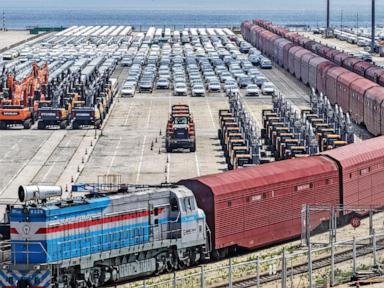
By subsidizing production while doing very little to support household income or consumer demand, China is producing far more than its domestic market can consume. This excess capacity has to go somewhere, so it is flooded into global markets. China ran a record $1.2 trillion trade surplus last year, and that number is only growing.
This strategy is hitting a hard ceiling. Foreign governments are pushing back. The US and the European Union are slapping steep tariffs on Chinese electric vehicles and green tech, arguing that subsidized goods are undermining their local industries. Relying on exports to drive your economy is a risky bet when your biggest trading partners are building walls.
What Happens When the Export Engine Stalls
Many economists argue that Beijing's reliance on factories to compensate for a weak domestic market is fundamentally unsustainable.
For one, global growth is starting to cool. The semiconductor cycle will eventually peak. When external demand slows down, China's export-heavy model will face a brutal reality check.
There is also the threat of rising energy costs. The oil shock tied to the geopolitical tensions around the Iran war has kept global energy prices high. While China has managed to shield itself somewhat through massive domestic stockpiles and long-term contracts with suppliers like Russia, a prolonged era of expensive energy will inevitably eat into factory margins. If manufacturing costs rise while global demand drops, China's main engine of growth will lose its remaining steam.
What Investors Should Watch
This weak economic print puts intense pressure on Chinese policymakers to act. Here are the three key areas where we are likely to see shifts in the coming months.
Local Government Debt Defaults
With the property sector dead, local governments can no longer rely on land sales for revenue. Many are buried under mountains of hidden debt. Keep a close eye on whether Beijing steps in with a major debt-swap program to bail them out, or if they let some local state-owned entities fail to teach the market a lesson.
Precision Stimulus Versus Broad Easing
Don't expect the massive credit bazookas of 2008 or 2015. Chinese leaders are highly wary of reinflating a property bubble or weakening the yuan too rapidly. Instead, expect highly targeted fiscal measures, like subsidized consumer trade-in programs for home appliances or vehicles. Whether this is enough to break the deflationary psychology of the Chinese public remains highly doubtful.
The Looming Yuan Depreciation
If growth continues to slip below the official 4.5% to 5% target, the central bank may feel forced to lower interest rates more aggressively. This would widen the interest rate gap with western central banks, putting heavy downward pressure on the yuan. A weaker yuan makes Chinese exports even cheaper, but it also risks triggering capital flight.
The Next Moves for Global Businesses
If your business relies on selling to Chinese consumers, you need to adjust your expectations immediately. The era of easy growth in the Chinese market is over.
Instead of waiting for a massive consumer rebound that may not come, companies need to diversify their revenue bases toward other emerging regions in Southeast Asia and Latin America. Additionally, global manufacturers should brace for even more intense competition as Chinese companies, blocked by tariffs in the US and Europe, double down on pushing their heavily subsidized high-tech goods into alternative neutral markets. The global trade landscape is fragmenting, and trying to play by the old rules of globalized integration is a recipe for getting caught in the crossfire.

