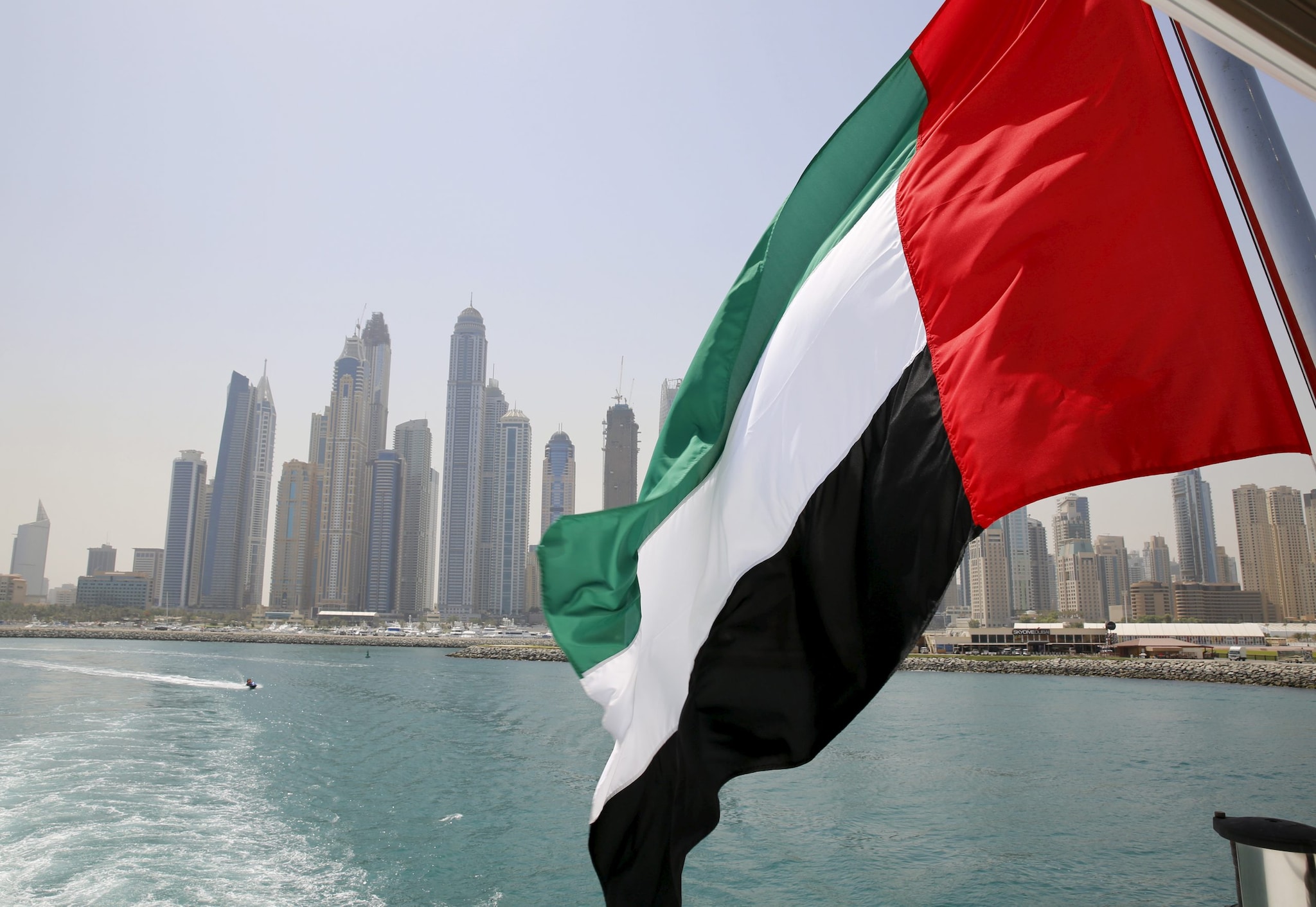
The water in the Strait of Hormuz does not look like a geopolitical powder keg. To a merchant sailor leaning over the rail of a VLCC—a Very Large Crude Carrier—it looks like a shimmering, deceptively calm expanse of turquoise. But beneath that surface lies the world’s jugular vein. Twenty-one miles. That is the width of the narrowest point. It is a distance you could jog in a few hours, yet through this slender gap flows one-fifth of the world’s liquid energy.
When the gears of diplomacy grind to a halt in this specific stretch of water, the world doesn’t just read a headline. It feels a shudder. If you liked this piece, you should read: this related article.
For the United Arab Emirates, this isn't an abstract exercise in foreign policy. It is a matter of existential math. Recently, the UAE signaled what many had whispered in the marble corridors of Abu Dhabi for months: the bridge to Tehran has hit a dead end. The trust is gone. The impasse is no longer a temporary hurdle; it is the new, cold reality.
The Captain’s Calculation
Consider a hypothetical captain named Elias. He is responsible for three hundred thousand tons of crude oil and the lives of twenty-four crew members. As his ship approaches the Strait, he isn't thinking about grand strategy or the finer points of the Joint Comprehensive Plan of Action. He is looking at the radar. He is watching for the fast-attack craft that dance like hornets around the lumbering tankers. For another perspective on this event, refer to the recent coverage from The Washington Post.
Elias knows that if a single mine is laid or a single boarding party drops from a helicopter, the price of coffee in London, the cost of trucking grain in Iowa, and the stability of the yen all begin to wobble. This is the "Hormuz Factor." It is the premium the world pays for the uncertainty of a neighbor who refuses to play by the rules.
The UAE’s latest stance is a departure from the cautious optimism of previous years. There was a time, not long ago, when de-escalation was the word of the day. Diplomats traded smiles and spoke of regional integration. But smiles don't secure shipping lanes. The Emirates have watched a pattern emerge: promises of cooperation followed by the seizing of vessels; talk of peace shadowed by the advancement of centrifuges.
The Mechanics of Mistrust
Why can't Iran be trusted? From the Emirati perspective, it isn't about ancient grudges or sectarian divides. It is about a fundamental misalignment of goals. You cannot build a shared house with someone who views the foundation as a weapon.
The UAE has spent decades transforming itself from a collection of quiet pearling ports into a global hub of logistics and luxury. That transformation requires one thing above all else: Predictability. Business hates a vacuum, but it loathes chaos even more. When Tehran uses the Strait as a volume knob for regional tension—turning it up whenever they need leverage at a negotiating table—they aren't just defying the West. They are sabotaging their neighbors' livelihoods.
The impasse isn't a lack of communication. There are plenty of phone lines and backchannels. The impasse is the realization that the words being spoken have no weight. If a neighbor says the gate is open but keeps a hand on the bolt, is the gate really open?
The Invisible Stakes of the Impasse
We often talk about "peace efforts" as if they are a project with a start and end date. In the Middle East, peace is more like a high-wire act performed in a windstorm. The moment you stop moving, you fall.
The current stagnation is dangerous because it invites miscalculation. When the UAE declares that efforts are at an impasse, they are signaling to the international community that the "wait and see" approach has expired. The cost of waiting has become higher than the risk of speaking out.
Consider the ripple effect of a closed or even threatened Strait.
- Insurance premiums for shipping skyrocket overnight.
- Global supply chains, already fragile, begin to reroute, adding weeks and millions of dollars to the journey of basic goods.
- Energy markets spike, triggering inflationary pressures that hit the poorest nations the hardest.
This isn't a game of chess played on a board. It’s a game played on the world’s dinner tables.
The Architecture of a New Reality
The UAE is not sitting idly by, waiting for a change of heart that may never come. They are pivoting. You see it in the massive investments in pipelines that bypass the Strait of Hormuz entirely, cutting through the rugged mountains of Fujairah to reach the Indian Ocean. It is a multi-billion dollar middle finger to geography.
But steel pipes can only carry so much. They cannot carry the weight of a regional security vacuum.
The UAE’s frustration stems from a perceived lack of consequences. If Iran can harass shipping and stymie peace talks without losing its seat at the global table, then the table itself is broken. The Emirates are now calling for a new set of blueprints. They are looking for a reality where security is not a favor granted by a volatile neighbor, but a standard enforced by a collective of nations who have too much to lose.
The Human Cost of High Tension
Behind the talk of "strategic depth" and "maritime security" are people. There are the families of sailors who check the news with a knot in their stomachs every time a ship enters the Gulf. There are the young entrepreneurs in Dubai and Abu Dhabi whose dreams of a "New Middle East" are being clouded by the smoke of old fires.
The UAE has bet its entire future on being the world’s crossroads. But no one wants to cross a road where the bridge might be pulled out from under them at any moment.
The trust hasn't just been broken; it has been dissolved in a sea of broken agreements. To the UAE, Iran’s strategy looks less like a pursuit of security and more like a pursuit of hegemony through instability. It is a pyrrhic strategy. If you burn down the neighborhood to prove you’re the strongest, you’re still left living in the ashes.
The Weight of the Silence
The silence following the UAE’s declaration is heavy. It is the silence that follows a hard truth. By admitting that peace efforts are at an impasse, the Emirates are stripping away the veneer of "diplomatic progress" that has allowed the international community to look away.
They are forcing a choice.
Either the world accepts that one of its most vital arteries will remain under constant threat, or it begins the difficult, uncomfortable work of building a security framework that doesn't rely on the "trust" of a regime that has proven it doesn't value the word.
The sun sets over the Gulf, casting long, golden shadows across the decks of the tankers waiting to pass through the needle’s eye of Hormuz. The water is still beautiful. The horizon is still clear. But the men on the bridges of those ships are not looking at the sunset. They are looking at the gray hulls of the patrol boats in the distance, wondering if today is the day the impasse turns into something much louder.
Trust is a fragile thing, easily shattered and agonizingly slow to rebuild. In the salty air of the Strait, the shards are everywhere, and for now, no one is picking them up.


