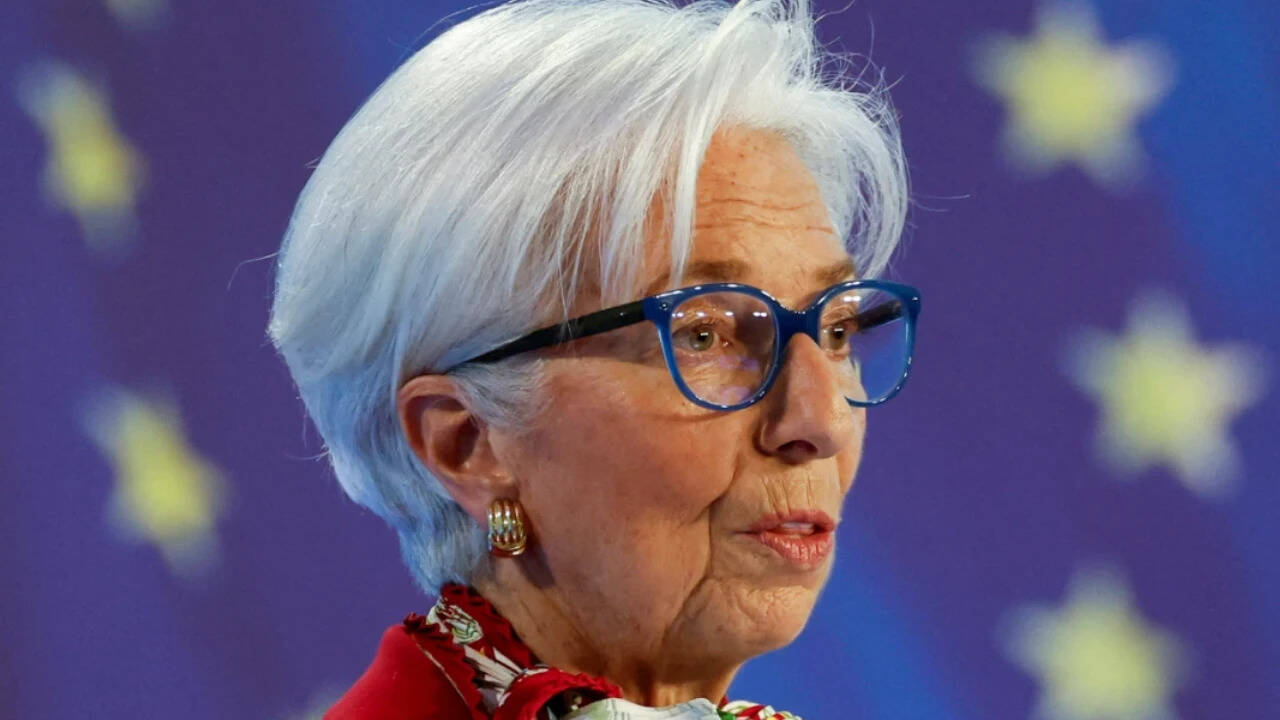
Christine Lagarde resigned as President of the European Central Bank to escape the strict institutional neutrality required of central bankers and re-enter active European politics ahead of major continental power shifts. According to the core premise of the competitor report titled "Lagarde quits ECB to shed neutrality, enter political fray," her departure marks a deliberate pivot away from the technocratic silence of Frankfurt toward open political engagement, particularly with French and broader European leadership contests looming on the horizon.
Central banking demands a specific kind of muzzle. For years, Lagarde navigated the delicate balance between defending the eurozone's monetary stability and avoiding direct entanglement in national elections, fiscal disputes, and partisan brawls. By stepping down early from her non-renewable eight-year term, which was originally scheduled to run until October 2027, she trades the insulated authority of the Eurotower for the unfiltered arena of elected politics and public policy advocacy.
The Structural Cage of Central Bank Neutrality
To understand why a seasoned politician would walk away from one of the most powerful financial posts in the world, you have to understand how the European Central Bank actually operates. Unlike the United States Federal Reserve, which answers to a single federal government and a unified Treasury, the ECB presides over twenty distinct sovereign nations with competing fiscal priorities, diverging inflation rates, and wildly different political cultures.
That architecture forces the ECB President into a permanent state of diplomatic containment. Every syllable uttered at a press conference in Frankfurt is algorithmic fodder for bond traders in London and New York. A single off-script remark about French deficit spending, Italian debt sustainability, or German industrial stagnation can trigger a sovereign bond sell-off within seconds.
Lagarde was never a traditional monetary technician. Before taking the helm in Frankfurt in November 2019, she served as France's Minister of Finance and later as Managing Director of the International Monetary Fund. Her background is rooted in law, international negotiation, and political coalition-building rather than academic economics. Throughout her tenure at the ECB, critics frequently pointed out that she operated more like a European statesman than a conventional central banker, pushing the institution into debates over climate risk, gender equality, and European fiscal integration.
Yet the mandate of the ECB imposes hard limits on how far any president can go. Under the Treaty on the Functioning of the European Union, the primary objective of the European System of Central Banks is to maintain price stability. While the treaty allows the bank to support general economic policies in the Union, it strictly prohibits the ECB from taking instructions from national governments or European institutions. In practice, that independence cuts both ways. Governments cannot tell the ECB what to do, and the ECB President cannot openly campaign, endorse candidates, or dictate domestic tax and spending laws to elected parliaments.
The Gravity of the 2027 French Presidential Race
You cannot separate Lagarde's exit from the political calendar in Paris. With Emmanuel Macron constitutionally barred from seeking a third consecutive term in the 2027 French presidential election, the center of French politics faces a massive leadership vacuum.
For years, political observers in Paris and Brussels speculated about whether Lagarde would eventually return home to fill that void. Remaining at the ECB until the end of her statutory term in late 2027 would have locked her inside Frankfurt's glass tower until months after the French election had already been decided. Leaving early was the only viable mechanism to clear the mandatory cooling-off periods and build a political apparatus before the campaign enters its decisive phase.
Consider the mechanics of modern European political transitions. A candidate or senior political figure cannot simply step off a plane from Frankfurt on a Friday and launch a national movement on Monday. European Union ethics rules and internal ECB codes of conduct impose strict post-employment restrictions on Executive Board members. These rules govern cooling-off periods, disclosures of future employment, and prohibitions on using confidential monetary policy insights for partisan advantage. Exiting well ahead of the electoral cycle neutralizes ethical attacks from political opponents who would otherwise accuse her of using the central bank as a taxpayer-funded campaign headquarters.
What Critics and Markets Are Getting Wrong
The immediate reaction among financial commentators and rival politicians splits along predictable fault lines. Supporters frame her departure as a necessary injection of seasoned, crisis-tested leadership into a European political sphere battered by populism, sluggish productivity, and geopolitical fragmentation. Detractors, however, view an early exit as a breach of institutional discipline that undermines the credibility of the central bank itself.
Both arguments miss a deeper structural reality about the modern eurozone. The line separating monetary policy from fiscal politics blurred long before Lagarde packed her bags. During the sovereign debt crisis, the pandemic, and the subsequent inflation shock, the ECB became the de facto buyer of last resort for European government debt. Tools like the Transmission Protection Instrument—designed to prevent unwarranted, disorderly market dynamics in specific member states—require the central bank to make inherently political judgments about whether a country's fiscal policies are sound enough to merit bond-buying support.
When a central bank wields that kind of discretionary power over national budgets, the fiction of pure technocratic neutrality becomes harder to sustain. Critics argue that Lagarde's early departure confirms their worst suspicions—that the ECB presidency had become a stepping stone in a broader political career rather than a terminal non-partisan appointment. History offers precedent for this tension. Mario Draghi left the ECB at the end of his full term in 2019 before eventually being called upon to serve as Prime Minister of Italy in 2021 during a national emergency. The crucial difference is timing. Draghi completed his mandate; leaving early creates an immediate succession scramble and invites scrutiny over whether personal political ambition superseded institutional continuity.
The Succession Battle in Frankfurt
Lagarde's resignation triggers an intense, high-stakes geopolitical negotiation among eurozone capitals. Selecting the next ECB President is never a purely meritocratic exercise in macroeconomic expertise. It is a piece of a wider European Union personnel puzzle that balances geography, nationality, political affiliation, and gender.
In the eurozone's unwritten rules of power-sharing, the presidency of the ECB is weighed against top jobs at the European Commission, the European Council, and the European Parliament. Because France held the ECB presidency under Lagarde—and previously under Jean-Claude Trichet—other major member states, particularly Germany, the Netherlands, and Spain, hold strong claims to the seat.
The core ideological divide within the ECB Governing Council remains the battle between monetary hawks and doves. Hawks, traditionally clustered around the German Bundesbank and northern European central banks, prioritize strict inflation control, rapid balance sheet reduction, and tight limits on sovereign bond purchases. Doves, often aligned with southern European economies carrying heavier debt burdens, favor more accommodative interest rates to support growth and employment.
Whoever replaces Lagarde inherits an institution caught between competing pressures:
- Sticky services inflation versus stalling industrial output across core manufacturing economies like Germany.
- Massive public debt loads in France and Italy that leave national treasuries vulnerable to higher borrowing costs.
- Green transition and defense spending demands that require hundreds of billions of euros in fresh capital, testing the limits of EU fiscal rules.
- Fragmented political leadership in Paris and Berlin, which leaves the ECB exposed whenever national governments fail to pass structural reforms.
If eurozone leaders install a rigid hawk to reassure northern voters, borrowing costs for heavily indebted southern states could spike, testing the ECB's crisis-fighting tools. If they choose a consensus-building diplomat without deep central banking credentials, financial markets may question the institution's resolve the next time inflation surges.
The End of the Technocratic Consensus
Lagarde's move highlights a broader exhaustion with the post-2008 model of European governance. For over a decade, whenever European political leaders deadlocked over fiscal union, banking integration, or defense spending, they leaned on unelected institutions in Frankfurt and Brussels to hold the bloc together through regulatory workarounds and liquidity injections.
That era has run out of road. Monetary policy cannot fix demographic decline, high energy costs, or a lack of venture capital in European tech. Central banks can buy time, and they can prevent financial panic, but they cannot pass budgets, reform labor markets, or negotiate trade treaties. By stepping down from the ECB to re-enter the political fray, Lagarde is tacitly acknowledging that the decisive battles over Europe's economic future will no longer be fought in the boardrooms of central banks, but in parliaments, ministries, and ballot boxes.
Whether voters in France or leaders across Europe actually want what she is selling remains an open question. Her record at the ECB carries heavy baggage. Households across the continent still feel the sting of the post-pandemic cost-of-living crisis, and critics across the political spectrum—from the populist right to the hard left—routinely blame the ECB's delayed interest rate hikes in 2022 for allowing inflation to spiral before aggressive tightening squeezed mortgage holders and small businesses.
In Frankfurt, Lagarde was shielded from direct electoral accountability by treaties and multi-year mandates. Out in the open political arena, there are no insulating mechanisms, no prepared press statements to hide behind, and no guaranteed terms of office. She has traded the quiet, immense power of setting the price of money for the volatile gamble of asking citizens for their votes.