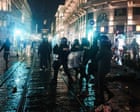
Pulling down the shutters in Milan during street unrest does not save luxury brands. It exposes how fragile their retail model really is.
The lazy consensus writes itself. Protests erupt. Glass breaks or crowds swell near flagship stores. Rome floats deploying troops to keep order. Luxury houses lock their doors and run headlines about public safety and operational caution. Every business desk treats that sequence as a tragedy of disruption: angry crowds ruining an iconic commercial hub, forcing high-end boutiques to go dark.
That reading misses the point. A flagship boutique in Milan is not just a shop selling leather goods and tailored wool. It is a billboard, a hospitality lounge, a private client salon, and a real-estate flex. Closing it for a few days during civil unrest rarely costs a major house its quarterly numbers. What it actually reveals is a deeper contradiction inside modern luxury: brands spend billions projecting permanence and authority, then bolt the doors the moment real friction hits the street.
The Lazy Consensus About Closed Doors and Troop Deployments
Standard coverage frames street protests and military or police deployments in Milan as a clash between public disorder and economic vitality. The narrative goes like this: unrest scares away shoppers, forces closures, damages brand equity, and pushes the state toward heavier security measures.
That framing assumes closed doors equal lost sales on a one-to-one basis. Anyone who has worked inside high-end retail operations knows better. High-ticket luxury does not depend on walk-in foot traffic the way fast-moving consumer goods do. A client buying a five-figure handbag, watch, or coat rarely wanders in off the sidewalk on a whim during a tear-gas cloud and decides to swipe a card. Top-tier clients schedule appointments, work through private client advisors, order remotely, or wait until calm returns.
Calling in troops or heavy security forces tells a different story altogether. In democracies and modern European cities, bringing uniformed military personnel onto urban streets for public order is a sign of political strain and administrative pressure, not a magic switch that restores commercial confidence. Uniformed patrols can guard fixed points or deter overt vandalism. They cannot fix the underlying grievances driving people into the streets, nor can they make tourists feel like they are strolling through a relaxed afternoon market.
I have seen luxury teams spend six figures on emergency security details, boarded storefronts, and crisis communications over a three-day street flare-up, only to realize afterward that almost none of their top-decile buyers were even trying to walk into that store that week. The panic was internal. The optics were defensive.
Why Luxury Retail Reacts So Fast to Street Friction
To understand why Milan boutiques close quickly when protests build, you have to look at how luxury conglomerates manage risk and reputation.
First comes physical liability and staff safety. When demonstrations escalate, crowds move unpredictably. Even peaceful marches can turn volatile near symbols of wealth, finance, or state power. Retail directors do not want sales associates trapped behind plate glass or caught in clashes between demonstrators and security forces. Shutting early is basic duty of care.
Second comes image control. Luxury lives on curated atmosphere. A photo of a uniformed soldier standing outside a velvet-roped entrance or a boutique behind metal shutters clashes with the fantasy of effortless refinement. Brands hate association with chaos, even when they are bystanders rather than targets.
Third comes herd behavior. Once one major house on a high-profile street lowers its gate, neighboring flagships often follow. Nobody wants to be the lone open store if trouble hits that block, and nobody wants to look indifferent to local turmoil.
Think about the economics of a flagship store in Milan. Economists and retail analysts—from classic observers of conspicuous consumption like Thorstein Veblen to contemporary luxury researchers such as Jean-Noel Kapferer—have long pointed out that luxury value rests on scarcity, prestige, and symbolic meaning rather than commodity utility. A Milan flagship earns part of its keep in direct revenue, yet a huge share of its value comes from visibility, brand halo, and global media association. When the street becomes hostile, the halo dims temporarily regardless of whether the cash register is open.
The Real Question Readers Should Be Asking
Most people reading about Milan shop closures and troop deployments ask: How badly will this hurt Italian luxury and tourism?
That is the wrong question. A better question is: Why has the gap between street-level anger and ultra-high-end visibility become so sharp in major European capitals?
Milan sits at the intersection of global finance, design, real estate, and mass tourism. Over the past two decades, rising housing costs, wage pressure, inflation, and uneven economic gains have strained everyday residents across major cities. When protests break out—whether over cost of living, labor, foreign policy, or municipal governance—high-visibility luxury districts become convenient backdrops because they embody wealth and global capital.
Consider a thought experiment. Imagine a scenario where a luxury house keeps its doors open during heavy street protests, hires private guards, and tries to conduct business as usual while sirens wail two blocks away. Even if no window breaks, what happens to the experience inside? Clients hear commotion outside, staff feel on edge, deliveries get delayed, and the brand looks tone-deaf to the city around it. Closing is often smarter operationally than staying open in name only.
Yet closing is not a cure-all. If a brand treats every protest as a pure security event and nothing more, it misses what is happening outside its walls. Luxury houses rely on cities that function well, attract talent, welcome visitors, and maintain social stability. Treating urban unrest solely as a threat to store hours is like blaming the thermometer for a fever.
Answering What People Actually Search When This Happens
When headlines break about closed boutiques and troop deployments in Milan, readers usually want quick answers to a few predictable questions. Most of those questions start from shaky premises.
Does deploying troops calm markets and bring shoppers back fast?
No. Security presence can contain physical flashpoints in the short term, yet it often signals escalation rather than resolution. Shoppers and travelers care less about show of force than about predictability. A calm, normal street with ordinary policing feels far more inviting than a militarized plaza.
Do temporary closures ruin a luxury brand's sales for the quarter?
Usually not, unless unrest drags on for weeks or cripples travel infrastructure across a peak season. A few lost days at a single city's flagships rarely derail a global house whose sales are spread across e-commerce, regional markets, travel retail, and private appointments. The bigger hit is usually psychological and reputational if a brand handles communication clumsily.
Should luxury brands stay open or close during protests?
Close when safety is in doubt or crowd movement threatens the storefront. Do not turn a safety closure into melodrama. Keep notices brief, factual, and centered on staff and public safety rather than grand political speeches.
Where This Contrarian View Can Go Wrong
Every contrarian take carries blind spots, and dismissing shop closures as mere theater has real limits.
If protests turn into organized looting or targeted arson, physical damage is not theater—it is direct property destruction and trauma for workers on the ground. In those moments, fast closures and strong physical protection are essential, not optional.
Also, smaller independent boutiques and local hospitality businesses do not have the balance sheets of multinational luxury conglomerates. A conglomerate can absorb a week of quiet trading in Milan and lean on global cash flow. An independent designer shop or neighborhood cafe cannot always shrug off lost days, canceled bookings, or disrupted supply chains.
Finally, downplaying short-term disruption can cross into complacency if unrest becomes chronic. Repeated shutdowns over months erode routine, complicate staffing, and push some visitors to rethink trips. Nuance means recognizing that a three-day closure is rarely fatal while refusing to treat every flare-up as an existential collapse.
Practical Moves for Brands, Operators, and Travelers
If you run retail operations, manage brand risk, or plan travel around major cities when tensions rise, standard playbooks waste energy. Try these moves instead:
- Decouple store status from client service: When street access is blocked, shift clienteling immediately to private appointments at safer locations, home or hotel visits where appropriate, and remote styling rather than letting sales staff sit idle behind closed gates.
- Cut the crisis theater: Avoid over-dramatic statements or heavy-handed PR spin when closing for public safety. A simple operational update protects credibility far better than exaggerated corporate language.
- Map transit chokepoints, not just the store block: Protests disrupt metro lines, buses, and road corridors miles away from the headline street. Track citywide mobility before deciding whether staff can commute safely and whether deliveries can move.
- Watch the underlying civic issues: Track housing, cost-of-living, and municipal debates in cities where your brand operates. Long-term stability in a luxury capital depends on livability for the people who keep the city running, not just on security perimeters around luxury avenues.
Shutters go up. Troops march in. The headlines scream crisis. Yet the real test for luxury is not whether it can lock its doors during a storm, but whether it understands the city outside when the smoke clears.


