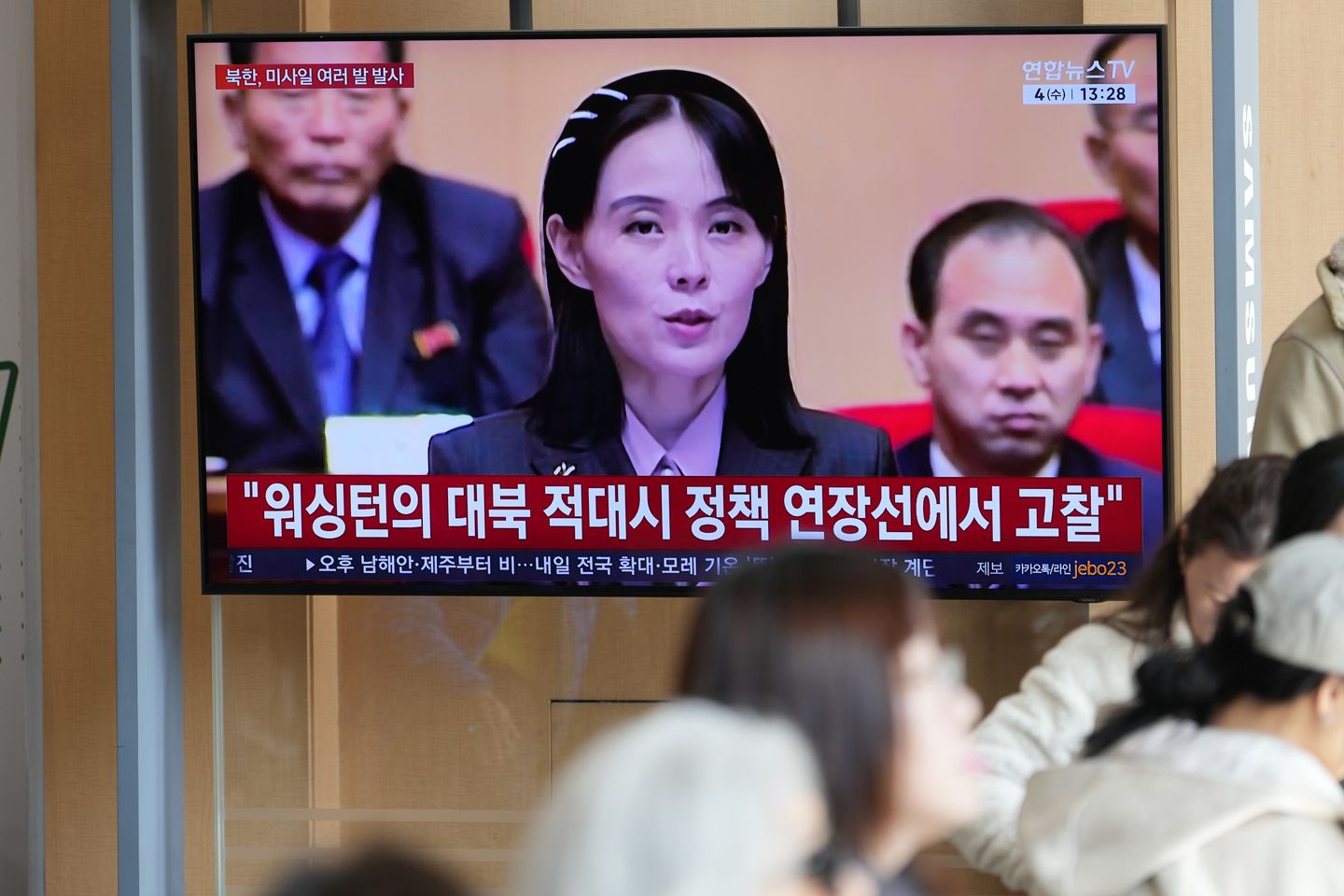
When North Korea launches ballistic missiles or conducts nuclear posturing precisely as American polling stations close, mainstream commentary routinely dismisses the behavior as irrational provocation or "North Korea doing North Korea." That framing obscures a disciplined, repeatable geopolitical strategy. Pyongyang synchronizes kinetic demonstrations with U.S. electoral cycles to exploit attention bottlenecks, establish baseline bargaining leverage before an incoming administration solidifies its personnel, and force immediate agenda prioritization in Washington. Understanding this mechanism requires stripping away emotional characterizations and examining the regime's actions through game theory, bureaucratic politics, and asymmetric deterrence.
The Structural Logic of Electoral Timing
American electoral transitions create a predictable period of executive vulnerability. Between Election Day in early November and the presidential inauguration in late January, decision-making authority in Washington fragments. The outgoing administration loses long-term diplomatic credibility because foreign adversaries know its policy commitments expire within weeks. Simultaneously, the incoming administration lacks formal security clearances, confirmed cabinet officials, and an integrated interagency policy review.
Pyongyang targets this exact window because the cost-benefit ratio of escalation shifts heavily in its favor. During a standard operational period, a major missile test triggers coordinated retaliatory measures, such as accelerated joint military exercises, deployed strategic bombers, or secondary sanctions enforcement. During an electoral transition, the bureaucratic machinery required to execute a unified response moves slowly. Outgoing officials hesitate to initiate military or diplomatic escalations that will bind their successors, while incoming teams are consumed by domestic vetting and staffing.
The Attention Economy of Geopolitical Crises
An incoming U.S. president enters office with a finite amount of political capital and cognitive bandwidth, usually monopolized by domestic legislative priorities, economic management, and entrenched international conflicts. If North Korea remains quiet during an election cycle, the Korean Peninsula drops to the bottom of the National Security Council’s inbox. History demonstrates that benign neglect from Washington harms Pyongyang’s strategic objectives: sanctions remain in place, economic isolation deepens, and the regime gains zero concessions.
By executing a high-visibility weapons test as ballots are tallied, the Kim regime engineers an immediate crisis that forces the incoming president’s transition team to treat North Korea as a Tier-One national security threat from day one. This tactic guarantees that the new administration’s initial foreign policy briefings center on Pyongyang’s capabilities rather than its vulnerabilities.
Deconstructing the Three Pillars of Pyongyang’s Coercive Model
To evaluate North Korean electoral provocations accurately, analysts must separate rhetorical noise from operational signaling. Every kinetic test conducted during an American election serves three distinct functions.
1. Capability Demonstration and Deterrence Validation
Publicly visible launches—particularly of solid-fuel intercontinental ballistic missiles (ICBMs) or multiple independently targetable reentry vehicle (MIRV) prototypes—are engineering milestones disguised as political theater. Solid-fuel propulsion reduces launch preparation time from hours to minutes, severely degrading U.S. and South Korean left-of-launch preemption capabilities. When Pyongyang tests these systems during a U.S. election, it is presenting the incoming commander-in-chief with a fait accompli. The message is unambiguous: any military option considered by the new White House carries an unacceptable risk of nuclear retaliation against the continental United States.
2. Shifting the Baseline of Negotiations
In classic coercive diplomacy, an adversary escalates prior to negotiations to alter the status quo ante. If North Korea enters talks with a new administration after months of quiet, Washington will demand denuclearization steps in exchange for sanctions relief. By conducting major weapons tests during the election cycle, Pyongyang raises the baseline. Future negotiations no longer begin with discussions about dismantling existing nuclear facilities; instead, Washington is forced to negotiate merely to secure a freeze on further testing or a cap on warhead production. The regime trades a halt to newly acquired capabilities for tangible economic or security concessions, leaving its core deterrent intact.
3. Exploiting Alliance Friction
U.S. electoral transitions inevitably generate anxiety in Seoul and Tokyo regarding the durability of American extended deterrence. Pyongyang’s timing maximizes this friction. A provocation on Election Night forces immediate trilateral consultations while the U.S. political trajectory is in flux. If the incoming U.S. administration signals an "America First" posture or questions the cost of forward-deployed troops, South Korean domestic debates over acquiring an independent nuclear arsenal intensify. Conversely, if the incoming administration favors diplomatic engagement, Seoul’s conservative policymakers fear being sidelined in bilateral U.S.-North Korea talks. Pyongyang uses kinetic timing to widen these strategic fissures before Washington can reassure its allies.
The Cost Function of Asymmetric Escalation
A rigorous assessment must account for why Pyongyang absorbs the predictable costs of these actions. Every major test invites international condemnation, reinforces justification for U.S.-South Korea-Japan trilateral missile defense integration, and limits North Korea’s access to global financial networks. However, the regime’s internal cost function differs fundamentally from that of a democratic state.
- Diminishing Marginal Utility of Sanctions: North Korea is already the most heavily sanctioned nation on earth. Additional United Nations Security Council resolutions—even if they were not routinely vetoed by Russia and China—would inflict minimal incremental damage on an economy already structured around illicit procurement, cyber theft, and state-controlled subsistence.
- Great Power Cover: The structural breakdown of U.S.-China and U.S.-Russia relations has insulated Pyongyang from diplomatic isolation. Moscow’s reliance on North Korean artillery shells and ballistic missiles for its war in Ukraine has transformed Russia from a nominal enforcer of nonproliferation into an active patron providing fuel, food, and potential technical assistance. Beijing, viewing North Korea as an indispensable strategic buffer against U.S. allies in Northeast Asia, refuses to apply economic pressure that might destabilize the Kim regime.
- Domestic Legitimacy: Within North Korea, the ruling apparatus relies on an ideological narrative of constant external siege to justify severe economic deprivation. Demonstrating technological parity with the United States during the pinnacle of American democratic theater reinforces internal regime cohesion and validates the state's "byungjin" (parallel development) legacy of prioritizing nuclear weapons above civilian living standards.
Operational Limitations of the Playbook
While Pyongyang’s electoral signaling successfully captures attention, the strategy suffers from severe structural diminishing returns. Relying on predictable, cyclical escalation creates strategic blind spots that constrain the regime's long-term objectives.
First, desensitization erodes coercive shock value. When North Korea conducts dozens of missile tests annually, individual launches lose their ability to shock global markets or dominate Western news cycles. An Election Night launch now competes with active kinetic wars in Eastern Europe and the Middle East, domestic U.S. political turmoil, and systemic economic concerns. To achieve the same psychological impact as a single Taepodong launch in the 2000s, Pyongyang must escalate to higher-order provocations—such as a seventh underground nuclear test or an atmospheric detonation over the Pacific—which carry a vastly higher risk of triggering an unpredictable military response from an incoming U.S. president eager to project strength.
Second, kinetic signaling cannot compel diplomatic engagement on Pyongyang’s terms. Testing missiles forces Washington to pay attention, but it rarely forces Washington to offer concessions. In practice, Election Night provocations often lock an incoming administration into a hardline deterrence posture before diplomatic channels are even established. Transition teams, unwilling to appear weak or reward bad behavior during their first hundred days, frequently default to containment, sanctions enforcement, and expanded military exercises, trapping both sides in a cycle of escalating hostility with no off-ramp.
Strategic Imperatives for Incoming Policy Teams
Washington must abandon reactive crisis management during electoral transitions. Treating Pyongyang’s Election Day provocations as anomalies guarantees that the regime retains initiative over the diplomatic calendar. Incoming national security teams should execute a pre-calibrated deterrence and signaling framework prior to Inauguration Day.
- Decouple Diplomatic Engagement from Testing Cycles: Transition officials must explicitly communicate through established backchannels—such as the New York channel at the United Nations—that weapons tests conducted between November and January will neither accelerate diplomatic outreach nor alter U.S. preconditions for talks. Removing the expectation of an immediate policy shift strips the provocation of its primary political utility.
- Automate Allied Deterrence Responses: Rather than convening ad-hoc emergency meetings that project uncertainty during a presidential transition, the Pentagon and Indo-Pacific Command should pre-authorize proportional, automated responses with South Korea and Japan. If Pyongyang tests an ICBM during the transition window, pre-scheduled strategic bomber overflights or trilateral naval exercises should execute within 48 hours without requiring new executive deliberations.
- Target Asymmetric Revenue Streams: Because traditional diplomatic condemnation fails to alter Pyongyang’s cost function, policy responses to electoral provocations must target the regime's actual financial lifelines. Incoming administrations should immediately synchronize Treasury Department actions with allied intelligence agencies to disrupt North Korean cryptocurrency laundering networks and illicit maritime ship-to-ship oil transfers, imposing tangible material costs on the ruling elite regardless of political transitions in Washington.


