Heat in Bangkok does not simply arrive. It settles. It pools in the narrow alleys between shophouses, presses against the corrugated tin roofs, and bakes the asphalt until the air shimmers with a heavy, exhaust-tinted haze.
For decades, anyone who walked the stretch of Phra Athit Road or navigated the labyrinthine damp of the old districts knew the specific exhaustion of the Thai capital. You moved through a canyon of gray. Concrete was the default language of progress. If a patch of earth managed to sprout a weed through a crack in the pavement, city crews viewed it as a failure of municipal hygiene.
Then came the shift. It was quiet at first. Almost invisible.
Meet Somchai. He is a retired electrician whose skin has been bronzed by sixty years of tropical sun. Every morning at five, before the city's infamous traffic begins its daily roar along Sukhumvit, Somchai walks two kilometers to a patch of land near the Chao Phraya River that used to be a collection of illegal scrap yards and derelict warehouses. Today, he sits on a wooden bench beneath the dense, weeping canopy of a banyan tree. The air here is four degrees cooler than the main road just fifty meters away. The sound of idling diesel engines is replaced by the rustle of broad leaves and the sharp chatter of bulbuls.
This is not an accident of nature. It is an urban rescue operation.
The Cost of the Gray Grid
Urban planners often talk about square meters of green space as if they were line items on a spreadsheet. They are not. They are the difference between a city that sustains human life and one that slowly bakes its inhabitants into irritability and heatstroke.
For a long time, Bangkok was losing this war. Rapid industrialization turned the metropolitan area into a heat island, a sprawling grid of glass and concrete that trapped thermal energy long after the sun went down. The numbers were stark. Studies from local environmental institutes revealed that Bangkok possessed less than seven square meters of green space per resident. For comparison, cities like Singapore and Tokyo hovered far above that baseline, intentionally carving out pockets of chlorophyll to offset the concrete onslaught.
The consequences were atmospheric and psychological. People grew isolated indoors, sealed inside air-conditioned shopping malls because the outdoors felt hostile. The city was growing richer on paper, but poorer in breath.
Change required an unlikely catalyst. It did not start with a massive federal decree handed down from a distant ministry. It started in the neighborhoods.
Radical Greenery in Unlikely Places
Consider what happens next when a city runs out of empty land. You stop looking horizontally and start looking in the gaps.
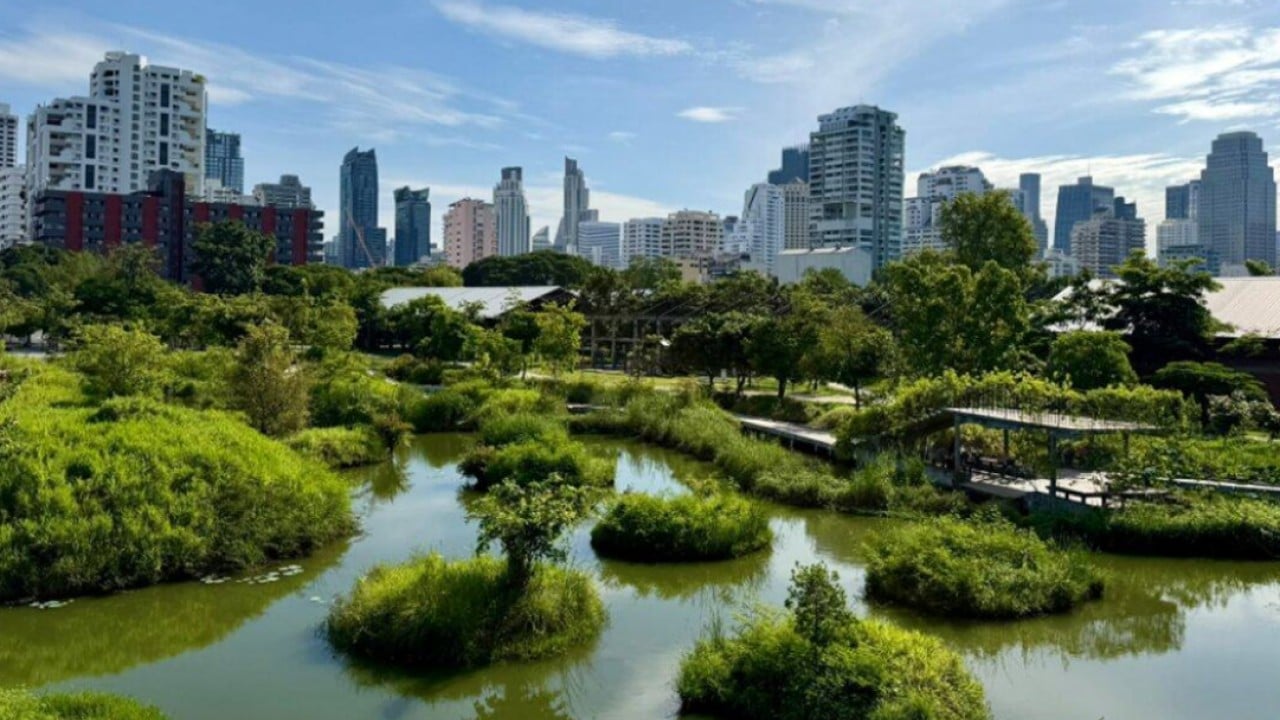
Architects and urban designers began identifying forgotten parcels—oddly shaped slivers of land beneath elevated tollways, abandoned railway spurs, and neglected canal banks. Instead of paving them over for parking, city administrators partnered with landscape architects to implement what is now known locally as pocket parks.
Take the transformation of the Phra Khanong district. Where rusted corrugated iron once fenced off a mosquito-breeding swamp, residents now find elevated wooden walkways winding through mangrove wetlands. Rainwater is no longer rushed into overwhelmed drainage pipes; it is captured by engineered bioswales, filtered through native reeds, and allowed to replenish the subterranean water table.
This is where the cold statistics of urban renewal intersect with human reality. When a neighborhood gets a park, property values shift, yes. But something more profound happens. Grandparents who previously stayed locked behind security gates now walk their grandchildren past flowering frangipani trees. Office workers on their lunch breaks take off their shoes and press their soles into actual dirt.
The revival is not just botanical. It is social.
The Architecture of Resilience
Bangkok’s green revival is driven by an acute awareness of survival. Climate change is not a theoretical abstraction in Southeast Asia; it is a wet, suffocating reality that announces itself every monsoon season and every record-breaking dry spell.
City officials realized that planting trees along sidewalks was no longer enough. They needed a systemic overhaul of how the urban ecosystem functions. Rooftops that were once tar-sealed deserts are slowly turning into urban farms and native grass gardens. The underground canal networks, historically treated as open sewers, are being dredged, cleaned, and flanked by linear parks that invite pedestrians back to the water's edge.
Yet, skepticism remains. Critics point out that these pockets of green, while beautiful, are drops of water in an ocean of concrete. They argue that gentrification often follows the arrival of a shiny new park, pushing out the very street vendors and long-term residents who gave these neighborhoods their soul.
It is a valid fear. Progress is rarely pure. When a neighborhood becomes greener, it becomes desirable. When it becomes desirable, the landlords take notice.
A Morning Routine Renewed
Back by the river, the sun is climbing higher, burning off the last wisps of morning mist over the Chao Phraya.
Somchai stands up from his bench, stretches his arms toward the canopy, and takes a deep breath. He remembers what this corner of the city smelled like thirty years ago—a suffocating cocktail of burning rubbish, sulfur, and two-stroke exhaust. Now, the dominant scent is damp earth and crushed lemongrass from the community garden nearby.
Bangkok is still loud. It is still chaotic, frantic, and relentlessly alive. The traffic will still snarl. The humidity will still test the limits of human patience.
Yet beneath the noise, something fundamental has shifted. The city has remembered that concrete is only a skeleton, and a skeleton needs flesh, breath, and green blood to survive.
The revival is messy, uneven, and far from finished. But as Somchai begins his walk home through the dappled shade of a roadside rain tree, the air feels different. It moves. It cools. It invites you to stay.