The sound changes before the impact does. Anyone who has spent time near heavy machinery knows the baseline hum of a facility running at scale. It is a deep, vibrating chord that settles in your chest, reassurance written in thousands of RPMs. At the Zaporizhzhia nuclear power plant, that hum used to be the pulse of an entire region.
Then comes the buzz. It is thin, high-pitched, and entirely synthetic. It sounds like a lawnmower engine suspended in mid-air, a lawnmower carrying several kilograms of high explosives.
When the drone struck the roof of Reactor Number 6's turbine building, the noise did not shatter the world. It was a dull, metallic thud, followed by the sharp crack of concrete fracturing under sudden, violent pressure. To the International Atomic Energy Agency (IAEA) experts stationed on-site, that sound was a boundary crossing. It was a physical reminder that the distance between a routine shift and a continental catastrophe is exactly as thick as a reinforced roof.
We treat nuclear safety as a series of abstract acronyms and bureaucratic reports. We read headlines about containment structures and cooling ponds as if they are pieces on a chessboard in a game played by someone else. They are not. Every incident at a facility like Zaporizhzhia is a human calculation made under intense psychological pressure, where a single stray fragment can rewrite the geography of Europe.
The Geography of Risk
To understand what happened inside the perimeter of Europe’s largest nuclear plant, you have to look past the military communiqués. The turbine building is not the reactor core. It does not house the uranium fuel rods or the primary cooling loops. Instead, it is the place where steam, heated by the immense energy of the reactor, is converted into electricity. It is a space filled with massive, spinning rotors, generators, and a web of high-pressure pipelines.
Think of it as the transmission of a car. If you hit the engine block, the car dies instantly. If you hit the transmission, the engine keeps running, but the power has nowhere to go, and the internal friction can tear the machine apart from the inside out.
The IAEA confirmed the strike with the flat, emotionless language typical of international oversight. They noted a thick, black plume of smoke. They identified the debris. They verified that, this time, the structural integrity of the containment remained intact.
But structural integrity is a lagging indicator.
The real damage is cumulative. It accumulates in the minds of the engineers who must walk into that turbine hall every morning, knowing that the ceiling above them has been transformed into a target. It accumulates in the decision-making processes of operators who are working under foreign military occupation, balancing their duty to the physics of the reactor against the reality of gun barrels at the checkpoint.
The Myth of the Fortress
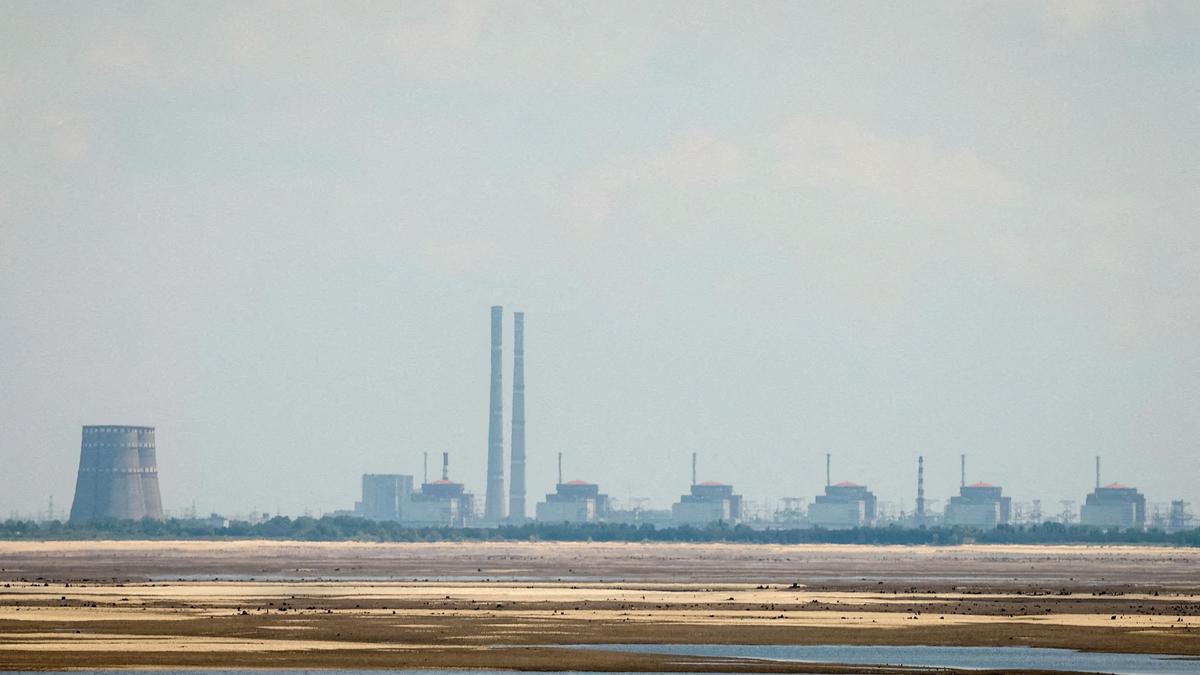
For decades, the nuclear industry built its reputation on the concept of defense in depth. Engineers designed structures to withstand unimaginable forces: commercial airliner crashes, seismic shifts, once-in-a-century floods. The concrete domes visible from miles across the Kakhovka Reservoir were supposed to be monuments to human foresight.
War complicates physics.
A facility designed to withstand a singular, catastrophic accident is not necessarily equipped to endure months of systematic, low-intensity attrition. Drones are small. They are cheap. They bypass traditional air defense networks by flying low, hugging the terrain, and utilizing the massive structures of the plant itself as radar shadows.
When a drone hits a turbine building, it isn't trying to cause a thermonuclear explosion. Real life doesn't work like Hollywood movies. The danger is much more mundane, and because of that, much more terrifying. A fire in a turbine hall can compromise the electrical systems required to keep the cooling pumps running. Without those pumps, even a shutdown reactor begins to heat up. Residual decay heat is a persistent, stubborn thing. It does not care about politics. It only cares about water circulation.
Consider the reality of the people inside. The operators at Zaporizhzhia are trapped in a living paradox. They are managing a highly volatile, six-reactor complex while navigating an environment where the spare parts inventory is dwindling, the communication lines are compromised, and the sky is loud.
The Language of Escalation
In the aftermath of the strike, the public space filled with the predictable chorus of denials and accusations. One side blamed the other; the other pointed back. This rhetorical fog is intentional. It turns a concrete threat into an ideological debate, allowing onlookers to choose a side rather than confront the underlying reality.
Rafael Grossi, the head of the IAEA, has spent months warning that the world is playing with fire. His reports read like transcripts from a slow-motion emergency room. He speaks of "close calls" and "unprecedented vulnerabilities."
What his bureaucratic prose implies is something every industrial worker understands instinctively: safety culture is not a set of rules written in a binder. It is an atmosphere. It requires trust, predictable routines, and the absolute certainty that if you flag a problem, resources will arrive to fix it.
When a drone strikes a building, that atmosphere evaporates. Every alarm becomes an ambiguous threat. Is it a system malfunction, or is it another arrival from the sky? The mental bandwidth required to run a nuclear plant safely is consumed instead by the basic mechanics of survival.
The Long Shadow
We have been here before, though the collective memory has begun to fade. The ghost of 1986 still haunts the Ukrainian soil, but the lessons of Chornobyl are often misunderstood. That disaster was born of a flawed design and flawed leadership. Zaporizhzhia is different. Its reactors are modern, robust, and protected by heavy containment vessels.
The vulnerability here is not the technology. It is the context.
Never before in human history has a major, operational nuclear power plant been converted into a frontline fortress during an active war. There is no manual for this. There is no simulation that the operators ran during their training in Kyiv or Moscow that prepared them for a scenario where artillery craters frame the cooling towers.
The international community watches through the lens of satellite imagery and occasional, brief updates from inspectors on the ground. We look at the coordinates, the damage assessments, and the technical diagrams. We treat it as a problem of logistics, assuming that as long as the radiation monitors read normal, the situation is under control.
That is an illusion born of comfort.
The monitoring stations only tell us what has already happened. They do not measure the microscopic stress fractures in the concrete roof of the turbine building. They do not measure the fatigue of an engineer who has been working double shifts for weeks because his colleagues fled the combat zone. They do not measure the probability of a fragment severing a critical backup power cable during the next attack.
The Fragile Chord
The strike on Reactor Number 6 did not cause a meltdown. The containment held. The radiation levels remained stable. The news cycle moved on within forty-eight hours, shifting its focus to other battles, other political debates, other numbers on a screen.
But the hole in the roof remains.
Somewhere in the turbine hall, the morning shift is clocking in. They walk past the scorched concrete, beneath the temporary patches designed to keep the rain off the generators. They check the gauges. They listen to the deep, heavy hum of the machinery, trying to drown out the memory of the synthetic buzz that came before.
The plant stands, a massive grey shape against the sky, functioning not because the situation is stable, but because a handful of people refuse to let it fail. They are holding a line that was never supposed to exist, operating on the razor-thin margin between industrial routine and historical disaster, while the sky above them remains entirely indifferent to their work.