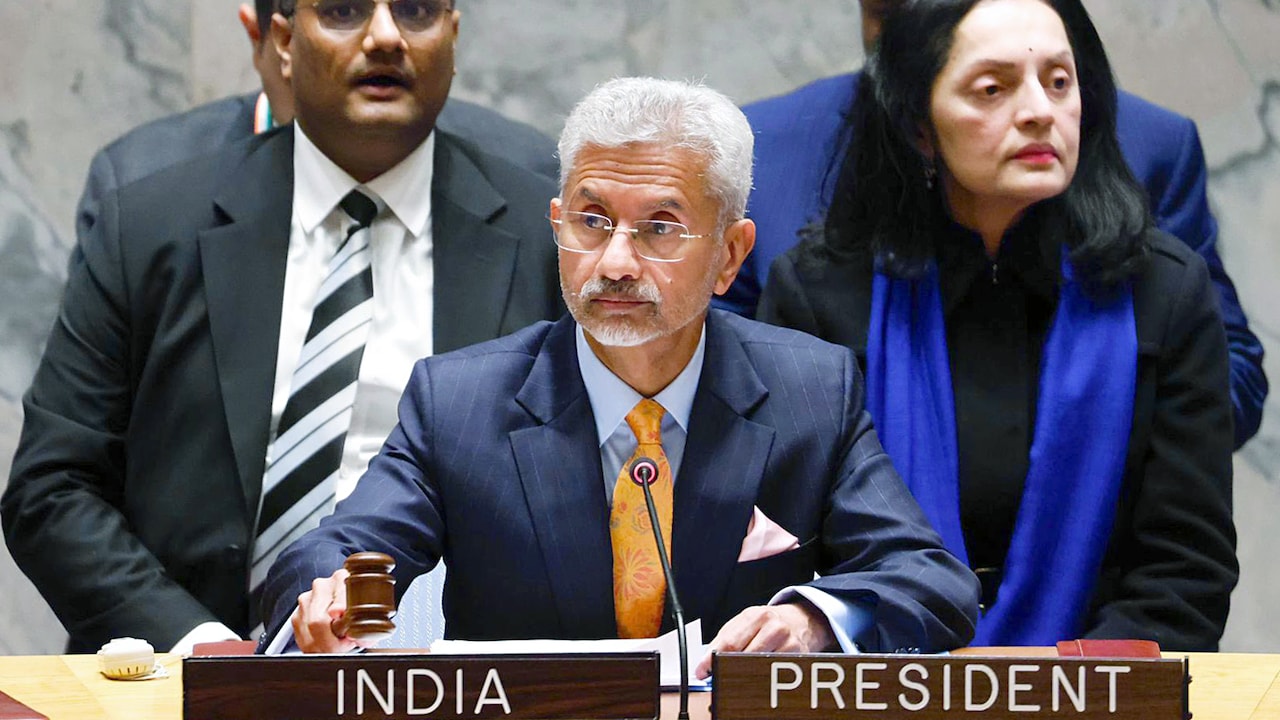
The launch of India’s official campaign for a non-permanent seat on the United Nations Security Council (UNSC) for the 2028-29 term, led by External Affairs Minister S. Jaishankar in New York, marks a transition from consensus-based diplomacy to a highly contested electoral math. While a two-year rotating seat is historically routine—India has held the position eight times previously—the 2026 campaign operates under a distinct structural matrix. New Delhi is not entering an uncontested regional rotation; it faces a direct, zero-sum challenge from Tajikistan for the sole available slot in the Asia-Pacific Group.
This campaign acts as an empirical baseline for India's broader strategic ambition: permanent membership in a reformed multilateral structure. To secure the minimum two-thirds majority of the UN General Assembly (129 of 193 votes), India must execute a highly granular mobilization strategy that offsets localized bloc voting against its broader macroeconomic and security value proposition. You might also find this similar coverage insightful: Why India and New Zealand Are Finally Moving Past Casual Diplomatic Flirting.
The Arithmetic of the Asia-Pacific Group Challenge
The primary bottleneck to an automatic endorsement for India is the structural composition of the voting blocs within the General Assembly. Tajikistan’s candidacy derives institutional momentum from its formal alignment with the Organisation of Islamic Cooperation (OIC), which controls a cohesive bloc of 57 member states.
If the OIC votes symmetrically, Tajikistan secures 44% of the required threshold before accounting for non-aligned or regional micro-states. To neutralize this structural advantage, India’s diplomatic deployment operates via a three-tiered retail engagement model. As highlighted in detailed articles by Al Jazeera, the implications are notable.
1. The Gulf Energy and Fertilizer Corridor
Jaishankar’s immediate preceding diplomatic itinerary across Qatar, Bahrain, Kuwait, and Oman represents a targeted intervention to decouple the economic interests of the Gulf Cooperation Council (GCC) from broader OIC voting alignments. India relies on these states for energy security and critical fertilizer imports, while simultaneously serving as a primary destination for Gulf sovereign wealth diversification. The objective is to convert bilateral trade dependency into a commitment of neutrality or split-voting during the secret ballot in June 2027.
2. The African Representation Void
The postponement of the India-Africa Forum Summit removes a high-leverage institutional mechanism precisely when New Delhi requires consolidation of the African continent’s 54 votes—roughly 28% of the General Assembly. This creates an opening for competing candidates to exploit. India must now shift to resource-intensive bilateral channels to retain its traditional support base within the Global South.
3. The Multilateral Alignment Counterweight
The recent electoral outcome where Kyrgyzstan defeated the Philippines (142 to 49 votes) for the 2027-28 UNSC seat serves as an operational warning. The Philippines' defeat was heavily correlated with its deepening, explicit security alignment with Washington, which alienated non-aligned member states in a secret ballot.
India’s core marketing framework leverages its doctrine of strategic autonomy, positioning itself as a structural bridge between Western security frameworks (such as the Quad) and Eurasian forums like the Shanghai Cooperation Organisation (SCO).
The Dual-Track Institutional Strategy
The secondary dimension of India's campaign is the logical tension between its short-term tactical pursuit of a rotating seat and its long-term structural critique of the UNSC's architecture. The institutional objective is not merely governance participation, but the systematic invalidation of the 1945 post-war power distribution.
[Tactical Objective: 2028-29 Non-Permanent Seat] ──> Demonstrates Coalition-Building Capability
                                                                  │
                                                                  ▼
[Strategic Objective: Permanent UNSC Reform]     ──> Leverages Structural Representation Deficit
The G4 alliance (India, Brazil, Germany, and Japan) operates on the principle that the current P5 composition lacks contemporary demographic and economic legitimacy. India’s argument rests on a fundamental representation deficit: the exclusion of the world's most populous nation, alongside the absolute exclusion of Africa and Latin America from permanent representation, degrades the enforcement capability of the Council.
However, the structural path to reform faces an institutional deadlock. The permanent members utilize a "nothing is agreed until everything is agreed" negotiating posture within the Intergovernmental Negotiations (IGN) framework. This strategy functions as a structural veto, allowing status-quo powers to freeze incremental progress by demanding a comprehensive consensus that is structurally impossible to achieve.
Consequently, India’s strategic position treats each successful non-permanent tenure as an empirical data point proving its capacity to act as a security guarantor, slowly raising the reputational cost for P5 members who maintain the blockade.
Quantifying the Geopolitical Friction Points
The upcoming 2028-29 tenure will intersect with a highly fractured global security environment characterized by three major systemic shocks: the war in Ukraine, the Gaza conflict, and the broader escalations involving the United States, Israel, and Iran. These conflicts introduce distinct variables into India's voting calculus.
- The Voting Dilemma of Strategic Autonomy: In a polarized council, abstract neutrality yields diminishing returns. Every abstention or vote on sanctions forces India to choose between its Western technology and defense partnerships (such as the India-EU Trade and Technology Council pathways) and its deep energy and logistical dependencies on Eurasian powers.
- The Global South Representative Burden: India positions itself as the functional interlocutor for developing economies suffering from the secondary economic shocks of these conflicts—specifically food insecurity, debt distress, and energy inflation. If India cannot convert its presence on the horseshoe table into tangible mitigation strategies for these states, its normative authority as a leader of the Global South will face rapid devaluation.
Strategic Recommendation
To secure the 2028-29 tenure against a consolidated regional challenge, India must shift from generalized normative rhetoric—such as the "#India4UNSC Peace, Planet, Progress" framework—to an explicit transactional diplomacy model.
The immediate operational priority must be the deployment of targeted bilateral packages toward small island developing states (SIDS) and African nations that are highly susceptible to localized bloc voting. These packages must emphasize real-time capabilities: digital public infrastructure (DPI) transfers, lines of credit for climate resilience, and defense capacity building.
Relying on historical goodwill or generalized assertions of global stature introduces an unacceptable margin of error in a secret ballot. New Delhi must price the exact diplomatic cost function required to peel votes away from the OIC and SCO blocs, county by country, to ensure its institutional trajectory remains viable.