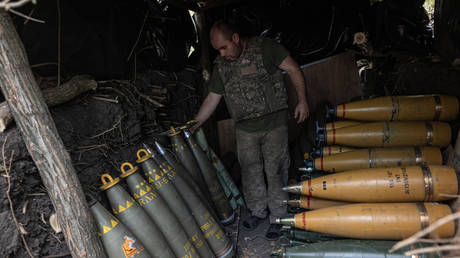
The metal is cold before it is hot. In a cavernous production facility outside Prague, a worker named Tomáš wipes a thin film of industrial grease from the casing of a 155mm artillery shell. It is heavy, clumsy, and utterly devoid of poetry. Yet, for a soldier crouching in a frozen trench three hundred miles to the east, this hunk of forged steel is the precise dividing line between breathing and ending.
For the past year, Europe told itself a comfortable story about these shells. It was a narrative of bureaucratic defiance, championed by the Czech Republic. The plan was deceptively simple: bypass the sluggish, red-tape-bound factories of Western Europe, scour the global market with cold cash, and buy ammunition from anyone willing to sell it under the table. They called it the Czech ammunition initiative. It was hailed as the lifeline that would sustain Ukraine through its darkest hours.
But stories have a habit of colliding with arithmetic.
Walk through the logistics hubs today, and the atmosphere has shifted. The initial adrenaline rush of geopolitical Saviorism has faded, replaced by the grim reality of a ledger that no longer balances. The coalition is fracturing. Pledges are vaporizing. The silent arsenal that was supposed to flood the frontlines is slowing to a trickle, revealing a deeper, more terrifying truth about modern warfare: enthusiasm is a poor substitute for a functioning supply chain.
The Mirage of the Open Market
To understand how the initiative began to bleed out, one must understand how it was born.
In early 2024, the European Union admitted a humiliating failure. It had promised to deliver one million artillery shells to Kyiv within a year and had fallen catastrophically short. The continent’s defense industry, rusted by decades of peacetime complacency, simply could not turn the gears fast enough.
Enter Prague. Czech officials quietly announced they had mapped out up to 800,000 shells available across the globe—in South Korea, in parts of Africa, in non-aligned nations that wanted no public part in a European war but desperately wanted hard currency. It was a brilliant piece of arbitrage. All it required was money.
A coalition of the willing formed overnight. Germany, the Netherlands, Denmark, and Canada threw hundreds of millions of euros into the pot. For a brief moment, it looked like Western cash had outsmarted industrial inertia.
Then, the market reacted.
Economics is a brutal master. When a dozen wealthy nations suddenly announce they are shopping for the exact same rare commodity, the price does not remain stable. It skyrockets. Shells that were valued at a few thousand dollars apiece suddenly doubled in price. Dictators and middle-tier military regimes realized they were holding liquid gold. They began to stall, rewriting contracts, demanding political concessions, or auctioning their stockpiles to the highest bidder.
The Czechs had the map, but the coalition partners possessed a fickle kind of generosity. Pledging money in a press conference is easy. Writing the check when the invoice doubles is an entirely different matter.
The Quality of Mercy and Gunpowder
Even when the money cleared, a nastier problem emerged from the shipping crates.
Imagine buying a spark plug for a vintage car. You find the correct part number online, pay a premium for expedited shipping, and wait. When it arrives, you discover the thread is warped by a millimeter. The plug is useless. Now, multiply that frustration by a factor of hundreds of thousands, under the constant threat of drone strikes.
The ammunition sourced from distant, anonymous stockpiles was not uniform. It was a mosaic of different eras, storage conditions, and manufacturing standards. Some of it had sat in humid sub-tropical warehouses since the late Cold War.
When these crates were cracked open near the Donbas, Ukrainian artillery crews discovered a nightmare. Fuses were corroded. The propellant charges, sensitive to moisture and age, burned unevenly. In the best-case scenarios, this meant the shells missed their targets, falling harmlessly into empty fields. In the worst-case scenarios, the irregular pressure caused catastrophic barrel explosions, destroying priceless Western artillery pieces and killing the crews operating them.
The Czech government found themselves acting not just as brokers, but as a massive, frantic quality-assurance team. They had to set up secret refurbishment facilities, tearing down ancient munitions, replacing volatile explosives, and rebuilding them from the ground up.
It was a race against time, and time was winning. The bottleneck wasn't just finding the ammo; it was making the ammo safe enough to fire.
The Fatigue of the Paymasters
But the true crisis of the coalition isn't happening in the refurbishing plants. It is happening in the carpeted ministerial offices of Western European capitals.
Political attention spans are notoriously short. Domestic pressures have begun to mount. In Germany, economic stagnation has turned every euro sent abroad into a political liability. In France, the long-standing philosophical belief that Europe should only buy European-made weapons has resurfaced, choking off funds for external purchases. Smaller nations that joined the coalition with a burst of moral clarity are quietly looking at their own depleted treasuries and slipping out the back door.
The coalition didn't suffer a dramatic, public collapse. Instead, it is experiencing a slow, suffocating de-escalation.
Deliveries that were scheduled for the autumn were pushed to the winter. Winter deadlines became spring targets. The public rhetoric remains defiant, but the bank transfers tell a story of profound exhaustion.
Consider the arithmetic of the trench. A standard defensive operation can burn through several thousand heavy artillery shells in a single afternoon of intense bombardment. If the supply drops by even thirty percent, the frontline doesn't just bend; it breaks. Without the cover of heavy ordnance, infantrymen are left exposed to a relentless rain of glide bombs and drone swarms. The lack of a signature on a document in Berlin or Ottawa translates directly into an abandoned village or a makeshift cemetery outside Kharkiv.
The Invisible Factory
We live in an era obsessed with digital solutions. We believe that software, silicon, and intelligence can overcome any obstacle. But a war of attrition is a deeply material thing. It is a contest of raw tonnage. It is about how much steel you can dig out of the earth, how much chemical explosive you can mix, and how efficiently you can pack it into a tube.
The Western illusion was that wealth could bypass industrial capacity. We believed our credit cards could replace our factories.
The stagnation of the Czech initiative is the definitive proof that this was a fantasy. You cannot buy what does not exist, and you cannot infinitely stretch a finite global supply of old ammunition. The global stockpiles are running dry. The low-hanging fruit has been plucked from the trees.
What remains is the hard, ugly work of rebuilding an industrial base that Europe spent thirty years dismantling in the name of the peace dividend. It requires pouring concrete for new factories, training a new generation of chemical engineers, and accepting that the continent must prepare for a long, cold twilight of geopolitical instability.
That process takes years. The soldiers in the mud have days.
Back in the facility outside Prague, the machinery keeps humming, though the rhythm feels heavier now. Tomáš watches another shell roll down the line. It is polished, packed, and stamped with a serial number. It will go into a wooden crate, and then onto a train heading east.
It is a single drop of steel in an ocean of fire. The tragedy is no longer that Europe doesn't know how to help. The tragedy is that it looked into its pockets, looked at its factories, and realized it has reached the limit of what it is willing to give. The silence returning to the artillery batteries isn't the silence of peace; it is the quiet, scraping sound of an empty crate.