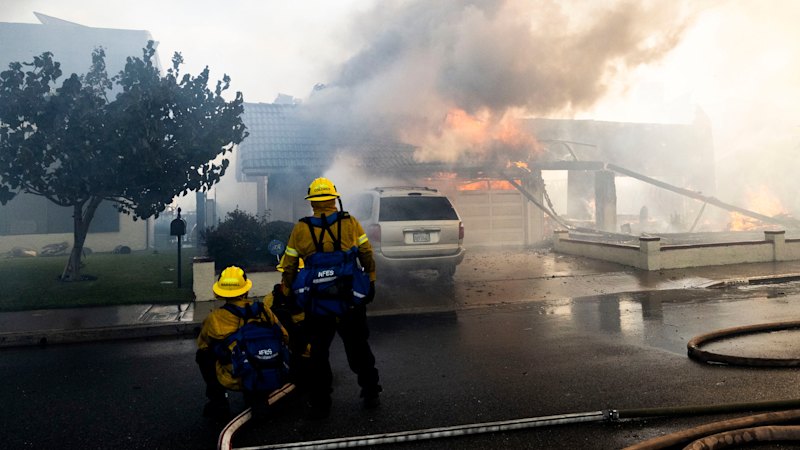
Homes burn during critical fire weather in California not merely because wind and heat arrive together, but because decades of suburban expansion, outdated neighborhood layouts, and slow-moving property upgrades leave thousands of houses vulnerable to wind-driven embers. When Red Flag Warnings hit, flames rarely need a massive wall of brush to destroy a block. A single glowing ember carried ahead of a gust can slip into an attic vent or ignite dry leaves piled against a garage door, turning a localized brush spark into a street-level disaster in minutes.
Standard breaking news coverage treats every wind-driven blaze as a surprise act of nature. Anyone who has covered California fire seasons for twenty years knows the script too well. Forecasters warn of low humidity and gusty offshore winds, crews stage engines along canyon roads, a spark flies, and within hours television cameras are zooming in on twisted metal frames and smoking chimneys. That surface reporting misses the deeper mechanics. Weather pulls the trigger, yet land-use policy, insurance economics, and construction choices load the chamber year after year. Also making waves lately: What The Desert Kept When Lake Mead Shrank.
How Critical Fire Weather Turns Sparks Into House Fires
Meteorologists use critical fire weather to describe a specific convergence of dry air, strong winds, and bone-dry fuel that allows fire to spread fast and resist containment. In California, that setup frequently arrives in autumn when Santa Ana winds in Southern California or Diablo winds in Northern California push air from inland plateaus down toward the coast. As the air descends, it compresses, warms up, and sheds moisture, sometimes dropping relative humidity into the single digits while wind gusts top 50 to 80 miles per hour.
Heat and wind change how fire behaves in ways casual observers underestimate. Flames tilt sharply toward unburned brush ahead of them, preheating leaves and twigs before the main fire front even arrives. Even more importantly, strong gusts loft millions of wind-driven embers—burning pine needles, bark chips, and twigs—miles ahead of the active flame front. More information on this are detailed by Associated Press.
Most homes lost in major California wind events do not burn because a towering wall of wildfire overran them. Many ignite from windblown embers landing on vulnerable surfaces or from neighboring structures catching fire.
Picture a hypothetical hillside subdivision built in the 1980s along a chaparral ridge. A homeowner keeps the lawn mowed and clears weeds ten feet out, thinking the job is done. Yet a gust drives a burning ember into an unscreened crawlspace vent or onto a stack of firewood tucked under a wooden deck. Once that small pocket catches, structural ignition can cascade across tightly spaced roofs and fences while firefighters are stretched thin across multiple simultaneous starts.
The Wildland Urban Interface Trap
Much of the danger sits inside the wildland urban interface, commonly called the WUI, where houses meet or intermingle with wild vegetation. California has added housing in fire-prone foothills and canyons for generations because land was cheaper, views were wider, and commuters were willing to drive farther. Each new cul-de-sac added more rooftops, driveways, and people to landscapes that historically burned every few decades.
Building codes have improved substantially over time. Newer construction in designated fire hazard zones requires ignition-resistant roofs, ember-resistant vents, tempered glass in many applications, and stricter exterior material rules. Those standards help new builds survive when properly maintained.
Yet California's housing stock is overwhelmingly older than its modern fire codes. Retrofitting millions of existing houses costs serious money. Estimates cited in recent state resilience analyses put the price tag of hardening all at-risk California homes at $30 billion or more. Telling a retired homeowner on a fixed income to replace a roof, upgrade windows, and re-mesh every vent is easy in a policy memo and punishing in real life.
| Risk Factor | How It Worsens Fire Losses | Practical Countermeasure |
|---|---|---|
| Offshore Wind & Low Humidity | Dries fuels rapidly, tilts flames forward, and lofts embers far ahead of the front | Early pre-positioning of crews, public safety power shutoffs, and rapid initial attack |
| Ember Intrusion | Ignites attics, eaves, decks, and debris traps before direct flames arrive | Home hardening upgrades such as fine mesh vents, noncombustible gutters, and enclosed eaves |
| Dense Brush & Ladder Fuels | Allows ground fire to climb into tree canopies and carry heat toward structures | Consistent defensible space clearing and community-wide fuel breaks |
| Narrow Roads & Bottlenecks | Slows evacuations while blocking fire engines trying to reach burning blocks | Coordinated early evacuation orders, cleared access lanes, and neighborhood planning |
Policy Blind Spots Nobody Likes to Debate
Ask five experts why losses keep climbing during critical fire weather, and you will hear five sharp arguments that rarely line up neatly. One camp points straight to climate trends and a century of aggressive fire suppression that allowed dense, stressed forests and chaparral to accumulate excess fuel. When extreme heat meets those dry fuels—even after winters with thin mountain snowpack—fires burn hotter and faster than legacy suppression tactics were designed to handle.
Another camp blames local planning approvals and utility infrastructure. Cities and counties have faced intense pressure to approve housing where land is available, sometimes outpacing evacuation capacity or water-system pressure during peak demand. Meanwhile, aging power lines and distribution gear remain flashpoints when high winds whip branches into conductors, forcing utilities to cut power for days at a time—a necessary safety move that still knocks out cell service, garage doors, and medical devices for residents in the dark.
Then there is the insurance market crunch, which sits right at the intersection of risk and reality. Insurers pulled back or raised rates sharply across high-risk zip codes as catastrophic wildfire losses mounted, pushing more policies onto the state's insurer of last resort, the California FAIR Plan. State regulators have moved to expand coverage options and tie discounts more closely to verified mitigation work, yet tension remains over how much risk should be priced into individual premiums versus shared across the broader market.
No single silver bullet fixes that tension. Subsidizing home hardening helps low-income owners, but public grants rarely cover the full cost of deep structural retrofits across entire counties. Clearing brush around one house helps, yet a neighbor's unmaintained yard or a wind-whipped palm tree can still throw embers across the property line. Even the best defensible space cannot guarantee survival during extreme windstorms if flying embers find an unsealed gap.
What Actually Separates Survivors From Ashes
Walk through any post-fire neighborhood survey and a clear pattern emerges. Surviving houses in the middle of charred blocks often share unglamorous details: metal or Class A fire-rated roofs, clear zones right up to the foundation, no dry mulch or stacked lumber touching siding, and gutters cleaned of pine needles. Little things decide big outcomes.
Real resilience requires treating wildfire readiness as a year-round operating habit rather than a seasonal panic when a Red Flag Warning pops up on a phone. Residents need clear, rehearsed evacuation routes, full fuel tanks before wind events arrive, and early readiness to leave when officials issue warnings—because waiting until flames cross the ridge turns an orderly exit into a gridlocked hazard.
Start with the immediate zero-to-five-foot zone around your home's walls and foundation, swap out dry woody mulch and combustible stored items near exterior walls for nonflammable alternatives, and check every vent, eave, and gutter before the next wind event hits.