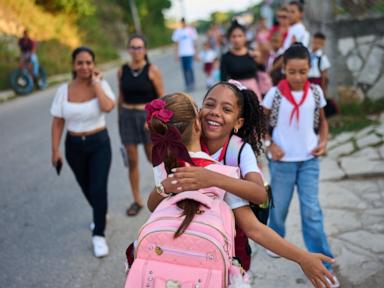
Every western headline this week treats Cuba reopening its classrooms against a backdrop of blackouts and water shortages as a humanitarian failure. The lazy consensus from foreign desks is predictable. Officials are accused of ignoring basic living standards, forcing kids into dark buildings, and masking a collapsing infrastructure under the guise of bureaucratic routine.
This framing reveals a profound misunderstanding of how resource-scarce nations operate under siege.
I have spent years analyzing operational resilience in embargoed and fragile economies. When you look at the Cuban school system through a traditional western corporate lens, you miss the mechanics entirely. Keeping schools open isn't institutional denial. It is the single most rational distribution strategy available to a state facing systemic supply shocks.
The Myth of the Ideal Operating Environment
The standard critique assumes a baseline of stability. It assumes you wait for the grid to stabilize, the pumps to run smoothly, and the supply chains to flow before you educate a generation. But waiting for ideal conditions in a permanently constrained economy is a slow death sentence for human capital.
Western commentary treats infrastructure as a binary state: it works, or it is broken. Reality on the ground is infinitely more granular. A school building in Havana or Santiago is not just a classroom. It is a social anchor, a distribution node, and an equalizer.
When power fails at home, a child sitting in an unlit, sweltering apartment absorbs the full weight of the crisis in isolation. When that same child is inside a school, even one struggling with intermittent electricity and water trucking, they are plugged into a collective safety net.
The Social Infrastructure Dividend
Let us look at what actually happens when you shutter schools during a crisis.
- Nutrition programs halt immediately, transferring the caloric burden entirely to impoverished households.
- Parental labor force participation drops off a cliff because adults must stay home to supervise children, paralyzing what little economic output remains.
- The learning gap hardens into permanent cognitive stratification.
Critics hyperventilate over the lack of running water or stable lighting. They ignore the fact that the alternative—indefinite domestic isolation—destroys social cohesion faster than a blackout ever could.
Operational Realities Versus Foreign Fantasies
I have watched foreign analysts lose their minds over institutional stubbornness in developing economies, assuming that persistence equals incompetence. They look at a school operating on a truncated schedule with improvised water storage tanks and call it a breakdown of governance.
It is the exact opposite. It is triage.
Cuba’s centralized administrative apparatus understands a brutal mathematical truth. If you allow the educational machinery to stop every time the grid falters or fuel imports stall, you create an unrecoverable momentum loss. Restarting a national education system from a dead stop is infinitely harder than managing a degraded, rolling-compromise schedule.
Administrators are running on institutional muscle memory developed over decades of economic warfare. They swap rigid timetables for flexible shifts. They leverage community water reserves. They prioritize communal safety and child welfare over administrative comfort.
Admitting the downsides to this approach is necessary. Children are dealing with discomfort. Teachers are exhausted. Instruction quality fluctuates wildly when classrooms lack basic digital tools or reliable lighting. No one is pretending this is a Scandinavian model of educational luxury.
The Real Agenda Behind The Outrage
Why do foreign outlets cover these school openings with such uniform pearl-clutching? Because it challenges the narrative of total, uninterrupted collapse.
If a state can keep its children in classrooms while navigating severe fuel and energy deficits, it proves that institutional resilience runs deeper than a fluctuating barrel count or a failing turbine. It demonstrates that human priority can override material scarcity.
Stop viewing infrastructure failures as absolute bars to progress. Sometimes, pushing forward through the dark is the only strategy that keeps the light from going out permanently.