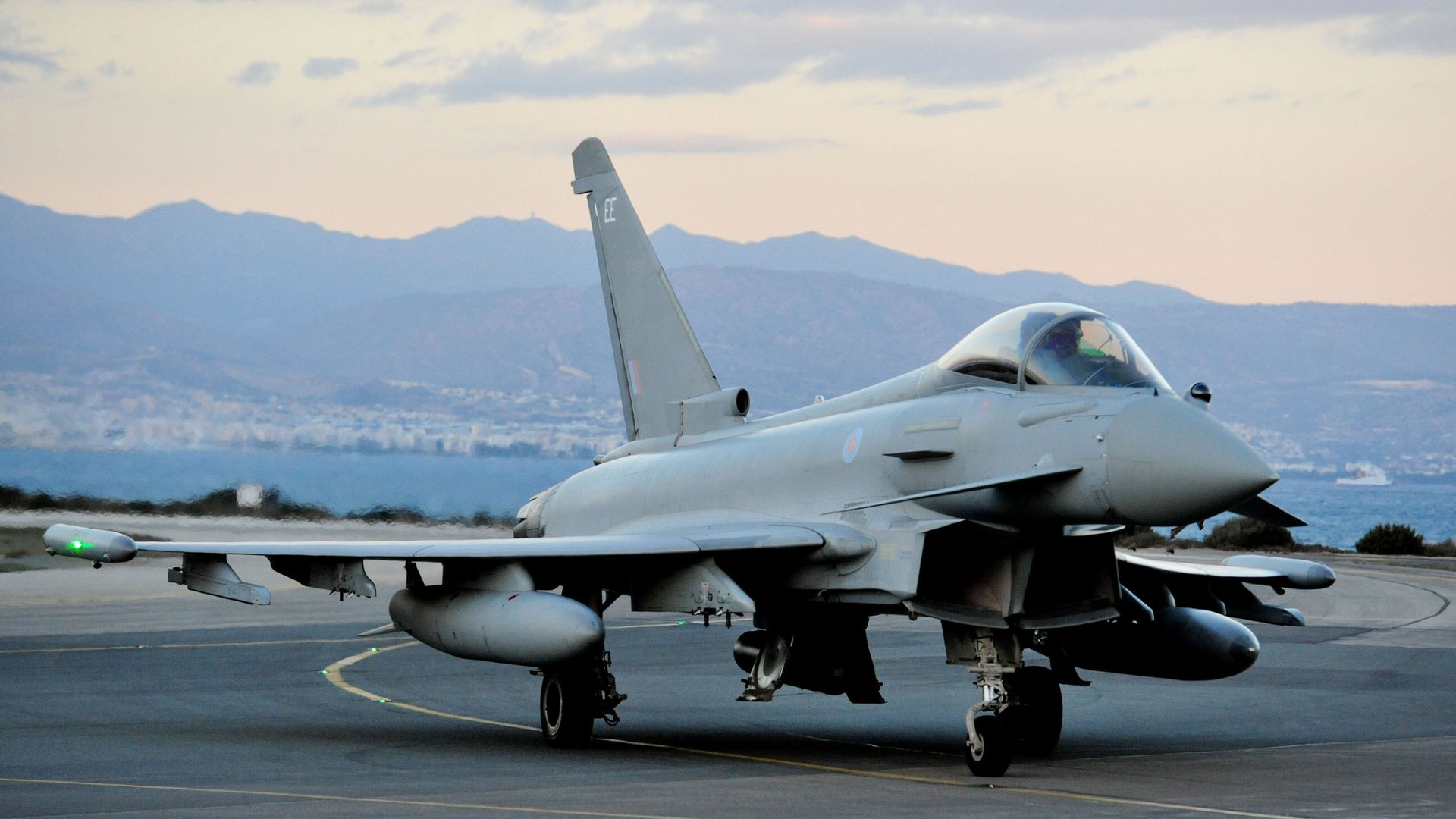
The headlines are screaming about a "breach" at Akrotiri. They want you to believe this was a failure of intelligence or a lapse in sentry duty. They are wrong. This wasn't a breach of a base; it was the final, messy autopsy of the 20th-century military doctrine. If you are still thinking in terms of "fences" and "no-fly zones," you are effectively fighting with a musket in a digital age.
The narrative being pushed by the legacy press is one of shock. They treat a drone strike on a British Overseas Territory as a freak occurrence—a bolt from the blue. It isn't. It is the mathematical certainty of cheap, attritional warfare meeting expensive, static targets. I have spent years watching defense contractors pitch billion-dollar "shields" that can be defeated by a $500 hobbyist kit and a basic understanding of swarm logic. The strike in Cyprus isn't a tragedy of errors. It is a reality check. Discover more on a related subject: this related article.
The Myth of the Hardened Perimeter
For decades, the RAF and its NATO allies have operated under the delusion of the "Green Zone" mentality. You build a wall, you install thermal cameras, and you assume the space inside is sacred. That era is over.
Small Unmanned Aerial Systems (sUAS) have turned every square inch of a base into a front line. When an explosive-laden quadcopter costs less than a single tire on a Typhoon fighter jet, the economic asymmetry becomes a weapon in itself. We are seeing a shift from "exquisite" warfare—where $100 million platforms fight other $100 million platforms—to "disposable" warfare. More reporting by Al Jazeera explores comparable views on the subject.
The strike on Akrotiri proves that our current defense posture is built on a fundamental misunderstanding of physics and finance.
- Physics: You cannot monitor 360 degrees of low-altitude airspace with 100% reliability using traditional radar.
- Finance: You cannot fire a $2 million Sea Viper missile at a Mavic Pro without bankrupting your own defense budget within a week.
The status quo is to "harden" the base. I’m telling you to stop trying to fix the fence. The fence is an aesthetic choice, not a security one.
The Signal and the Noise Problem
Everyone asks the same question: "Why didn't they see it coming?"
They didn't see it because they were looking for a "threat" that looks like a MiG-29. Modern Electronic Warfare (EW) suites are designed to filter out birds, clutter, and civilian traffic. A drone is essentially a bird with a battery. To see the drone, you have to lower the threshold of your sensors to the point where the screen is white noise.
I’ve stood in Ops rooms where the operators are drowning in false positives. If the alarm goes off every time a seagull flies past the radar, the operator eventually ignores the alarm. That is not a "training failure." That is a human cognitive limit.
The strike in Cyprus didn't succeed because the UK is weak. It succeeded because the UK is using a "top-down" defense architecture to fight a "bottom-up" insurgency. We are trying to use a scalpel to stop a swarm of bees.
Stop Buying Shields and Start Buying Resilience
The instinct of the MoD will be to buy more "Counter-UAS" (C-UAS) technology. They will write checks to the usual suspects for jamming towers and kinetic interceptors. This is a sunk cost fallacy in action.
The dirty secret of C-UAS is that it’s always one firmware update behind the threat. If you jam the 2.4GHz frequency, the attacker switches to 5.8GHz. If you jam that, they use pre-programmed GPS coordinates or optical flow navigation that doesn't require a radio link at all. You cannot jam a camera that is "seeing" its way to a target.
Instead of trying to stop the strike—which is statistically impossible over a long enough timeline—we should be redesigning the bases to survive them.
- Distributed Parking: Why are Typhoons lined up like sitting ducks on a tarmac? It looks great for a PR photo, but it’s an invitation to a suicide drone.
- Sacrificial Infrastructure: We need to stop building "everything-in-one" command centers. If a single drone strike can take out your comms, your logistics, and your fuel, you haven't built a base; you’ve built a target.
- Active Decoys: For every real jet, there should be five inflatable, heat-emitting decoys. Make the enemy waste their $500 drone on a $200 balloon.
The Cyprus Geopolitical Trap
The "lazy consensus" says Cyprus is a strategic asset. In its current state, it is a strategic liability.
Akrotiri is a stationary aircraft carrier parked in one of the most volatile neighborhoods on Earth. It is surrounded by civilian populations, making kinetic defense (shooting things down) a nightmare. If you miss a drone and hit a local village, you’ve lost the information war before the smoke clears.
The attacker doesn't even need to destroy a plane to win. They just need to prove they can hit the base. The psychological impact of a drone landing on the CO’s desk is worth more than a dozen destroyed hangars. It signals to the world that the British Empire’s "impenetrable" outposts are actually glass houses.
The Mathematical Truth of Interception
Let’s look at the actual numbers. If an adversary launches a swarm of 50 drones, each costing $1,000, their total investment is $50,000.
To counter that swarm, a modern military might use:
- Directed Energy (Laser) weapons (unproven at scale).
- Electronic jamming (easily bypassed by autonomy).
- Traditional AA guns (huge risk of collateral damage in Cyprus).
If your defense cost is higher than the attack cost, you are losing the war of attrition. $50,000 in drones vs. a $2.5 billion military infrastructure. The math is brutal. It’s not just a drone strike; it’s an economic eviction notice.
The Myth of "State-Sourced" Threats
The media loves to point fingers at specific nations. "It must be Iran," or "It’s a Russian proxy."
By focusing on the who, they ignore the what. The "what" is that the barrier to entry for precision-guided munitions has dropped to zero. You don't need a state-sponsored lab to build a strike drone anymore. You need a 3D printer, an off-the-shelf flight controller, and a YouTube tutorial.
Labeling this a "state act" is a coping mechanism. It allows military leaders to feel like they are still playing a game of chess against a peer. The reality is they are playing a game of whack-a-mole against a crowd.
If we assume only "states" can do this, we fail to prepare for the day a disgruntled local or a small-time cell does the same thing. The Cyprus strike is the democratization of high-precision violence.
Abandon the Perimeter or Lose the Base
The concept of the "safe" rear area is dead. In the coming years, we will see more of this. Not because our intelligence is failing, but because our architecture is obsolete.
The "bold" move isn't more sensors. It’s the total abandonment of the centralized base model. If your power is concentrated in one spot, it is vulnerable to a swarm. If your power is distributed, mobile, and redundant, a drone strike is just an annoyance, not a headline.
Military leaders will hate this because it’s messy. It’s hard to command a distributed force. It’s hard to maintain jets when they aren't all in a neat row. But the alternative is watching a billion dollars of hardware go up in flames because someone forgot to account for a plastic toy with a grenade taped to it.
The fence didn't fail in Cyprus. The very idea of the fence failed.
Move your assets. Hide your signatures. Stop pretending the sky is yours. It isn't.