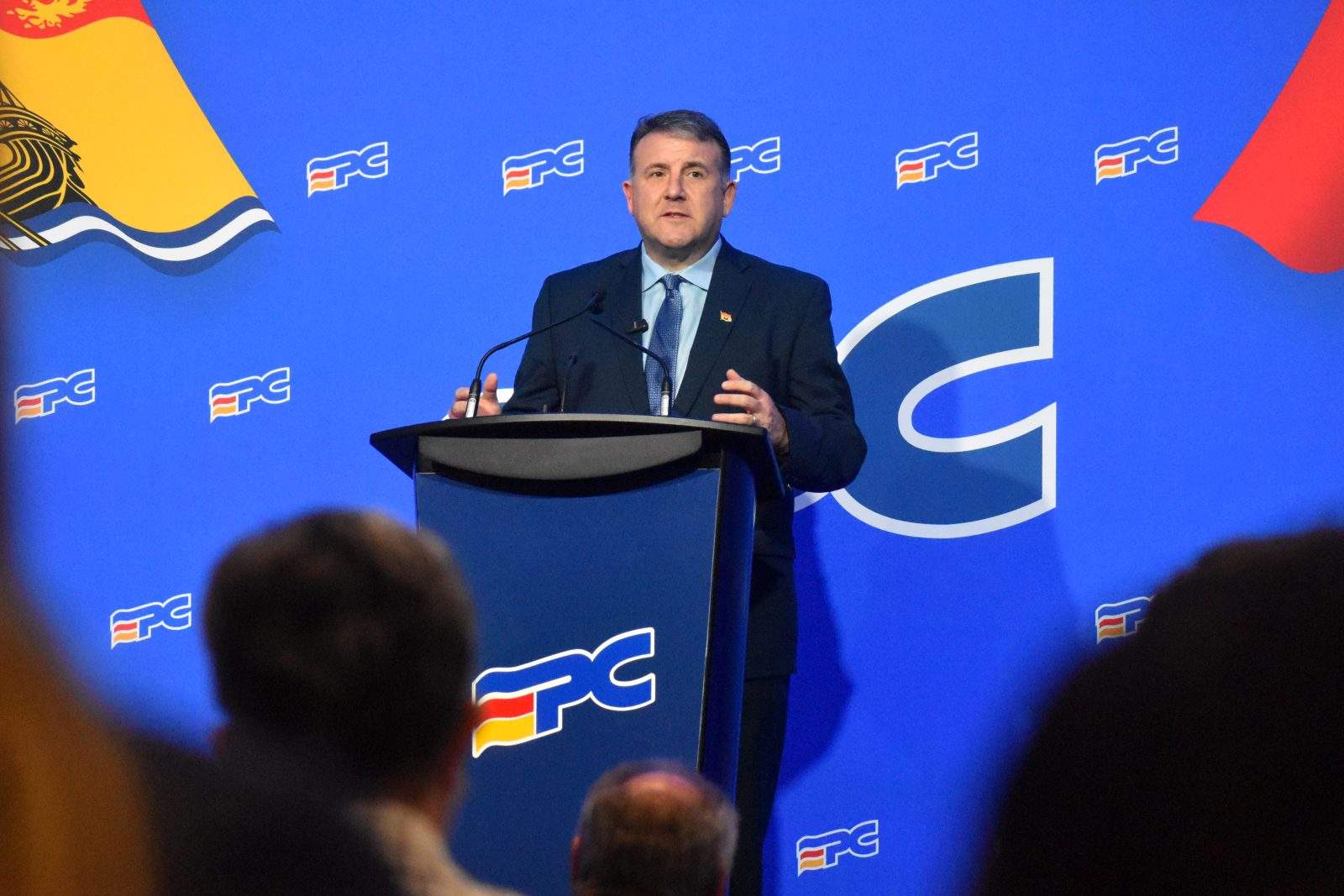
Daniel Allain did not rescue New Brunswick’s Progressive Conservatives on October 17, 2026. He inherited a smoking crater and a party that still refuses to diagnose why it blew up.
Standard political coverage treats Allain’s 58.6% to 41.4% victory over MLA Don Monahan as a neat reset button. Bilingual former minister. Local governance reformer. Moderate counterbalance to Blaine Higgs. Supposedly, that combination automatically solves the PCs' francophone problem, heals caucus wounds, and puts the party back on track to defeat Susan Holt’s Liberals.
That is lazy consensus. It mistakes a leadership crown for a coalition.
Anyone who has watched Atlantic Canadian political campaigns up close—and I have spent enough war rooms watching well-meaning "unity candidates" get shredded by structural math—knows how this movie usually ends. When a party loses nine seats in a general election, drops to 16 in the legislature, and watches its outgoing leader lose his own riding, crowning a familiar insider does not erase the fault lines. It exposes them in daylight.
The Lazy Consensus Around Daniel Allain
Look at the standard talking points surrounding Allain’s win. First, pundits argue that because Allain is francophone and Moncton-rooted, he automatically restores PC competitiveness in Acadian ridings. Second, they claim his 2023 vote alongside opposition members on school gender policy proves he is a pragmatic bridge-builder who can widen the tent. Third, they assume a single leadership vote settles the ideological argument inside the PCs.
Every single one of those assumptions skips the hardest arithmetic in New Brunswick politics.
Linguistic identity is not a magic wand in a province where political alignment shifts across economic regions, urban-rural divides, and cultural grievances. Allain defeated Monique LeBlanc in Moncton East in 2020 with 45.17% of the vote, then lost the seat in 2024 to Alexandre Cédric Doucet. Having a bilingual leader helps messaging in Moncton and northern ridings, yet bilingualism alone cannot turn skeptical voters into loyalists when a party’s brand has been pulled in two directions at once.
Even more telling is the reaction from inside the right. Within days of Allain’s win, party member Jason Purdy announced plans to launch a new centre-right vehicle—the New Brunswick Party—explicitly because he views Allain as too socially progressive and called him a "Liberal Lite". Allain brushed off the threat, noting that parties come and go in New Brunswick and pointing out that roughly 4,000 members voted in the leadership contest.
That brush-off misses the point. You do not need a rival party to poll at 30% to hurt a rebuilding opposition. In tight provincial ridings, peeling away even 4% to 8% of fiscal-conservative or socially traditional voters hands seats straight to the governing Liberals.
A party that fights its civil war in public while sitting in opposition does not look moderate to the center. It looks disorganized to everyone.
"Progressive Conservative" Is Not a Slogan. It Is a Tension.
Veteran New Brunswick watchers like CBC’s Jacques Poitras and political analysts who track Maritime coalitions have pointed out for years that PC divisions rarely stay buried when power slips away. The party’s name itself holds two impulses that frequently collide: fiscal restraint and social moderation.
Allain has leaned openly into framing the party as "socially progressive and fiscally responsible," calling that balance a 150-year tradition. On paper, that sounds like sensible centrist positioning. In practice, political coalitions in New Brunswick are brittle when voters feel forced to choose between cultural values and pocketbook relief.
During the Higgs era, Allain oversaw sweeping local governance reforms that consolidated hundreds of local entities into fewer than 100. That was heavy administrative lifting—and politically hazardous work. Structural municipal reform creates winners and losers in towns and rural service districts alike. Some residents praise modernization and clearer accountability; others remember higher tax bills, lost local identity, or clumsy implementation.
Meanwhile, Allain’s cabinet exit in June 2023 and his break with Higgs over school policy on gender identity and sexual orientation gave him instant credibility with critics of the former premier. Yet governing Liberals have already tried to pin the "Higgs-Allain government" label back onto him.
Imagine a scenario where Allain campaigns in 2028 on a promise of disciplined fiscal management and broad inclusion. Liberal strategists will immediately ask two questions: if you were part of the Higgs cabinet that pushed controversial policies and restructured local governance, why did it take a leadership vote to object? And if you are now championing social progressivism, why are hardline conservatives walking out the door?
Neither question is easy to answer with a soundbite. Both require a coherent governing record and a unified bench—neither of which is guaranteed when Allain starts out without a seat in the legislature.
The Questions People Are Actually Asking (And Why They Miss the Mark)
When a provincial party changes leaders after a bruising defeat, search traffic and coffee-shop debates cluster around predictable questions. Most of them point people toward the wrong diagnosis.
Does Daniel Allain’s win mean the PCs are ready to beat the Liberals?
No. Winning a party leadership race with 2,543 votes out of roughly 4,000 ballots cast proves you organized your base better than a rookie MLA. It does not prove you can win a general election across 49 ridings.
In fact, signing up roughly 2,815 members during the race—slightly ahead of Monahan’s 2,357—shows how narrow the active party base currently is in a province of over 800,000 people. General elections are won by persuading swing voters who care about healthcare wait times, housing costs, and affordability, not just party insiders debating past caucus votes.
Is Allain’s "49/49 strategy" realistic?
Allain has talked about needing a "49/49 strategy" so the PCs are competitive in every riding across New Brunswick. As an aspiration, competing everywhere is fine. As a short-term operational plan, it is a trap.
I have seen opposition parties burn scarce fundraising dollars trying to look equally strong everywhere at once, only to lose winnable suburban and swing seats by a few hundred votes. With a $35,000 leadership entry fee, a $250,000 leadership spending limit, and a party rebuilding from 16 seats, resource discipline matters far more than sweeping slogans. You win a province by locking down your core, targeting specific swing ridings, and recruiting credible local candidates long before writ drop.
Did Higgs’s departure solve the PCs' biggest vulnerability?
Removing a polarizing leader removes a lightning rod; it does not automatically repair damaged relationships. Blaine Higgs’s exit after losing his own seat in 2024 closed a chapter, yet the underlying tension between populist/traditional conservatives and institutional/moderate conservatives did not vanish on October 17.
When a leader has no legislative seat, every day outside the chamber is a test of relevance. Sitting MLAs carry the daily combat in question period while the leader campaigns from the outside, waiting for the right moment or seat opening to enter the house. That dynamic creates natural friction unless roles and discipline are ironclad from day one.
Comparing the Real Contenders and Fault Lines
To see what Allain is actually up against, strip away the victory speech and look at the concrete realities shaping the party right now.
| Factor | Conventional Narrative | Reality on the Ground | Risk for PCs |
|---|---|---|---|
| Leadership Mandate | Decisive reset after a tough race. | 58.6% win over one rival in a modest turnout pool (~4,000 votes). | Overreading membership math as broad public momentum. |
| Francophone Outreach | Bilingual insider fixes Acadian weakness automatically. | Language helps communication, but regional and policy grievances still cut across lines. | Assuming identity alone converts skeptical ridings. |
| Right-Flank Cohesion | Fences mended once the vote ends. | Critics already threatening a rival party over social policy. | Vote-splitting in tight ridings if discontent hardens. |
| Legislature Presence | Strong voice guiding the party forward. | Allain begins without a seat in the legislature. | Ceding daily spotlight to caucus rivals or government ministers. |
Where This Contrarian Take Can Go Wrong
Honesty requires naming the blind spots in a skeptical argument. A contrarian case against Allain could fail if three things break his way.
First, political memory in New Brunswick can be shorter than commentators expect when cost-of-living pressures mount. If the governing Liberals stumble on healthcare access, economic growth, or fiscal management over the next two years, voters frustrated with the incumbent government may warm to a seasoned administrator with public- and private-sector management experience.
Second, breakaway right-wing parties in Atlantic Canada often struggle with candidate recruitment, ballot organization, and funding once election rules tighten. What sounds loud in October can shrink fast by election night if voters conclude a protest vote only helps the Liberals.
Third, Allain’s background—spanning municipal politics in Dieppe, running NB Liquor, working in senior government administration, and managing corporate affairs—gives him operational familiarity with how the provincial machinery works. If he pairs steady management with genuine listening in francophone and anglophone communities alike, he can rebuild credibility step by step.
What Allain Actually Needs to Do Next
Stop giving unity speeches and start doing unglamorous political triage.
- Pick your battles in the legislature. Align tightly with sitting PC MLAs so caucus messaging stays disciplined and sharp during session. Public squabbling is free ammunition for the government.
- Define fiscal conservatism in plain numbers. Do not rely on the phrase "fiscally responsible" as a bumper sticker. Show concrete trade-offs on spending, debt, and affordability that hold up under scrutiny.
- Earn trust riding by riding, not by press release. Rebuilding after a nine-seat loss takes local organizing, strong candidates, and real presence in communities that felt ignored—both English and French.
Crowns do not win elections. Discipline, math, and unity do.