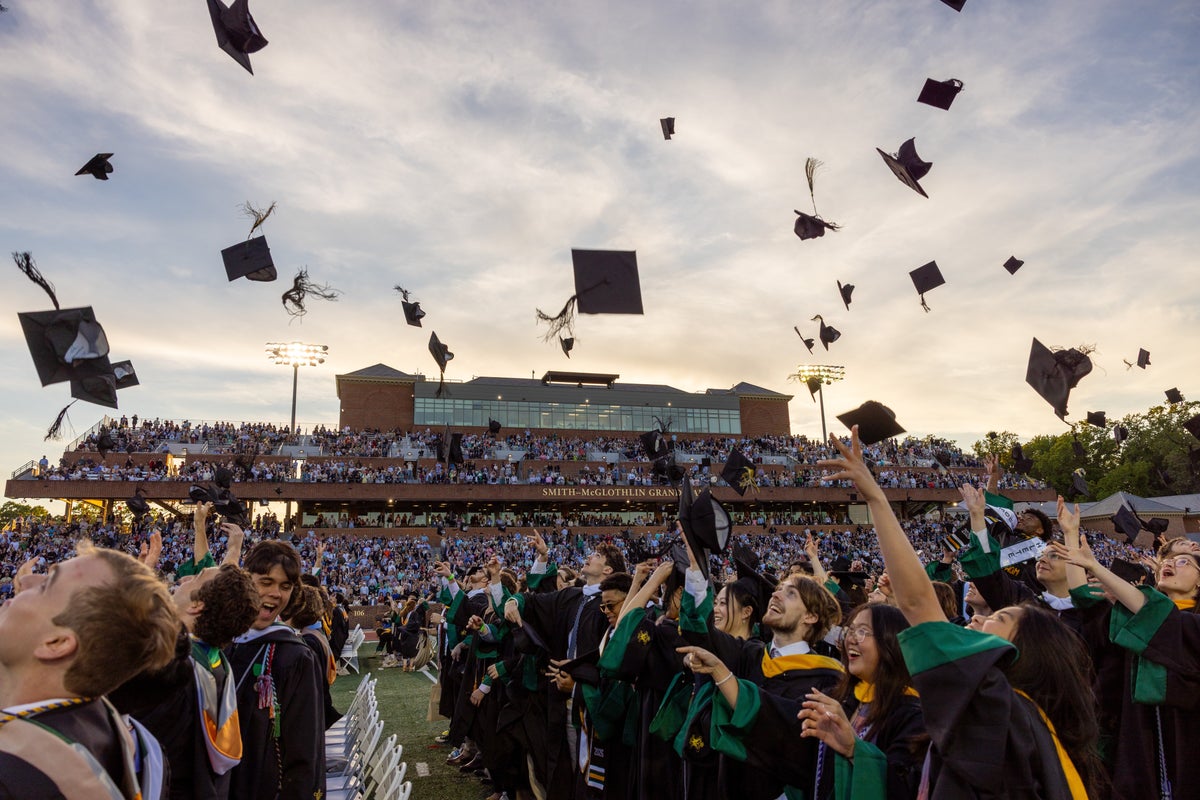
The plastic chairs on the campus lawn were hot. For four years, the routine was predictable: cram for midterms, drink too much coffee, borrow rent money, and survive. Now, the heavy polyester gown trapped the midday heat, sticking to the small of the back.
Then came the speech.
It was supposed to be the victory lap. Instead, the keynote speaker—a tech executive in a tailored suit—began talking about the glorious efficiency of artificial intelligence. He spoke of automation, optimization, and the sweeping horizon of a frictionless world.
He expected applause. He got a wall of noise.
It started as a low rumble in the back rows, a collective throat-clearing of hundreds of twenty-two-year-olds who had just spent eighty thousand dollars for a piece of paper. Then, it crystallized. A sharp, piercing hiss. A chorus of boos. It rolled over the stage like a wave, drowning out the expensive sound system. The executive froze, his mouth open, a PowerPoint slide glowing uselessly behind him.
This scene is no longer an isolated meltdown. Across the country, commencement ceremonies have turned into ideological battlegrounds. Graduates are actively shouting down the very technology that was supposed to save them.
They aren’t doing it because they hate progress. They are doing it because they are terrified.
The Mirage of the Entry-Level Gig
For decades, the deal was simple. You endure the sleepless nights, you take on the crushing debt, and in return, you get your foot in the door. You start at the bottom—sorting data, drafting basic memos, scheduling meetings, writing rudimentary code. You do the grunt work.
That grunt work was the ladder. But the ladder is missing its bottom rungs.
Consider a hypothetical graduate named Maya. She represents thousands of real students entering the workforce this year. Maya spent four years mastering Python and software architecture. Five years ago, her skill set would have triggered a bidding war among mid-sized tech firms. She would have started as a junior developer, learning the ropes from senior engineers while making a livable wage.
Today, those junior developer roles are vanishing.
A single manager utilizing an advanced AI copilot can now do the work that used to require a team of three entry-level engineers. The basic code generation, the debugging, the syntax checking—the tasks that used to be Maya’s ticket into the industry—are completed in seconds for the cost of a software subscription.
When university presidents invite tech evangelists to preach about the beauty of this disruption, it feels less like inspiration and more like mockery. The boos aren't a rejection of the tool; they are a protest against the erasure of their future.
The Quiet Panic in the Rows
To understand the friction, you have to look at the numbers behind the anxiety. Recent labor data reveals a jarring shift: hiring for entry-level college graduate positions has slowed significantly, even as overall employment figures remain stable. Companies are hoarding senior talent while freezing the pipeline for newcomers.
The math is brutal. The average student loan debt hovers around thirty-seven thousand dollars. Interest accumulates daily. When a commencement speaker tells a crowd that AI will "streamline corporate operations," what the graduate hears is: You will not be able to pay your rent next month.
It is easy for tech executives to dismiss this as standard generational anxiety. Every generation faces disruption. The weavers fought the mechanical looms; the typists fought the personal computer. But those transitions had a different geometry. The mechanical loom replaced the hand, not the mind. The personal computer required a human operator to function.
The current wave of automation is different. It targets cognitive labor. It mimics synthesis. It drafts the legal brief, writes the marketing copy, and analyzes the financial spreadsheet. It targets the exact skills that universities teach.
The Broken Promises of the Ivory Tower
The anger is also directed inward, toward the institutions that collected the tuition. Higher education is an oil tanker trying to turn in a canal. It takes years to approve a new curriculum, decades to tenure a faculty. Meanwhile, the baseline capabilities of machine learning models shift every six months.
Students are graduating with skills that became obsolete while they were studying them. They spent semesters learning formatting styles, database management structures, or basic graphic design principles that can now be executed by a prompt in a chat window.
The realization is a slow, cold sickness. You sit in a lecture hall for four years, listening to professors who haven't worked in the private sector for twenty years, only to enter a market that has completely rewired itself while you were reading textbooks.
When the commencement speaker stands up and praises the "agility" of the new economy, the hypocrisy becomes too loud to ignore. The university gets its tuition; the tech company gets its efficiency; the graduate gets a bill and a generic email rejecting their application for an unpaid internship.
The Evolution of the Protest
This isn’t a Luddite rebellion. The students booing at these ceremonies are the most technologically literate generation in human history. They use these tools every day. They know exactly what they can do.
And that is precisely why they are screaming.
They don't view the technology as a sci-fi miracle. They view it as a corporate mechanism designed to lower labor costs at their expense. They see the corporate world using automation not to liberate workers from drudgery, but to eliminate the worker entirely from the balance sheet.
The sound of hundreds of graduates booing a speaker is a rare moment of unscripted truth in an environment defined by carefully curated PR. It is the sound of a generation refusing to smile politely while their economic viability is rationalized away as "collateral friction."
The ceremony ends. The caps are thrown into the air, falling back down to earth in a chaotic flurry of mortarboards. The families gather for photos, smiling through the underlying tension, holding bouquets of grocery-store flowers.
Maya packs her gown into a plastic bag. She looks at her phone, at the rows of bookmarked job boards, at the automatic rejections sitting in her inbox. The celebration is over, the lawn is empty, and the silence that follows the protest is louder than the booing ever was.