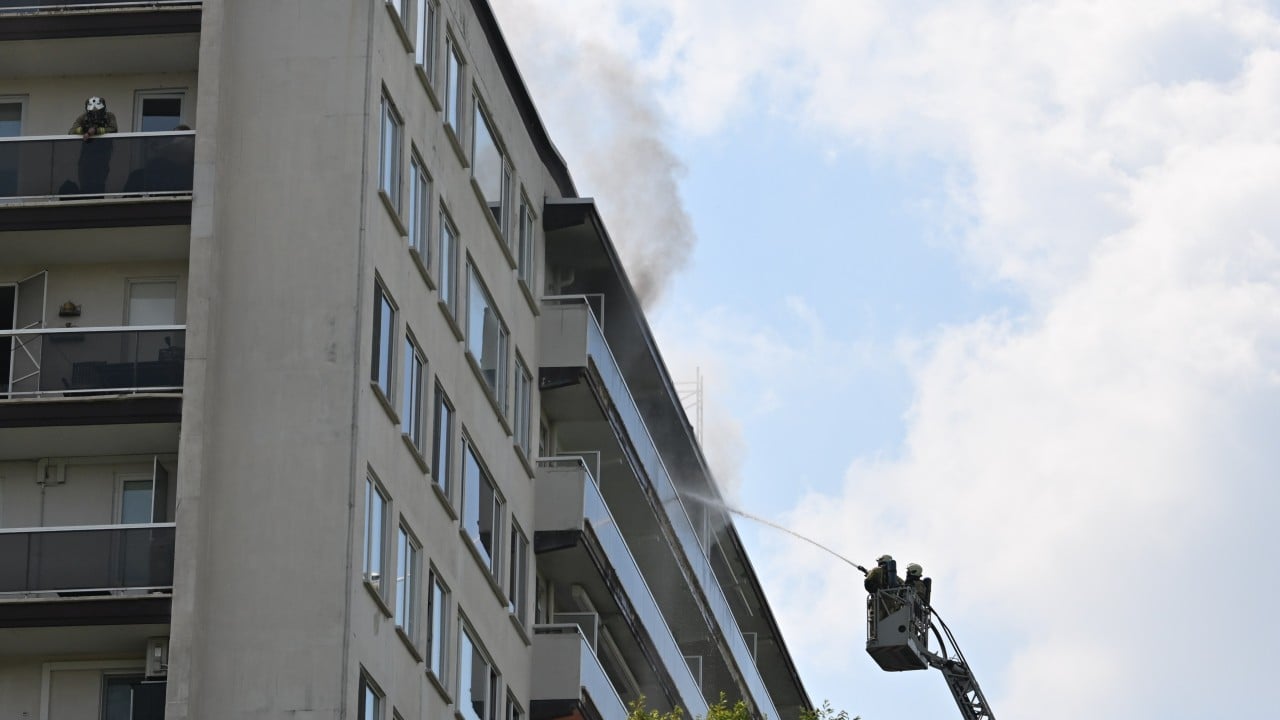
A standard Wednesday morning in the Linkeroever district of Antwerp ended in a predictable European horror story. A fire broke out on the ground floor of a ten-story residential building, killing at least five people, sending dozens to local hospitals, and trapping families on smoke-clogged balconies. While early alerts focused on a raging fire visible on the eighth floor, investigators quickly shifted attention downward. A technical failure on the ground floor had turned the entire building structure into a vertical furnace, proving once again that Europe's aging concrete housing stock remains a ticking structural hazard.
This disaster is not an isolated piece of bad luck. It is the direct consequence of mid-century architectural designs that treat elevator shafts and stairwells as open chimneys during a ground-floor crisis.
The Chimney Effect in Post War Housing
When the fire ignited at 9:53 AM in the ground floor utility spaces of the Linkeroever tower, the residents living on the upper floors had no idea they were already trapped.
The building houses more than 200 people across 80 apartments. Within three minutes of the power cutting out, thick black smoke had already filled the corridors of the tenth floor. This happens because of a well-documented engineering vulnerability known as the stack effect. When a fire starts at the base of a high-rise, the hot air rises rapidly through any vertical opening, drawing toxic smoke upward with immense pressure.
Mid-century European high-rises rarely feature the sophisticated pressurized stairwells found in modern corporate towers. Instead, they rely on heavy fire doors that residents frequently prop open for convenience, or older seals that fail under intense heat. When those barriers fail, the central stairwell ceases to be an escape route. It becomes a chimney.
Survivors described opening their front doors only to be met by a solid wall of toxic black fog. For eighty-year-old Jaklien Heeren on the fifth floor, a split-second decision to run through the emerging flames saved her life. For others, the only option was retreat. Residents on the top floors barricaded themselves in their apartments, fleeing to their terraces to wait for fire department ladders.
Why European Fire Standards are Failing in Practice
On paper, Western European fire regulations are among the strictest in the world. In reality, those regulations are frequently written for new construction, leaving millions of residents living in legacy blocks built between 1960 and 1980 completely unprotected.
The Antwerp tragedy exposes three critical regulatory gaps that municipal governments across the continent continue to ignore.
The Myth of Compartmentalization
Modern fire safety relies on the principle of containment, the idea that a fire should be locked inside its room of origin for at least 60 minutes. In older buildings, renovations over decades have compromised these barriers. Utility companies drill holes through concrete floors to run fiber-optic cables, internet lines, and modern plumbing. If these penetrations are not meticulously resealed with specialized fire-stop materials, they create hidden pathways for smoke to bypass fire doors entirely.
Inadequate Automatic Suppression Systems
Retrofitting older, occupied residential blocks with automated sprinkler systems is expensive, complex, and politically unpopular. Consequently, landlords and local housing authorities opt for minimal compliance, installing basic smoke detectors in common hallways while ignoring the internal utility shafts where electrical faults actually begin. When a ground-floor failure happens, there is no localized system to suppress the spark before it catches the building's main infrastructure.
The Limits of External Rescue
We saw dramatic footage of rescuers lowering residents from the side of the Antwerp tower using ropes and ladders. It makes for heroic journalism, but it is an indictment of the building's internal safety. Fire ladders have strict height limitations, often maxing out around the seventh or eighth floor depending on street access and wind conditions. Anyone trapped above that line is entirely dependent on the structural integrity of their apartment door and the speed of the interior attack crew.
The Hidden Threat of Mechanical Failure
The Antwerp police department quickly clarified that the disaster originated from a technical failure rather than arson or resident negligence. This phrasing is a polite shield for a systemic infrastructure crisis.
As these buildings cross the half-century mark, their internal electrical grids are being pushed far past their engineered lifespans. Ground-floor electrical substations, aging transformer units, and main distribution panels are working harder than ever to power a modern lifestyle filled with high-draw consumer electronics, air conditioning units, and vehicle charging systems that the original 1970s architects never anticipated.
When an ancient breaker fails or a main cable overheats in a ground-floor utility room, it sits directly beneath the building's primary exit points. A single catastrophic failure at the base cuts the power to the entire building, plummets the stairwells into darkness, disables the elevators, and starts a fire at the exact spot where residents are supposed to evacuate.
The Cost of Inaction
Local politicians routinely offer thoughts and condolences after these events. Belgian Prime Minister Bart De Wever expressed his deep appreciation for the emergency services, but appreciation does not fix a faulty junction box or install a fire damper in a ventilation shaft.
The structural changes required to make these buildings safe are well known to forensic engineers. They require mandatory retrofitting of automated fire doors, the complete sealing of all vertical utility shafts with certified fire-rated materials, and the installation of external, pressurized escape stairs.
Until municipal governments shift from reactive mourning to mandatory infrastructure spending, the concrete towers housing Europe’s working class will remain vertical traps waiting for the next short circuit.