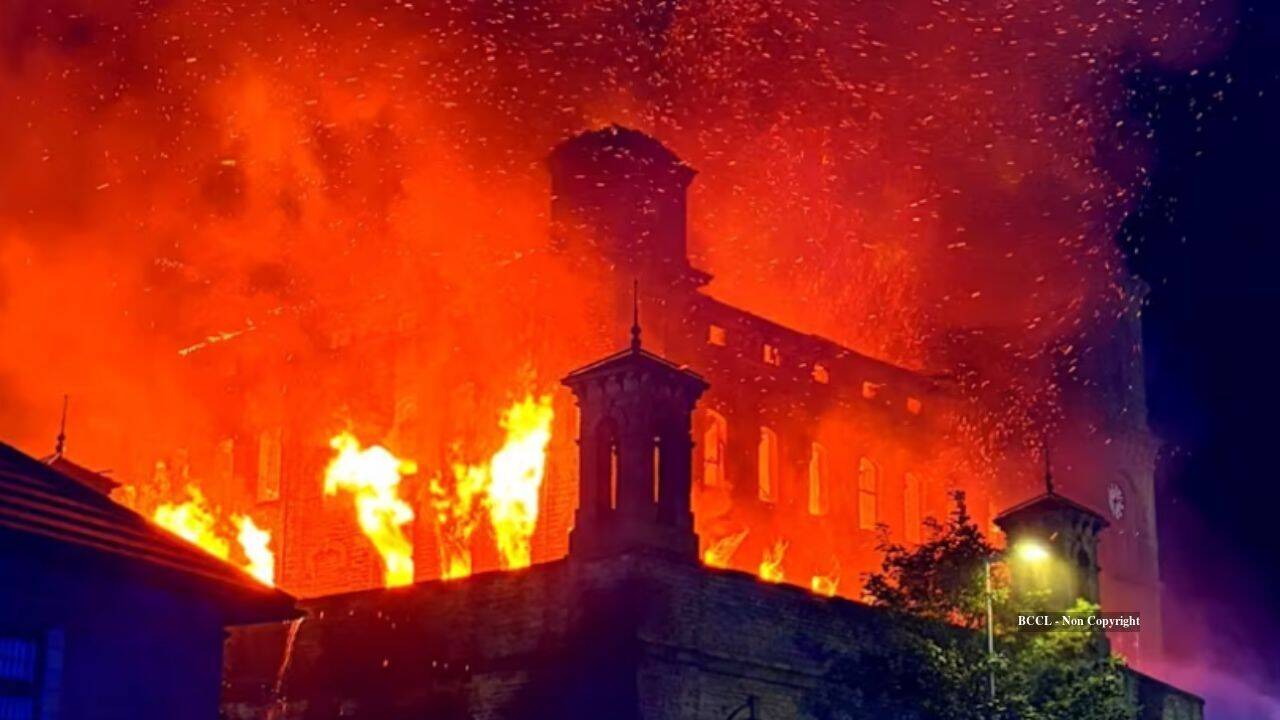
The smoke over Keighley was thick enough to choke the history right out of Yorkshire. When twelve fire engines converged on Dalton Mills, it was not just an emergency response to another blaze at a derelict Victorian complex; it was another catastrophic chapter in the slow-motion destruction of Britain’s architectural heritage. The sprawling 19th-century textile landmark, once a powerhouse employing over two thousand workers and later immortalized as a gritty backdrop for Peaky Blinders and Downton Abbey, has burned again.
This is not merely a story of bad luck or spontaneous combustion. It is a chronic failure of accountability, ownership limbo, and urban neglect.
The Anatomy of an Avoidable Disaster
To understand why Dalton Mills keeps burning, one must look past the cinematic glamour of television crews and period dramas. Built during the absolute zenith of the British textile trade, the massive complex on Dalton Lane represents a monument to industrial ambition. Thick stone walls, timber internal floors, and vast open manufacturing bays made these buildings marvels of Victorian engineering. Those exact architectural traits, however, turn them into giant vertical firetraps once abandoned.
When production companies packed up their cameras, the economic reality set in. Operating and maintaining a Grade II listed historic structure costs an astronomical sum. Private owners faced insurmountable repair bills, local councils struggled with shrinking municipal budgets, and the building slipped into a legal purgatory.
Then came the fires.
A massive blaze gutted the interior in 2022, drawing over a hundred firefighters to combat an inferno that chewed through the historic roof and floors. Instead of triggering a robust, immediate fortification of the property, the site drifted further into administrative neglect. The Crown Estate assumed legal responsibility in 2024, yet the torch of ownership did little to shield the property from subsequent arson attacks in 2025 and a relentless sequence of deliberate fires in early 2026.
When a vacant industrial landmark burns repeatedly, the root cause is rarely accidental. It is a symptom of systemic abandonment.
The Illusion of Cinematic Preservation
There is a cruel irony in how modern media treats industrial ruins. Millions of viewers worldwide marvelled at Dalton Mills on their television screens, watching Cillian Murphy’s Shelby family stride through atmospheric, smoke-filled courtyards. That exposure created a false sense of security. Audiences assumed that because a building was famous, it was safe.
Television brings temporary glamour, not long-term endowment funds. Film crews arrive, write a locational fee check, paint temporary facades, and leave. They do not fund roof repairs, install modern fire suppression systems, or pay for round-the-clock private security details. Once the directors say cut, the historic fabric of the mill is left to fend for itself against trespassing, vandalism, and structural decay.
Heritage campaigners have pointed out this uncomfortable truth for years. Fame does not pay for tuck-pointing masonry or replacing fire-damaged timber trusses. When local authorities and national bodies treat these structures as convenient backlots rather than fragile community anchors, disaster becomes inevitable.
The Broader Crisis of Industrial Heritage
Keighley is far from alone in this fight. Across the North of England, towns built on the wool and cotton trades are littered with colossal brick monoliths that local governments cannot afford to demolish and private developers cannot afford to restore.
Consider a hypothetical post-industrial town in Lancashire where a comparable nineteenth-century mill sits vacant. The council wants to convert it into community housing or cultural studios, matching successful regeneration projects seen in other parts of the UK. Yet, the upfront remediation costs—removing asbestos, stabilizing compromised foundations, and meeting modern fire safety codes—exceed the total projected market value of the finished apartments by millions of pounds. Without aggressive government intervention or targeted heritage grants, the property sits empty. Empty properties attract trespassers. Trespassers invite arson.
At Dalton Mills, the cycle of destruction has nearly run its course. Each successive fire strips away another layer of irreplaceable history, turning authentic Victorian craftsmanship into charred rubble.
The emergency services will pack up their hoses, investigators will sift through the damp ash, and politicians will issue statements expressing deep concern. But unless the fundamental model of how Britain protects its industrial architecture changes, historic monuments will continue to burn down to their foundations while the bureaucracy watches from a safe distance.
A devastating fire at a historic Yorkshire mill
This visual report captures the scale of the emergency response and the severity of the damage inflicted on the landmark structure.