For decades, the global aerospace industry, satellite operators, and energy grid managers have relied on a straightforward rule of thumb to predict solar storms: count the blemishes on the face of the Sun. Sunspots have served as the fundamental metric for tracking the 11-year solar cycle. This method is fundamentally flawed. Groundbreaking helioseismic data reveals that the Sun's deep interior is undergoing a massive structural reorganization, generating intense magnetic forces that are completely hidden from traditional surface observations. This hidden activity explains why current solar storms are defying standard tracking models, posing an immediate, unmonitored threat to the technology keeping our modern world online.
Understanding this subterranean shift requires discarding the old assumption that what happens on the solar surface mirrors what happens underneath. Data compiled by the Birmingham Solar-Oscillations Network (BiSON) has exposed an escalating mismatch between the exterior metrics and the internal mechanics of Solar Cycle 25. While surface sunspot numbers suggest a relatively standard, naturally declining phase of solar activity, the acoustic vibrations echoing through the star tell an entirely different story.
The Acoustic Discovery of an Interior Shift
Astrophysicists cannot look directly into a star. Instead, they listen. Through helioseismology, researchers capture global sound waves—known as p-mode oscillations—that ripple through the plasma interior. As these acoustic waves move through regions of intense magnetic activity, their frequencies warp and shift. By sorting these signals into low-, mid-, and high-frequency bands, scientists can effectively map the internal geography of the Sun at various depths.
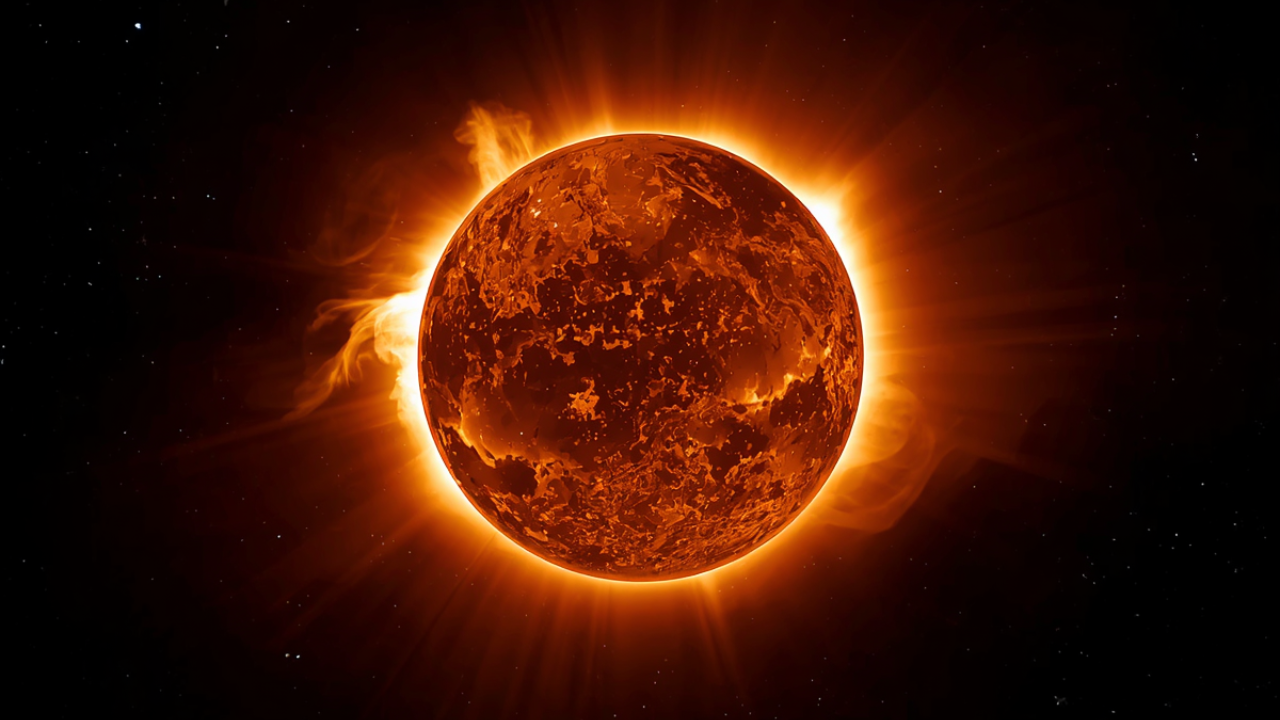
The latest analysis of nearly 40 years of BiSON data reveals a structural anomaly that traditional forecasting models never anticipated. Over the course of the last four solar cycles, the deep, churning dynamo that generates the Sun’s global magnetic field has begun compressing itself. The magnetic architecture is being squeezed upward into an ultra-shallow layer, concentrated strictly within 1,000 kilometers of the solar surface.
This means the magnetic engine driving our space weather is becoming increasingly skin-deep. When observed through high-frequency seismic bands, Solar Cycle 25 matches the raw internal intensity of the historic, hyperactive cycles of the late 20th century. Yet, on the outside, the sunspot counts do not reflect this underlying volatility. The internal engine is running at a dangerously high RPM, but the dashboard gauges on Earth are registering a normal cruise speed.
Why Surface Tracking Fails the Modern Grid
The failure to read these internal signals leaves our infrastructure vulnerable. Traditional space weather forecasting relies heavily on two proxies: the International Sunspot Number and the F10.7 radio flux. These metrics are historical artifacts, chosen because they were the only things 19th and 20th-century astronomers could reliably observe from the ground. They assume that a strong internal magnetic field will always force its way to the surface, bursting through the photosphere to create visible sunspots.
The current structural reorganization shatters that assumption. Yale University astronomer Sarbani Basu notes that this evolving relationship between internal solar oscillations and surface activity cannot be explained away by simple fluctuations in magnetic strength. The geometry of the star's magnetic storage has changed.
The practical consequences of this blind spot are already materializing. Early predictions from the international consensus panels estimated that Solar Cycle 25 would be exceptionally weak, mirroring the quiet behavior of Cycle 24. Relying on those peaceful projections, infrastructure operators planned their satellite lifespans and power grid maintenance schedules with a false sense of security. Instead, the cycle overshot those surface-level predictions, unleashing severe geomagnetic storms that triggered widespread satellite orbital decay and forced emergency power redirections across high-latitude grids.
The Mechanics of a Skin Deep Dynamo
To comprehend the threat, one must look at the traditional solar dynamo model. In a standard cycle, magnetic fields are amplified deep within the tachocline—the transition zone between the radiative core and the convective exterior. These fields build buoyancy, eventually rising through hundreds of thousands of kilometers of plasma before puncturing the surface.
[Old Model: Deep Dynamo]
Tachocline (Deep) -> Buoyant Rise -> Photosphere (Sunspots)

[Current Observation: Compressed Dynamo]
Tachocline (Weakened) -> High Concentration (<1,000km Subsurface) -> Volatile Space Weather
The compression of this activity into a shallow 1,000-kilometer subsurface band changes the physics of eruption. When magnetic fields are confined to a narrow, highly turbulent zone just beneath the surface, they interact far more chaotically. The plasma in this upper shear layer moves at wildly different velocities depending on latitude and depth. Forcing the Sun's magnetic field into this violent boundary layer increases the likelihood of rapid, unpredictable magnetic reconnection events. These events are the precise triggers for X-class solar flares and coronal mass ejections.
Because the fields are trapped in this shallow reservoir, they do not need to form massive, deeply rooted sunspot groups to store immense energy. They can snap, twist, and erupt with very little warning on the surface. We are no longer dealing with a predictable, slow-boiling pot; we are dealing with a pressurized surface film ready to rupture.
Implications for Earth and Orbiting Systems
This systemic change in solar behavior is occurring at the worst possible moment for human civilization. Our dependence on orbital infrastructure has grown exponentially since the last major solar maximum. Low Earth Orbit (LEO) is now crowded with thousands of commercial satellite constellations providing global internet, navigation, and defense telemetry.
When an unpredicted coronal mass ejections strikes the upper atmosphere, the sudden influx of X-ray and ultraviolet radiation ionizes the thermosphere. This causes the upper atmosphere to heat and expand outward. Satellites in LEO suddenly find themselves flying through a much denser soup of gas than they were designed to handle. The resulting atmospheric drag degrades orbits rapidly, potentially causing catastrophic asset losses for operators who missed the warning signs because surface sunspot metrics looked clear.
On the ground, the risks to high-voltage transformer networks are equally severe. The rapid fluctuations of Earth's magnetic field during a solar storm induce geomagnetically induced currents (GICs) directly into long-distance power lines. These currents saturate transformer cores, causing rapid overheating and potential grid collapse.
Rebuilding the Forecasting Model
The discovery of this hidden internal signal means our existing predictive infrastructure is obsolete. We cannot continue managing space weather risks using a system developed during the analog era.
Transitioning to an interior-first forecasting model requires a significant shift in resources:
- Continuous Helioseismic Monitoring: Ground networks like BiSON and GONG must be treated as critical national security assets, receiving sustained funding to provide real-time acoustic tracking of the subsurface shear layers.
- Space-Based Acoustic Platforms: Deploying dedicated orbital helioseismology instruments capable of tracking high-frequency p-mode variations without the atmospheric distortion experienced by ground-based telescopes.
- Dynamic Dynamo Modeling: Abandoning static 11-year cycle assumptions in favor of fluid magnetohydrodynamic models that account for the decadal migration of magnetic storage depths.
The scientific community has confirmation that the Sun's internal biorhythm has shifted into an unfamiliar mode of operation. The current cycle has proved that the star's interior can remain highly volatile even as its surface appearance calms down. If the aerospace and energy sectors continue to judge the danger solely by the number of spots on the solar surface, they will eventually find themselves blind to a catastrophic orbital or grid event. The signal is vibrating loudly beneath the surface, and it is time to start listening.