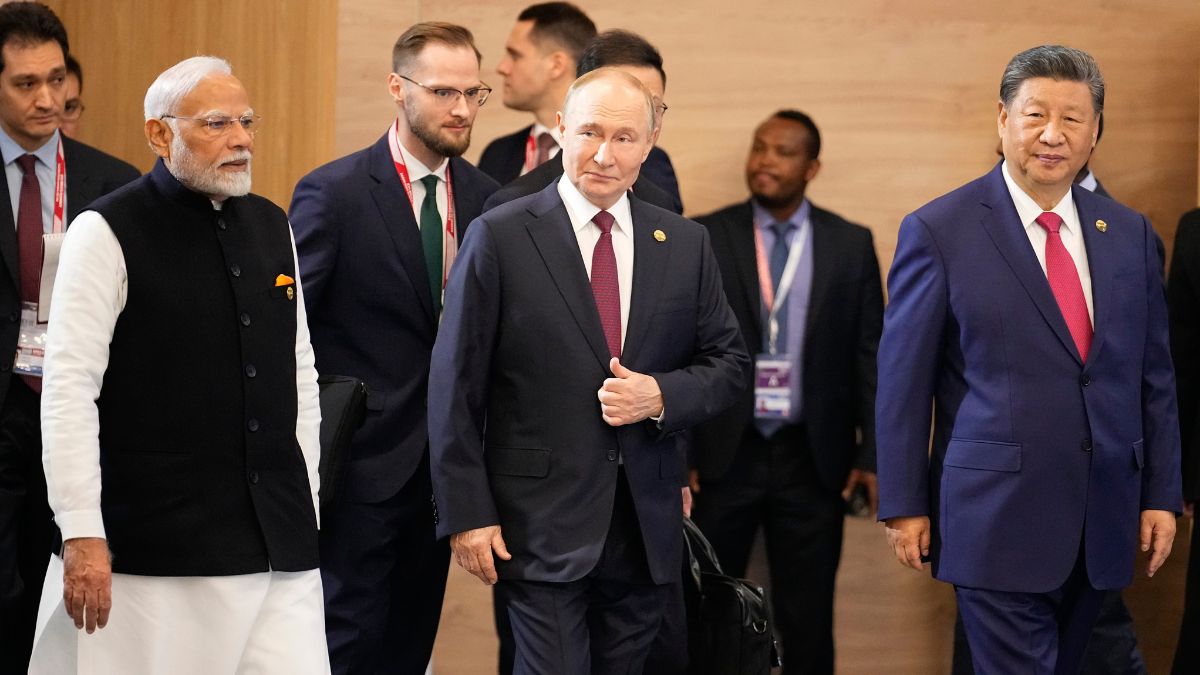
Every western commentary piece published right before a BRICS summit reads like a bad spy thriller written by an actuary. You have read the standard script a hundred times. China and Russia make a strategic advance, India gets squeezed between western security architectures and eastern economic gravity, and analysts hyperventilate about whether the dollar is about to collapse into a smoking crater.
It is lazy, flat-footed thinking. It assumes international relations operate like a playground scuffle where nations permanently take sides based on playground loyalties.
I have spent years watching corporate supply chains pivot overnight and listening to trade negotiators trade insults behind closed doors in Geneva and Singapore. The conventional narrative claims Beijing and Moscow are engineering a masterstroke to pull New Delhi into an anti-western economic bloc. It completely misses the structural reality. India is not a pawn being played by the Kremlin or Zhongnanhai. India is running its own sovereign playbook, one that treats bilateral partnerships as transactional utilities rather than blood oaths.
The Fallacy of the Monolithic East
Let us dismantle the core delusion. The Western press loves to group BRICS together as a cohesive ideological counterweight to the G7. This is wishful thinking born of lazy categorization.
Moscow and Beijing share an urgent, burning need to bypass Western financial plumbing because of comprehensive sanctions regimes. New Delhi has no such existential panic. India is the fastest-growing major economy on earth, sitting comfortably on a mountain of foreign exchange reserves, trading aggressively with the United States and Europe while simultaneously buying discounted Russian crude and negotiating bilateral trade terms with Beijing from a position of demographic strength.
When China and Russia make diplomatic or economic overtures toward India ahead of a multilateral summit, Washington hyperventilates that New Delhi is slipping away. That panic stems from a fundamental misunderstanding of Indian foreign policy tradition. Strategic autonomy is not a buzzword diplomats throw around at cocktail parties; it is a hardwired geopolitical operating system.
India does not want a unipolar world dominated by Washington, and it certainly does not want a unipolar Asia dominated by Beijing. New Delhi wants a multipolar order where it serves as one of the primary poles. If you evaluate Indian diplomacy through the lens of Western alliance politics, every move looks like a betrayal or a paradox. Evaluate it through the lens of unvarnished national self-interest, and every single puzzle piece clicks violently into place.
The Energy Pragmatism Myth
Look at how the commentary class treats India's oil imports from Russia. Pious editorial boards in London and New York throw their hands up in despair, asking how the world's largest democracy can undermine Western sanctions.
The answer is brutally simple. India has 1.4 billion people to feed, electrify, and transition into a modern industrial base. When global energy markets experience severe volatility, prime ministers do not sacrifice their domestic industrial output on the altar of distant geopolitical signaling. Buying Russian oil at a discount is not an ideological endorsement of Vladimir Putin's military campaigns; it is basic economic hygiene.
Furthermore, Western critics conveniently forget that European nations spent years quietly buying Russian natural gas through convoluted intermediaries while lecturing developing nations on moral purity. India simply cut out the middlemen and did it openly, refusing to apologize for prioritizing the economic welfare of its working class over the comfort of Western think tanks.
Beijing watches this transactional ruthlessness with a mixture of professional respect and deep anxiety. China wants junior partners. India refuses to be anyone's junior.
The Border Paradox
You cannot talk about Sino-Indian dynamics without addressing the elephant in the Himalayas. The Line of Actual Control remains heavily militarized, and the memory of the 2020 Galwan Valley skirmish casts a long shadow over every bilateral handshake.
The lazy narrative says that because India and China sit in the same room at BRICS summits, their deep-seated territorial and security competition has somehow evaporated. That is nonsense. Economic engagement and strategic containment can, and do, coexist simultaneously in the modern global economy.
India bans Chinese apps, scrutinizes Chinese foreign direct investment with a microscope, and aggressively fortifies its northern border. At the exact same time, Indian manufacturers import critical active pharmaceutical ingredients and heavy machinery components from China because complete decoupling overnight is economic suicide.
This is the nuance the headline-writers miss. Modern statecraft is not an all-or-nothing game. Nations can be fierce geopolitical rivals in one domain and pragmatic commercial partners in another. Washington struggles to understand this because American political culture demands moral clarity and clean narratives. Asia operates in perpetual shades of gray, where countries cooperate and compete in the same breath.
What the Financial Markets Are Missing
Investors who pull capital out of emerging markets every time a geopolitical pundit screams about BRICS de-dollarization are throwing money away based on ghost stories.
A unified BRICS currency is a pipe dream. You cannot fiat a common currency into existence without shared fiscal policy, integrated banking systems, and deep mutual trust—three things Moscow, Beijing, and New Delhi fundamentally lack. China wants the yuan to be the dominant regional hegemon. India has zero intention of replacing Western currency dominance with Chinese currency dominance. They would much rather trade in local currencies where bilateral deficits permit, insulating themselves from Western financial leverage without signing up for a Beijing-run monetary empire.
The real story ahead of these summits is not about the death of the dollar or the birth of an anti-western axis. It is about the messy, chaotic construction of a polycentric financial architecture where middle powers refuse to let Washington or Beijing dictate the terms of their sovereignty.
Stop looking for dramatic paradigm shifts. Look at the quiet, grinding machinery of bilateral trade agreements, supply chain diversification, and technological self-reliance. That is where the actual game is being played. And right now, New Delhi is playing it better than anyone else at the table.