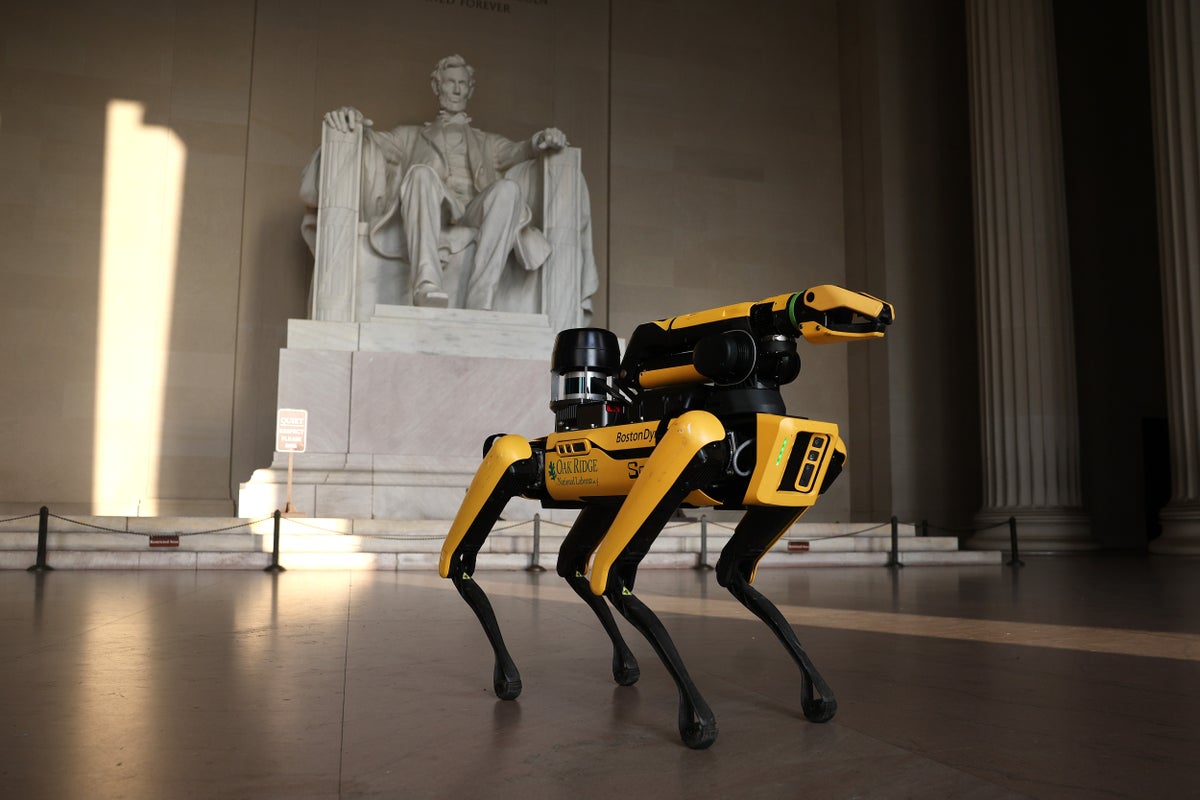
Federal procurement filings from the Department of Homeland Security indicate that U.S. Immigration and Customs Enforcement intends to allocate between one and two million dollars toward acquiring quadruped robotic platforms. This capital expenditure targets the integration of remote-operated robotic systems—specifically platforms designed by Boston Dynamics—into high-risk tactical environments. Deconstructing this procurement requires looking past surface-level media narratives of futuristic policing and instead evaluating the underlying unit economics, operational bottlenecks, asset amortization curves, and strategic substitution effects driving federal adoption of field robotics.
The capital allocation of two million dollars represents a fractional line item relative to broader federal security budgets, yet it unlocks a distinct tier of asset deployment. With standard industrial quadruped units priced at approximately seventy-five thousand dollars base, the proposed funding ceiling permits the acquisition of roughly twenty to twenty-six operational units alongside necessary payload modules, spare power cells, and command hardware.
Allocating capital toward robotic systems instead of human personnel introduces a fundamental shift in operational risk mitigation. Traditional entry protocols into confined, obstructed, or subterranean environments expose tactical teams to asymmetrical hazards, including structural collapses, unmapped architectural layouts, and concealed hostile actors. Deploying a mechanical asset transforms a high-fatality-risk reconnaissance phase into a zero-personnel-risk telemetry gathering phase.
The economic rationale rests on liability minimization and asset replaceability. The total cost of a tactical entry involving personnel injury encompasses medical liabilities, operational downtime, investigative inquiries, and potential litigation. A quadruped robot functions as a disposable capital asset. When an asset absorbs catastrophic damage during an interior breach, the financial loss is strictly bounded by replacement cost, whereas human injury introduces unbounded variables.
The Mechanics of Remote Tactical Insertion
Integrating robotic quadrupeds into field operations alters the tactical timeline through three distinct mechanical advantages: sensory persistence, spatial penetration, and cognitive offloading.
Tactical officers operating under adrenaline compression experience severe cognitive tunneling and narrow visual fields. A quadruped equipped with 360-degree optical arrays, thermal sensors, and gas detection payloads provides an objective, uncompressed telemetry feed to command elements stationed outside the hazard zone. This continuous data stream removes the fog of entry operations.
Spatial penetration represents the second vector of utility. Standard architectural barriers, such as industrial doors, low-clearance crawlspaces, and rubble-strewn entryways, typically require manual breaching tools that compromise stealth and expose operators. Modern quadruped manipulators feature mechanical arms capable of turning levered handles, stabilizing against uneven terrain, and righting the chassis after a fall. The machine translates complex physical geometry into traversable coordinates without risking human musculoskeletal injury.
The third mechanism involves cognitive offloading. By delegating initial structure clearing to a remote operator viewing a terminal, the agency shifts the primary burden of exposure from biological assets to silicon systems. The operator makes tactical decisions from a ballistic-shielded perimeter rather than the threshold of a breach point.
Procurement Patterns and Systemic Scaling
This acquisition does not occur in a vacuum; it aligns with a broader federal pattern of expanding non-lethal and remote-operated intervention tooling. Analysis of recent Department of Homeland Security procurement logs reveals concurrent scaling in specialized field assets, including substantial investments in close-quarter compliance and de-escalation hardware.
When analyzing the velocity of technological adoption across law enforcement agencies, a clear bifurcation emerges between public relations constraints and operational utility. Municipal agencies, such as the New York Police Department, previously retreated from identical deployments following intensive community pushback and brand damage. Federal agencies operate under insulated public scrutiny loops, allowing them to absorb localized criticism in exchange for long-term technological normalization.
The economic scaling of these systems follows a classic hardware-as-a-platform curve. Initial purchases focus on hardware acquisition and baseline operator training. As telemetry data accumulates across diverse operational environments—ranging from maritime shipping containers to subterranean transit tunnels—the agency builds proprietary operational playbooks. These playbooks dictate future budget expansions, shifting the procurement profile from experimental pilot programs to mandatory standard-issue infrastructure.
Operational Limitations and Failure Modes
Despite the clear economic and risk-mitigation incentives, deploying robotic quadrupeds introduces severe operational vulnerabilities that standard risk assessments frequently underestimate.
Battery endurance represents the primary physical bottleneck. Current commercial quadrupeds operate under constrained power profiles, typically delivering between ninety minutes and three hours of continuous locomotion depending on payload weight and terrain difficulty. In extended siege or multi-level clearing scenarios, power depletion necessitates mid-operation extraction or battery swapping, which breaks tactical momentum.
Connectivity attenuation presents a secondary failure mode. Subterranean environments, thick-walled industrial complexes, and reinforced concrete structures severely degrade radio frequency signals. Without robust mesh-network relay nodes or autonomous tether configurations, remote operators risk losing telemetry and video feeds precisely when the asset crosses into high-risk interior zones.
Public accountability frameworks remain entirely reactive rather than proactive. Unlike traditional use-of-force doctrines governed by constitutional constraints and clear Chain-of-Custody standards, autonomous and remote-operated surveillance platforms occupy a regulatory grey area. The absence of explicit legislative guardrails regarding data retention, facial recognition integration, and automated target recognition creates systemic legal exposure for the deploying agency.
Prioritize establishing immutable, cryptographically secured audit logs for every telemetry stream captured by deployed robotic units before expanding fleet allocation beyond the initial acquisition phase.