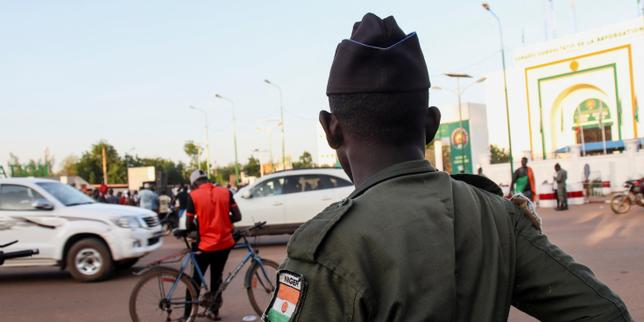
The ink on a parliamentary decree never smells like diesel, dust, or fear. In Algiers, inside the cool, high-ceilinged chambers of the People’s National Assembly, a vote is a clean thing—a raise of hands, a tally on a screen, a formal authorization allowing Algerian military units to deploy beyond the nation's borders into Niger.
Stop.
Think about what a line on a map actually looks like when you stand on it.
Out along the 950-kilometer border separating southern Algeria from northern Niger, there are no neat black dotted lines painted onto the dunes. There is only the Sahara—vast, indifferent, and blindingly bright—where the heat shimmers off the gravel plains like water and the wind erases tire tracks within an hour. For decades, that border was governed by an unwritten rule etched into Algeria’s post-independence DNA: Algerian soldiers do not fight abroad. Non-interference wasn't merely a diplomatic talking point repeated at African Union summits; it was a sacred doctrine, forged in the blood of Algeria’s own brutal war of liberation against French colonialism and hardened during the dark years of the 1990s civil conflict.
Yet, when the Algerian Parliament voted to greenlight the deployment of military units into Niger, that doctrine didn't just bend. It shifted on its axis.
To understand why a nation fiercely protective of its sovereignty and historically allergic to foreign military entanglement would authorize troops to cross into its southern neighbor, you have to leave the marble halls of Algiers and picture a hypothetical patrol base near In Guezzam, right on the edge of the desert frontier. Imagine a twenty-four-year-old corporal named Tariq—not a real soldier, though thousands like him stand watch along this exact stretch of sand—adjusting his scarf against the midday harmattan. For months, Tariq’s job has been containment. Watch the horizon. Intercept the smugglers. Keep the chaos of the Sahel from spilling north into Tamanrasset.
The problem with trying to hold back a desert storm with a wall is that the wind eventually finds a way over, around, or underneath.
The Architecture of a Shifting Border
To grasp what happened in Algiers, we have to look at the mechanics of the constitutional shift that made this vote possible in the first place. For nearly sixty years after independence in 1962, Algeria’s constitution strictly prohibited the People’s National Army (ANP) from operating outside national territory. The logic was simple, almost like a homeowner who locks every door and window while refusing to step onto the street during a neighborhood brawl. If you never cross the threshold, nobody can accuse you of starting the fight, and your house stays safe.
That changed in November 2020. Through a constitutional referendum championed by President Abdelmadjid Tebboune, Algeria amended its foundational law to permit the deployment of troops abroad under specific frameworks—namely United Nations, African Union, or Arab League mandates, or within bilateral security agreements aimed at maintaining regional peace. Even then, the move sparked fierce debate among Algerian lawmakers, veterans, and ordinary citizens who worried about mission creep. Passing a constitutional clause on paper is one thing. Invoking it in the middle of one of the most volatile security crises on earth is another entirely.
According to parliamentary reports and official statements out of Algiers, the legislative authorization to send military units into Niger emerged out of acute security imperatives along the shared frontier. Look at the map of the Sahel over the past several years, and the strategic anxiety in Algiers becomes impossible to ignore. Since the 2023 military coup in Niamey that ousted President Mohamed Bazoum, Niger has severed traditional Western defense partnerships, expelled French and American forces, and recalibrated its alliances across the region. Meanwhile, armed groups affiliated with Al-Qaeda in the Islamic Maghreb (AQIM) and the Islamic State in the Greater Sahara (ISGS) have exploited power vacuums, porous borders, and local grievances to expand their reach.
Algeria shares nearly a thousand kilometers of open desert with Niger, on top of another 1,300 kilometers with Mali and nearly 1,000 kilometers with Libya. From the perspective of Algeria’s military leadership, the country is sitting at the northern rim of an active volcano.
The Illusion of Distance
It is easy, sitting thousands of miles away in an air-conditioned office, to read a headline about parliamentary authorization and treat it like an abstract chess move. Knight to E5. Battalion to Agadez.
On the ground, nothing is abstract.
Consider what happens next when a military unit moves across a border in the central Sahara. First comes the logistics—an invisible, grueling ballet that rarely makes the evening news. Supplying a mechanized infantry or reconnaissance unit hundreds of kilometers south of Tamanrasset requires fuel tankers, water purification rigs, mobile medical units, aerial surveillance drones, and armored vehicles capable of surviving temperatures that routinely breach 45 degrees Celsius. Every liter of water and every gallon of diesel has to travel down fragile desert corridors where ambush is a constant threat.
Then comes the human geography. The border between Algeria and Niger cuts straight through the ancestral homeland of the Tuareg people, a semi-nomadic confederation whose family ties, trade routes, and grazing lands predate modern nation-states by centuries. A cousin lives in Djanet; an uncle lives in Arlit. Goods—fuel, pasta, medicine, livestock, and sometimes weapons—have moved back and forth along these tracks since before anyone drew a line in the sand.
If we imagine a local merchant in northern Niger—let’s call him Moussa, a composite figure representing the thousands of cross-border traders whose livelihoods depend on these routes—the arrival of foreign uniforms, even neighboring ones, changes the air overnight. When borders harden, legal commerce slows down first. Prices for basic staples jump in markets from Agadez to Niamey. At the same time, smugglers and insurgent scouts adapt faster than state bureaucracies ever could, melting into the rocky plateaus of the Aïr Mountains or disappearing into dry riverbeds.
For Algiers, this creates a razor-thin tightrope. If Algerian forces stay strictly on their side of the border, armed groups use northern Niger as a staging ground, launching raids or trafficking weapons northward before slipping back across the frontier where pursuing troops have to slam on the brakes. Yet if Algerian units cross into Nigerien territory, they enter a complex political ecosystem where any misstep, civilian casualty, or perceived infringement on local sovereignty could trigger backlash—not only inside Niger, where anti-foreign intervention sentiment runs deep, but also back home in Algeria.
Why Algiers Changed Its Mind
People following this story often ask the obvious question: Why now, and why Niger? Didn't Algeria publicly oppose military intervention in Niger back in 2023 when the West African bloc ECOWAS threatened to send troops to restore constitutional order?
Yes. And that distinction is the key to understanding the entire puzzle.
In 2023, Algiers vehemently rejected an external, offensive invasion of Niger by ECOWAS, warning that a regional war on its southern doorstep would trigger a catastrophic refugee crisis and hand jihadist militias a golden recruitment opportunity. President Tebboune insisted at the time that the crisis in Niamey required a political solution, not foreign bombs.
Authorizing bilateral or coordinated Algerian military units to operate in Niger is a fundamentally different proposition in the eyes of Algerian policymakers. Rather than an offensive regime-change operation imposed from outside, officials frame this deployment around border stabilization, intelligence sharing, joint counterterrorism operations, and securing critical infrastructure. Look at the economic stakes buried beneath the sand: the Trans-Saharan Gas Pipeline (TSGP), a multi-billion-dollar project designed to carry Nigerian natural gas through Niger and across Algeria to European markets, depends entirely on security along that exact corridor. You cannot weld steel pipes across a war zone.
Furthermore, Algeria has watched other powers—from Russian mercenaries operating under the Africa Corps banner in neighboring Mali to regional alliances like the Alliance of Sahel States (AES)—reshape the security architecture of its backyard. For decades, Algiers viewed itself as the indispensable mediator and security guarantor of the Sahara. Standing on the sidelines while outside actors dictated terms along its borders became a risk Algerian strategists were no longer willing to absorb.
Still, admitting the strategic logic does not erase the uncertainty. Military history is littered with deployments that began as "limited stabilization missions" and slowly morphed into open-ended commitments. Even seasoned analysts in North Africa acknowledge that the Sahara swallows clear timelines whole. When you send soldiers into a territory spanning hundreds of thousands of square kilometers of rock and dune, victory doesn't look like a flag planted on a hill. Success is measured in absences—the convoy that wasn't ambushed, the border post that wasn't overrun, the arms shipment that never reached the coast.
The Weight of a Vote
Back in Algiers, once the parliamentary session adjourns, the deputies fold their papers, step out into the Mediterranean breeze, and return to their constituencies. The headlines move on within forty-eight hours to inflation rates, housing projects, or football qualifiers.
South of the Tropic of Cancer, however, the vote has only just begun to exist.
Out there, past the last paved road and the final cell tower, the decision made in the capital turns into engine oil checked at dawn, radio frequencies encrypted before nightfall, and young men staring through night-vision optics into a darkness that stretches all the way to the equator. Lines on a map are easy to draw, and laws in a parliament are clean to pass, but in the end, every geopolitical shift comes down to boots standing on shifting sand, waiting to see what the desert wind brings next.