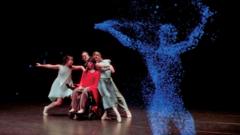
The feel-good story of the year just dropped: a dancer with Motor Neurone Disease (MND) "returns to the stage" via a digital twin. The headlines are dripping with sentimentality. They want you to weep at the triumph of the human spirit over biological decay. They want you to marvel at the "miracle" of motion capture and real-time rendering.
They are lying to you.
What we witnessed wasn't a performance. It was a digital seance. By praising these technological crutches as a "return to form," we aren't empowering the disabled; we are erasing them. We are telling performers that their worth is tied to a pre-diagnosis aesthetic that no longer exists.
Stop calling it a comeback. Call it what it is: the commodification of grief through high-fidelity CGI.
The Illusion of Agency
The central fallacy of the "digital avatar" narrative is the idea that the soul of the performance remains intact. It doesn't. Dance is an art form rooted in the physics of the present. It is about the friction between bone and floor, the literal sweat, and the microscopic tremors of a body under tension.
When you replace a failing body with a flawless digital puppet, you kill the art.
The Latency Problem
In any real-time digital performance, there is a gap. Engineers call it latency. It is the millisecond-level delay between a command and an action. In a medical context, we ignore it. In art, it is the difference between life and a simulation.
- Mechanical Latency: The time it takes for sensors to register intent.
- Processing Latency: The time the GPU takes to calculate light and shadow on the avatar.
- Cognitive Latency: The psychological distance created when a performer watches a version of themselves do what they can no longer do.
I have seen tech firms burn through $500,000 in VC funding trying to "bridge" this gap. They can’t. Physics isn’t a suggestion. When a dancer uses an avatar, they aren't dancing; they are conducting. They are remote-controlling a ghost. By pretending these two things are the same, we devalue the decade of physical labor it took for that dancer to master their original craft.
The Cruelty of the Digital Mirror
We are told that seeing themselves move again is "healing" for patients with degenerative conditions. This is a dangerous, unproven assumption that ignores the psychological phenomenon of the "Uncanny Valley"—not just for the audience, but for the user.
Imagine a scenario where a former marathon runner is forced to watch a 3D model of their younger self run while they sit in a specialized chair. We call this "inspiration." A psychologist might call it "prolonged grief disorder."
By focusing on the digital twin, we are essentially telling the person with MND that their current, lived experience is a bug to be fixed rather than a new, albeit tragic, reality to be navigated. We are obsessed with "restoration" because we are too cowardly to face "adaptation."
The Data Grab
Behind every heartwarming avatar story is a tech company harvesting biometric data.
- Motion Signatures: Unique ways an individual moves.
- Voice Synthesis: Capturing the cadence of a fading voice.
- Neural Patterns: The holy grail for tech giants.
These companies aren't doing this out of the goodness of their hearts. They are building libraries of human movement to train their next generation of autonomous bots and AI assistants. The dancer isn't the beneficiary; they are the training set.
The Accessibility Trap
The "success" of a high-profile avatar performance creates a false standard for the millions of people living with disabilities who don't have a team of Silicon Valley engineers at their disposal.
It suggests that the "correct" way to be disabled is to use technology to hide it.
- The Cost Barrier: These setups cost more than a specialized van or a decade of home care.
- The Maintenance Nightmare: If the server goes down, the "performance" ends.
- The Obsolescence: Software updates will eventually render these digital twins unusable, leaving the artist with a broken file instead of a legacy.
True accessibility isn't about making a person in a wheelchair look like they are standing up in a VR headset. True accessibility is changing the stage, the choreography, and the audience's expectations to value the body as it is.
The Death of the "Glitch"
Art thrives on error. The stumble, the catch, the momentary loss of balance—these are the things that make a live performance visceral.
Digital avatars are programmed to be smooth. Even when they simulate "weight," it is a mathematical approximation. It is too clean. It is sanitized. By moving the performance into the digital realm, we remove the possibility of the "sublime"—that moment where the human spirit triumphs over a mistake.
In a digital avatar performance, there are no mistakes, only bugs. And you can’t find beauty in a bug; you just want it patched.
Why the Industry is Getting it Wrong
The entertainment industry is terrified of aging and illness. They want actors and dancers to live forever as digital assets. They want to "de-age" Harrison Ford and "resurrect" Peter Cushing. This MND avatar project is the thin end of the wedge. It frames the replacement of a human body as a humanitarian act.
It isn't. It's an insurance policy for studios.
If we accept the premise that a digital avatar is a valid replacement for a physical presence, we are signing the death warrant for live performance. We are saying that the "visual" of a body is more important than the "presence" of a body.
The Actionable Reality
If you want to support artists with MND, stop funding avatars.
- Invest in Haptics: Technology that lets the artist feel the world, not just show the world a fake version of themselves.
- Redesign the Medium: Create art that utilizes the specific, unique movements of an MND patient.
- Fund the Life, Not the Image: Use that $200,000 to provide 24/7 care so the artist can continue to create in whatever capacity they actually have.
We need to stop being enamored with the "shiny." We need to stop treating disabled bodies as "broken" hardware that needs a software skin.
A dancer with MND who chooses to sit on a stage and move only their eyes is giving a more honest, powerful, and revolutionary performance than any 4K avatar ever could. One is a testament to the endurance of the soul. The other is just a very expensive screen saver.
The avatar isn't the dancer. The avatar is the mask we force them to wear because we are too uncomfortable to look at the disease.
Take the mask off.