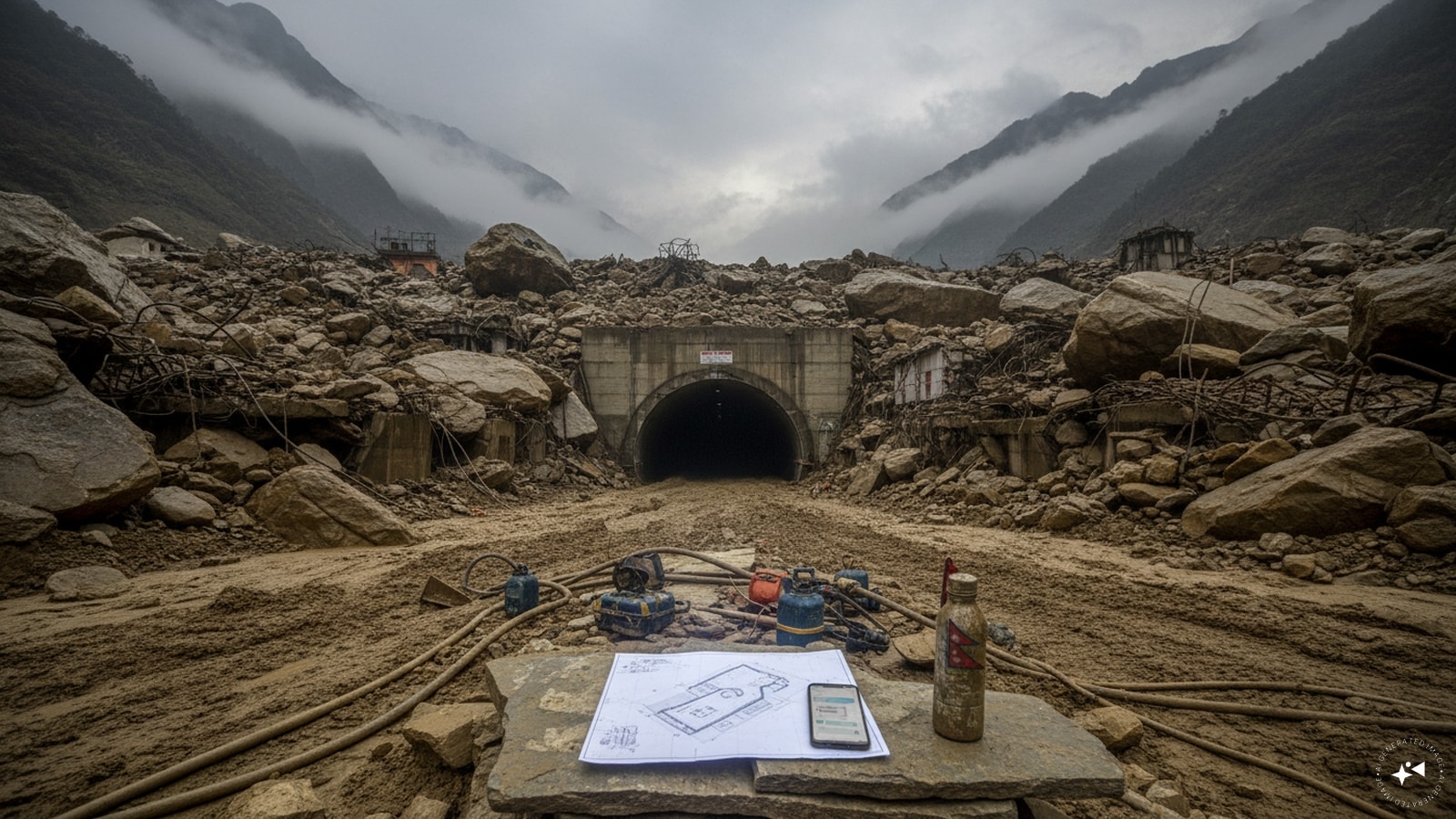
The rain did not fall; it crushed. For hours, the sky hung low over the valley like a saturated sponge, until the weight became unbearable and the rivers forgot their banks. Mud turned into liquid earth. Roads dissolved into grey grease. Electricity flickered, gasped, and died, leaving millions wrapped in the blind, deafening roar of monsoon fury.
In moments like this, official machinery moves with the grace of an ocean liner turning in a bathtub. Bureaucracy requires memos, clearance, and hierarchy. But water does not wait for committee approval. Water rises an inch a minute. Water steals breath before a siren can wail.
When the state apparatus stalled in the mud, something unexpected filled the void. It was not a high-tech satellite or a multi-million-dollar emergency response command center. It was a smartphone notification pinging in the dark.
Ping.
Another message. Another coordinate. Another life hanging by a thread.
The Frequency of Survival
Imagine a small, flickering screen illuminated against a pitch-black bedroom wall in Kathmandu. Outside, the Karnali river is chewing through concrete foundations. Inside, a group of software engineers, off-duty civil servants, and GIS specialists are staring at their phones with bloodshot eyes. They are thousands of miles away from the roaring currents physically, yet they are standing dead center in the disaster zone digitally.
This is the WhatsApp group that became a government.
We often talk about technology in terms of abstraction. We call it connectivity, infrastructure, or digital transformation. Those words taste like dust. They fail to capture what happens when code meets catastrophe.
Consider how this network operates. It is decentralized, chaotic, and breathtakingly fast. A stranded family in a submerged rooftop sends a blurred photo and a shaky landmark description to a local relative. That relative forwards it to a public channel. Within seconds, an engineer in the makeshift digital war room catches the ping.
Using open-source mapping tools, satellite feeds, and crowd-sourced verification, the engineer strips away the panic to find the raw truth: latitude, longitude, urgency. They do not have a uniform. They do not have a badge. They have a keyboard, a laptop battery at forty percent, and a refusal to look away.
Within minutes, that verified pin is routed directly to rescue boat operators waiting on the muddy banks miles downstream.
When Analog Systems Break
To understand why this digital improvisation matters, you have to look at why traditional emergency responses fail during extreme weather events.
Heavy rainfall acts as an immediate eraser of infrastructure. Cellular towers lose power. Traditional dispatch centers get overwhelmed by a tsunami of frantic phone calls, turning emergency helplines into endless, maddening busy signals. When every second counts, a jammed phone line is a death sentence.
Our institutional systems are built for linear crises. They assume a steady flow of information from the ground up: citizen calls dispatch, dispatch alerts field units, units execute. But monsoons are non-linear. They shatter communication lines simultaneously across multiple districts.
The engineers understood this systemic vulnerability long before the river overflowed. They didn't build a new app from scratch. They used the tools already humming in everyone's pockets. WhatsApp, Telegram, and shared Google Sheets became improvised switchboards.
It is an imperfect system. Rumors occasionally slip through. False alarms spark phantom deployments. I remember watching a similar crisis unfold years ago, tracking frantic messages from trapped villagers while my own basement slowly filled with brown, brackish water. The psychological toll of filtering noise from distress signals is staggering. You stare at a text message from a stranger begging for help, knowing that your next keystroke might decide whether a rescue team finds them or swims past them in the dark.
Yet, despite the chaos, this crowd-sourced network achieved what rigid bureaucratic hierarchies could not: radical agility.
The Anatomy of a Rescue
Let us trace a single thread through the noise.
A message drops into the chat at 2:14 AM.
“Four elderly people stranded on a tin roof in Rautahat. Water level rising fast. Send help.”
In a traditional dispatch model, this message might bounce between three different departments before a dispatcher even verifies the location. Here, the triage happens in real-time.
An engineer sitting in a quiet apartment three provinces away grabs the text. They cross-reference the vague description—"near the old brick kiln by the eastern bend"—against topographical flood maps and recent drone telemetry. They spot the roof. They drop a precise pin.
Another volunteer in the group checks local rescue boat rosters, matches the coordinates to the closest deployed inflatable raft team, and flags the message with a red siren emoji.
The boat captain, checking his phone under a plastic tarp in the pouring rain, sees the alert. He turns his outboard motor into the churning black water.
There are no signed forms here. No procurement audits. There is only a chain of human empathy linked by fiber optics and cellular towers running on emergency diesel generators.
By 3:45 AM, four shivering bodies are pulled from a corrugated iron roof into a bouncing rubber raft. They are wrapped in thermal blankets they didn't know existed, handed water bottles packed by volunteers they will never meet, and ferried to high ground.
That is not just data management. That is salvation engineered on the fly.
The Cost of Invisibility
We praise these digital volunteers as heroes, and they are. But celebrating their heroism obscures a dangerous reality.
When citizens have to build shadow dispatch networks to save their neighbors from drowning, it reveals a profound failure of public infrastructure. Technology should augment state capacity, not replace it entirely.
The engineers in that WhatsApp group do not want to run emergency services. They do it because the alternative is watching their countrymen drown while listening to recorded holding messages on government hotlines.
We live in an era of climate acceleration. The monsoon seasons are growing more erratic, more violent, and less predictable. The floods of today are the baseline of tomorrow. If our disaster response relies entirely on the midnight heroics of exhausted coders working out of spare bedrooms, we are building our future on sand.
Governments must learn from these grassroots tech interventions. They need to absorb these open-source mapping methods, integrate citizen-sourced verification protocols into official emergency frameworks, and build robust, decentralized communication channels that can survive the initial shock of a disaster.
The Final Signal
The storm eventually breaks. The grey clouds tear open to reveal a pale, indifferent sun. The floodwaters begin their slow, sluggish retreat, leaving behind a landscape caked in thick, grey silt, ruined crops, and the heartbreaking debris of displaced lives.
Back in the WhatsApp group, the frantic chatter slows down. The endless stream of SOS messages drops to a trickle, then stops entirely.
For a moment, there is silence.
Then, the administrative updates begin. Lists of missing persons. Demands for clean drinking water distribution. Offers of dry clothing and volunteers for cleanup crews. The digital organism shifts effortlessly from emergency triage to long-term recovery.
The screen goes dark as the phone battery finally hits zero.
Out in the valley, the river flows back into its scarred channel, carrying away the wreckage of the night, leaving behind a quiet reminder of what happens when ordinary people refuse to let technology divide them from their humanity.