You are standing in the kitchen, keys in hand, and you mutter three casual words to the empty air: Go for a walk.
Before the final syllable even leaves your lips, a low, tectonic rumble begins in the hallway. Nails click against hardwood like falling dice. A golden retriever materializes at your knees, tail spinning with such centrifugal force that his entire hindquarters sway. His eyes lock onto yours with the ferocious intensity of a monk discovering an ancient text.
To you, it was just a passing thought. To him, it was a transmission from an alien intelligence.
For centuries, we treated our dogs as furry barometers of mood, creatures that responded to tone rather than substance. They heard the cheerful lilt in our voices, we assumed, or they picked up on the frantic choreography of our morning routines. They were emotional mirrors, wonderful and simple, but fundamentally deaf to the architecture of human language.
Science has just proven us entirely wrong.
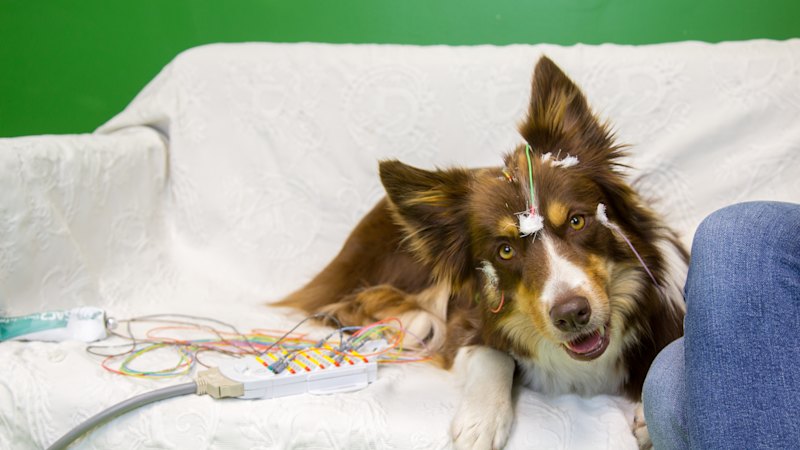
Consider what happens when neuroscientist Attila Andics fires up an fMRI machine in Budapest. Inside that bulky, roaring tube sits a dog, awake, unrestrained, and listening to his owner speak. What the scanner reveals is nothing short of a neurological ghost story. When a dog hears human speech, the left hemisphere of their brain lights up.
That is not a poetic coincidence. That is the exact same region humans use to process vocabulary.
Dogs are not just reading your emotions. They are doing something far more extraordinary. They are translating you.
The Anatomy of a Translation
To understand what is happening inside that woolly skull, we have to look at how language is built. Human speech is a two-part harmony: what we say and how we say it. The vocabulary carries the literal definition. The intonation carries the emotional freight.
If you lean over your sleeping Labrador and coo in a tone dripping with sweet affection, “You are a terrible, smelly parasite,” what does he do? He wags his tail. He thumps his head against the duvet. He feels loved.
Why? Because for a long time, researchers believed dogs were one-trick ponies of prosody. They only processed the music, not the lyrics. They heard the upward inflection of a question or the soothing hum of a compliment, and they reacted to the melody while completely missing the words.
Andics and his team decided to test this separation. They trained thirteen family dogs to lie completely still inside functional magnetic resonance imaging scanners. Then, they played recordings of their trainers speaking. The trainers used praise words with praising intonation, praise words with neutral intonation, neutral words with praising intonation, and neutral words with neutral intonation.
The results shattered a wall we had built between species.
The dogs’ brains processed the meaning of the words independently of the tone. When a known word was spoken—regardless of whether it was delivered with a flat voice or a jubilant chirp—the left hemisphere recognized the lexical item. But the emotional evaluation
The Secret Language We Share With Dogs Every Single Day
lifestyle, health
The floorboards always creak in the exact same spot. It is a dry, protesting squawk that usually sends sleeping paws twitching. But tonight, it did not. Tonight, the heavy, rhythmic breathing from the rug by the fireplace did not skip a beat.
Then came the rustle.
It was not the loud, intentional crinkle of a treat bag being dragged across the kitchen counter—a sound that can rouse a canine from the deepest stages of REM sleep with military precision. It was something far quieter. A thumb sliding across the slick plastic seal of a mail-order envelope. A microscopic vibration of friction.
Before the envelope had even parted an inch, two amber eyes snapped open. A tail gave a lazy, obligatory thump against the wool.
How did she know?
For decades, we have treated our conversations with our dogs as a charming exercise in one-sided devotion. We speak in high-pitched, melodic registers that sound ridiculous to human ears, assuming our pets are simply reacting to the musical cadence of our affection rather than the architecture of our words. We hand out treats for sitting, roll balls across lawns for fetching, and pat ourselves on the back for teaching them a vocabulary of fifty or a hundred commands.
We thought we were training them. We thought they were just really good at guessing our moods based on the twitch of an eyebrow or the angle of a shoulder.
We were wrong. Completely, beautifully wrong.
Science has finally begun to catch up to what anyone who has ever wept into a damp golden retriever coat already suspected in their bones. Dogs do not just hear the music of human speech. They parse the lyrics. They dissect the grammar, separate the emotional seasoning from the literal instruction, and map our phonetic world using neural machinery that looks astonishingly similar to our own.
Consider what happens inside the brain of a dog when a human voice fills a room.
Functional magnetic resonance imaging studies conducted on awake, unrestrained dogs have peeled back the skull's mystery to reveal a startling landscape. When a familiar voice speaks, the left hemisphere of a dog's brain lights up in response to meaningful words. Not just the tone. Not just the happy frequency. The actual semantic value of the word itself. Meanwhile, the right hemisphere processes the emotional intonation, deciding whether you are speaking with joy, caution, or mild irritation.
Dogs are linguistic critics. They are bilateral listeners, weighing what you say against how you say it, checking for consistency the way a seasoned diplomat reads between the lines of a treaty.
Imagine, for a moment, the dog sitting by the door while you talk on the phone to a friend. To you, the conversation is a blur of complaints about traffic and plans for dinner. To the dog, it is a dense audio stream filled with predictive markers. When you say the word "walk" with a flat, declarative tone—perhaps while complaining about having to walk someone else through a spreadsheet—the dog remains unmoved. But change the pronoun, lift the inflection, and attach it to a specific sequence of phonetic cues, and the left hemisphere fires like a switchboard.
They understand far more than we give them credit for. And they do it by tracking patterns that fly past us in a blur of casual chatter.
Linguists and animal behaviorists often point to the way we speak to dogs as a primary driver of this linguistic bridge. It is called dog-directed speech, or motherese, and it shares the exact acoustic exaggerations we use when speaking to human infants. We stretch our vowels. We raise our pitch. We turn ordinary statements into lyrical questions.
To a skeptic, this looks like foolish human sentimentality. Why talk to a terrier like a toddler?
Because it works as an evolutionary key.
When researchers tested how dogs and human babies respond to these exaggerated vocal contours, the results were striking. Both species show a heightened neural sensitivity to high-pitched, modulated speech. It acts as an attentional anchor. It tells the listener: Focus here. Information of high survival or social value is being transmitted.
We built a bridge across the species divide not through brute-force training, but through the shared rhythm of our breath and the melody of our affection. We trained them to listen to us by speaking to them with the unguarding innocence we usually reserve for our own newborns.
Yet, understanding the words is only half the puzzle. The true magic lies in how they map those words onto our chaotic, unpredictable world.
Think about a dog named Max, sitting on a worn porch in rural Vermont as the autumn wind rattles the dry cornstalks. Max’s human, an old carpenter with hands like seasoned oak, drops his tools into a metal bucket with a sharp clatter. He doesn't look at Max. He doesn't point. He simply mutters into the chill air, "Truck."
To an outsider, the word is an isolated noun, hanging awkwardly in space. To Max, that single syllable is an entire narrative. It triggers a complex web of associations: the cold metal of the tailgate, the smell of damp pine needles on the floorboards, the particular rhythm of the engine turning over after three sluggish coughs. Max is not translating "truck" into a mental picture of a vehicle; he is retrieving a memory trace of an experience shared with his person.
This is where the standard scientific models often fall short. They treat canine comprehension as a dictionary lookup, as if a dog’s brain operates like a pocket translation app, swapping human English for canine understanding word by word.
In reality, it is closer to poetry.
When dogs listen to us, they are performing a feat of cross-species translation that relies heavily on context, episodic memory, and an uncanny ability to read human intent. They do not care about the syntax of a sentence as much as they care about the agency behind it. When you tell a dog, "Leave it," they are not analyzing the imperative mood or the grammatical structure of a negative command. They are reading the sudden drop in your vocal energy, the tightening of your jaw, and the historic weight of every single time you used that exact tone to keep them safe from a rotting carcass in the woods.
We are teaching them our language, yes. But in doing so, we are also learning theirs.
We learn to read the micro-movements of their ears—the subtle backward pivot that signals hesitation, the forward tilt of total engagement. We learn the difference between a sigh that expresses contentment and a sigh that marks the reluctant abandonment of a hope for an extra slice of cheese.
This mutual fluency creates a strange, beautiful intimacy. You can be sitting in a crowded room filled with people who speak your native tongue fluently, people who understand every idiom and cultural reference you deploy, and yet feel entirely alone. At the same time, you can share a silent room with a creature covered in fur who cannot utter a single human phoneme, and feel completely, profoundly understood.
How is that possible?
Because human language is so often a weapon or a shield. We use words to disguise our intentions, to polish our images, to lie to ourselves and others. We wrap our fears in corporate jargon and our insecurities in small talk.
Dogs do not have that luxury. When they listen to our words, they are listening past the garbage we pile on top of our thoughts. They are listening for the emotional truth underneath the syntax. They hear the fatigue in your "hello" after a brutal day at the office before you even take off your coat. They hear the sudden lift in your voice when you talk about someone you love.
They use our language to check if we are okay.
As the night deepens in the farmhouse, the fire settles into a quiet, pulsing bed of red embers. The mail-order envelope sits unopened on the counter, its contents irrelevant now that the immediate threat—or promise—has been categorized and dismissed by two amber eyes.
The dog shifts her weight, sighs deeply, and rests her heavy chin back across her paws. Her breathing falls back into that slow, steady rhythm, anchoring the room in a quiet certainty.
She knows your voice. She knows your words. And long after the lights go out, she will still be listening, translating the quiet cadences of your dreams into a language only the two of you share.