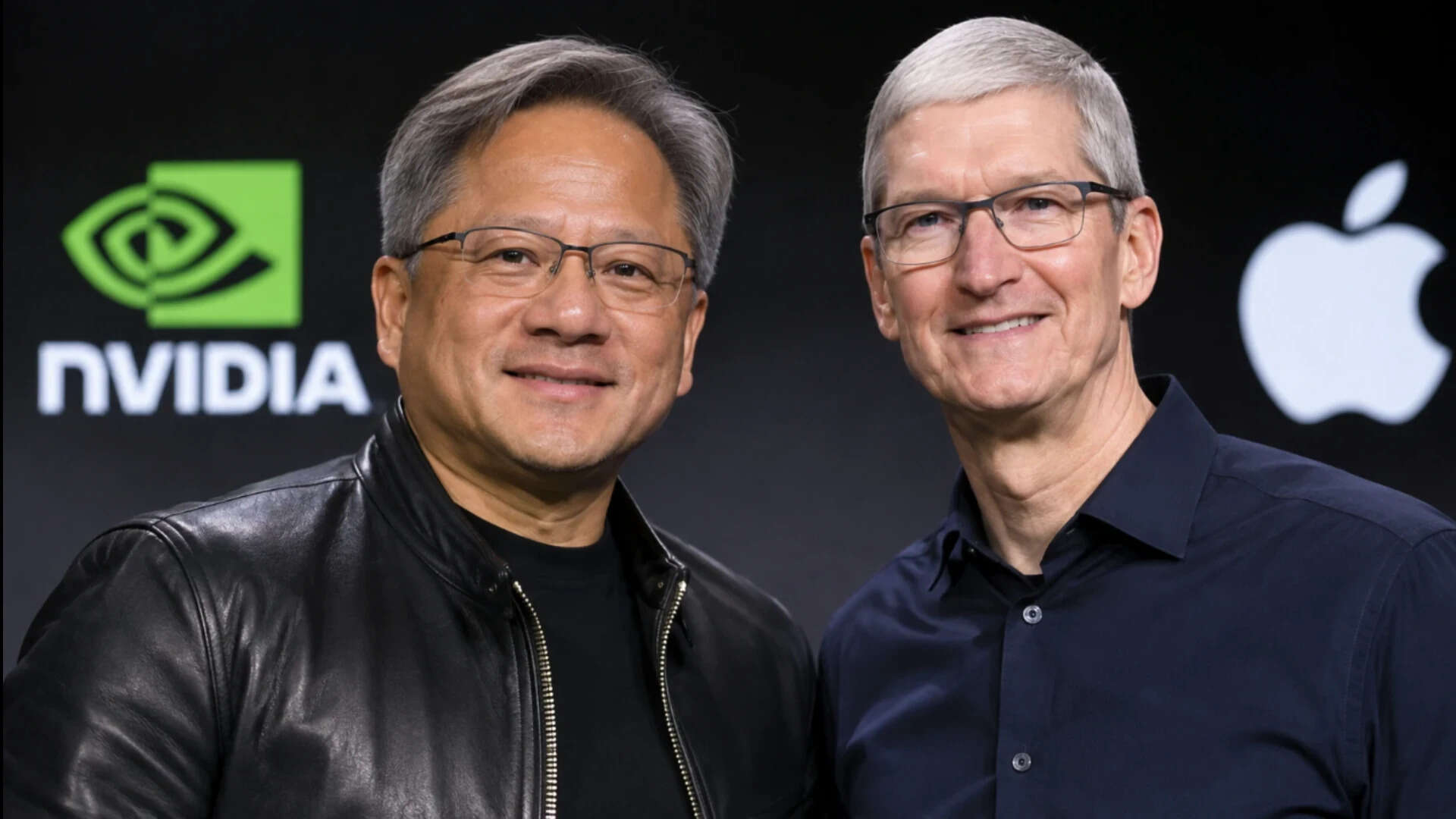
Rumors out of Washington and Silicon Valley suggest President Donald Trump has floated the idea of Apple CEO Tim Cook replacing Jensen Huang at the helm of Nvidia. On paper, the premise sounds like pure political theater, or perhaps a misunderstanding of how publicly traded tech giants operate. A sitting president cannot simply reassign corporate chief executives like cabinet secretaries. Yet dismissing the chatter as mere noise misses the massive geopolitical chess game unfolding behind the scenes.
The friction comes down to export controls, supply chain vulnerabilities, and two wildly different philosophies on how to handle Beijing.
Nvidia sits at the center of the global artificial intelligence boom, supplying the high-performance graphics processing units that train massive language models. That dominance has made Jensen Huang the most scrutinized executive in the semiconductor industry. For months, Huang has walked a tightrope between Washington's national security hawks and Nvidia's bottom line in China. Tim Cook, meanwhile, has spent over a decade perfecting the art of appeasing both superpowers while keeping Apple's manufacturing engine humming. To understand why Trump might view Cook as the ideal operator for Nvidia, you have to look at the structural pressures tearing the chip sector apart.
The Geopolitical Collision Between Washington and Silicon Valley
Nvidia is not just a chip designer anymore. It is a critical piece of American national defense infrastructure, at least in the eyes of the Pentagon and the Commerce Department. Every time Nvidia engineers a workaround chip to comply with U.S. export restrictions—such as the modified processors built specifically for the Chinese market—regulators in Washington tighten the screws further.
Huang has been vocal about the unintended consequences of these bans. He has argued publicly that cutting off American chipmakers from the Chinese market does not stop China from developing artificial intelligence; it simply forces Chinese tech giants like Huawei to accelerate their own domestic alternatives. To Huang, losing access to one of the world's largest technology markets permanently damages American competitiveness.
To an administration focused on aggressive decoupling and tariff enforcement, that posture looks less like pragmatic business sense and more like resistance.
Enter Tim Cook.
During Trump's first term, Cook famously bypassed traditional lobbying channels and built a direct, personal rapport with the president. While other tech leaders sparred with the White House over immigration, content moderation, and trade wars, Cook sat down for dinners, toured manufacturing facilities with Trump in Texas, and secured crucial tariff exemptions for the iPhone. Cook did not argue with the administration's worldview in the press. He worked inside it, offering optical wins on domestic job creation while quietly protecting Apple's margins.
From Trump's perspective, the contrast is stark. Huang represents an outspoken founder-CEO pushing back against export limits. Cook represents a disciplined, compliant operator who understands transactional politics and knows how to keep Washington happy without sacrificing shareholder value.
Corporate Reality Versus Political Wishful Thinking
Here is the problem with the scenario. Neither Trump nor the federal government has the legal authority to force a leadership change at Nvidia.
Nvidia is a publicly traded company governed by a board of directors with a fiduciary duty to its shareholders. Since Huang co-founded the company in 1993, he has steered it from a niche maker of PC gaming graphics cards into one of the most valuable corporations on earth. Under his leadership, Nvidia did not just ride the artificial intelligence wave; it built the surfboard, the ocean, and the beach.
Replacing Huang would trigger an immediate and catastrophic sell-off on Wall Street. Institutional investors view Huang not merely as a manager, but as the chief architect of Nvidia's technical moat.
Consider how Nvidia actually maintains its lead. It is not just about making fast silicon. Nvidia's true stranglehold on the market comes from CUDA, its proprietary software platform and programming model. Developers have spent nearly two decades writing code specifically for CUDA. Switching away from Nvidia hardware means rewriting massive amounts of foundational software, a costly and painful process that competitors like AMD and Intel have struggled to overcome.
Huang understands the technical intricacies of silicon architecture, compiler design, and data center networking at a granular level. He famously operates with a flat organizational structure, keeping dozens of direct reports so technical problems reach his desk without bureaucratic filtering.
Tim Cook is arguably the greatest supply chain logistician in corporate history. Before taking over for Steve Jobs in 2011, Cook transformed Apple's operations by slashing inventory, locking down component suppliers, and building a global manufacturing machine centered in East Asia. He turned Apple into a multi-trillion-dollar cash generator through operational discipline, incremental product refinement, and services expansion.
What Cook is not, however, is a semiconductor architect.
The Myth of the Interchangeable Tech CEO
Silicon Valley history is littered with the wreckage of companies that swapped out visionary founders for professional operators at the wrong moment.
When Apple pushed Steve Jobs out in 1985 in favor of Pepsi executive John Sculley, the company nearly went bankrupt within a decade. Sculley knew how to market consumer goods and manage corporate hierarchies, but he lacked the product intuition to navigate a rapidly shifting computing market.
A similar dynamic played out at Intel. For years, Intel dominated the semiconductor world through superior manufacturing and engineering leadership. Over time, leadership shifted toward finance and operational executives who prioritized share buybacks and short-term margin protection over aggressive capital expenditure in next-generation lithography. By the time Intel realized it had fallen behind Taiwan Semiconductor Manufacturing Company (TSMC) in chip fabrication, the gap had become nearly impossible to close.
Hypothetically, if Tim Cook were dropped into the corner office at Nvidia tomorrow, his skillset would solve the wrong set of problems.
Nvidia does not suffer from supply chain inefficiency. Its primary bottleneck is manufacturing capacity at TSMC, specifically around advanced packaging technologies like CoWoS (Chip-on-Wafer-on-Substrate), which is required to bind high-bandwidth memory to AI processors. Cook already shares that exact same supplier relationship with TSMC for Apple's A-series and M-series chips. Putting Cook in charge of Nvidia would not magically conjure extra cleanroom space in Taiwan or speed up the construction of TSMC's fabrication plants in Arizona.
Worse, Cook's methodical, risk-averse management style clashes directly with the breakneck pace of AI hardware development. Under Huang, Nvidia compressed its product release cycle from two years down to a relentless annual cadence—moving from the Hopper architecture to Blackwell, and already detailing Rubin. That pace requires a leader willing to bet billions on unproven silicon architectures years before the software demand fully materializes.
Where Cook Would Actually Shine at Nvidia
To be fair to the premise, there are specific areas where Cook's playbook would give Nvidia an immediate edge.
- Washington Diplomacy: Cook would likely end the public friction between Nvidia and federal regulators, establishing backchannel agreements on export licenses and domestic manufacturing commitments.
- Supply Chain Diversification: While Nvidia relies almost entirely on TSMC and Samsung for foundry work, Cook has spent years aggressively shifting portions of Apple's assembly footprint into India and Vietnam to reduce single-country exposure.
- Enterprise Lock-In: Cook excels at monetizing an existing ecosystem. He would likely accelerate Nvidia's transition toward recurring enterprise software licensing, extracting higher-margin revenue from companies already locked into Nvidia hardware.
Even with those advantages, the trade-off makes zero sense for Nvidia's board. You do not bench your star quarterback during the fourth quarter of the Super Bowl because the league commissioner prefers the opposing team's coach.
Why Tim Cook Would Never Take the Job
The rumor also ignores Cook's own career trajectory and incentives.
Cook has spent nearly three decades at Apple. He is deeply embedded in its culture, commands immense loyalty from its executive team, and sits atop a company with unmatched consumer reach and cash reserves. Taking the top job at Nvidia would mean inheriting a massive regulatory target at the exact moment antitrust authorities in the United States and Europe are sharpening their knives.
Nvidia already faces intense scrutiny over its market share in AI accelerators, which hovers around 80 to 90 percent. Regulators are examining whether Nvidia bundles its networking gear unfairly with its GPUs or punishes cloud providers that experiment with rival chips. Stepping into that regulatory crossfire while trying to learn the intricacies of data center thermodynamics and tensor core math is a losing proposition for an executive nearing the twilight of his career.
Furthermore, Apple is fighting its own existential battles. Cook is currently steering Apple through a delicate transition in artificial intelligence with Apple Intelligence, trying to prove that on-device privacy and tightly integrated hardware can beat cloud-based AI models. Abandoning Apple mid-transition to run a chipmaker would tarnish the legacy he spent fifteen years building.
The Real Message Behind the Chatter
When political figures float dramatic corporate shakeups, the literal proposal is rarely the point. The rumor itself functions as leverage.
By publicly or privately musing that Tim Cook would do a better job running Nvidia, Trump sends an unmistakable warning shot across Jensen Huang's bow. The message is simple: fall in line on China policy, stop complaining about export controls in the media, and start delivering tangible domestic manufacturing wins.
We have seen this exact playbook used across other industries. During his first administration, Trump routinely targeted defense contractors like Lockheed Martin over F-35 cost overruns, pharmaceutical companies over drug pricing, and automakers over Mexican factory investments. In almost every instance, the goal was not to seize control of the company, but to force the sitting CEO to the negotiating table with concessions in hand.
For Huang, the pressure is mounting from all sides. Washington wants him to choke off Beijing's access to advanced compute. Beijing is launching antitrust probes into Nvidia and urging domestic firms to buy local chips instead. Meanwhile, Nvidia's biggest customers—Microsoft, Meta, Google, and Amazon—are pouring billions of dollars into designing their own custom ASICs (Application-Specific Integrated Circuits) to reduce their dependence on Nvidia's pricey hardware.
Huang does not need Tim Cook to replace him, nor is there any realistic mechanism for that to happen. What Huang does need is a way to survive the geopolitical crossfire without fracturing the global semiconductor supply chain that made Nvidia a multi-trillion-dollar juggernaut in the first place. Until he finds that balance, expect Washington to keep floating names of executives who look a little more willing to play ball.