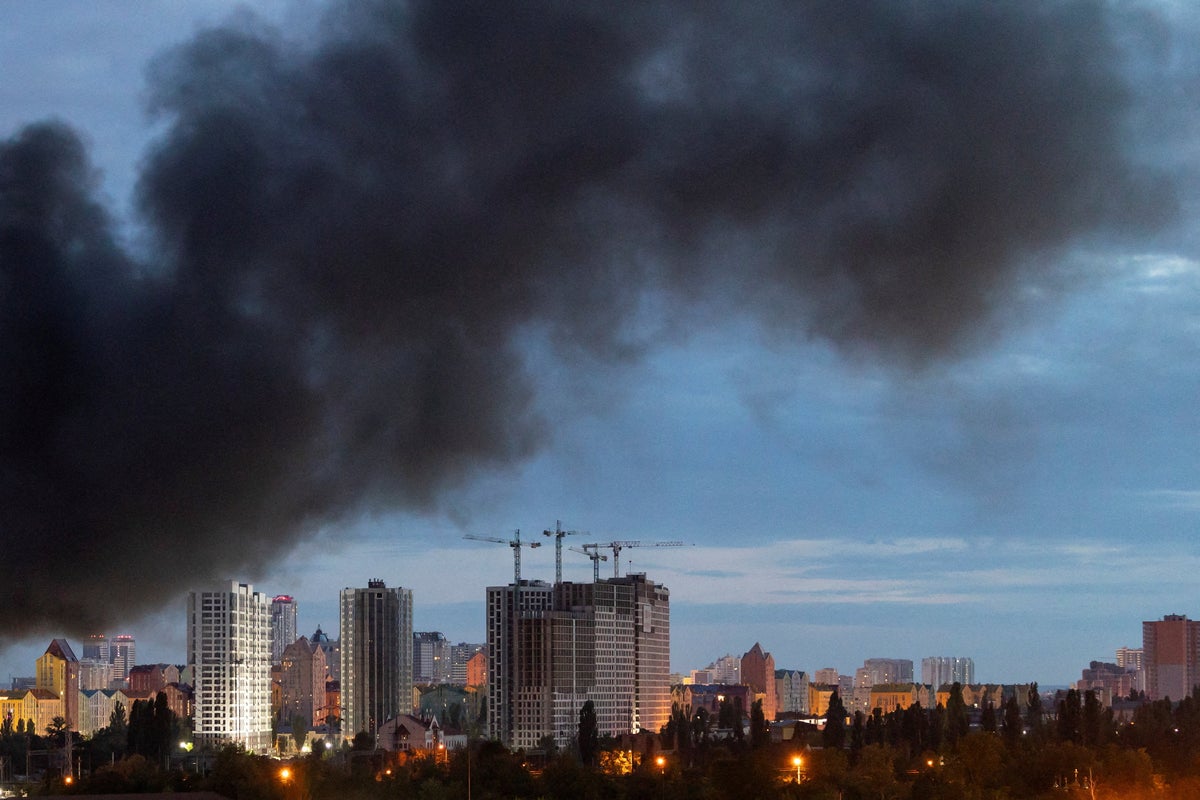
Western media outlets are stuck in a repetitive loop of lazy reporting. Every time a volley of Russian ballistic missiles and Shahed drones hits Kyiv, the headline is identical: tally the tragic civilian casualties, list the damaged infrastructure, and imply the strategy is pure terror. It is a surface-level narrative that misses the entire geopolitical and military calculus playing out in the skies over Ukraine.
Mainstream coverage treats these strikes as a series of isolated, vindictive outbursts. They look at a smoking crater in a residential area and conclude Russia is simply wasting millions of dollars in precision munitions to terrorize civilians. This is a fundamental misunderstanding of modern attrition warfare. The real objective is not the rubble on the ground; it is the exhaustion of the sophisticated air defense network protecting it.
Military strategists call this suppression of enemy air defenses (SEAD) by technological exhaustion. By treating every strike as a localized tragedy rather than a piece of a massive chess match, commentators are blinded to the brutal math governing this conflict.
The Brutal Math of Air Defense Attrition
The standard narrative celebrates every high interception rate reported by Ukrainian officials. When a report states that 18 out of 20 missiles were downed, the public cheers. They see it as a total victory for Western technology like the Patriot, NASAMS, or IRIS-T systems.
That view is dangerously shortsighted.
Consider the economics of a standard engagement. Russia frequently launches cheap, Iranian-designed Shahed-136 loitering munitions alongside complex Kh-101 cruise missiles and Kinzhal ballistic missiles. A Shahed drone costs roughly $20,000 to manufacture. The interceptor missiles fired from a Patriot battery—such as the PAC-3 MSE—cost between $3 million and $4 million each.
Even when the air defense system successfully intercepts the target, the financial asymmetry is staggering. You are using a multimillion-dollar asset to destroy a flying lawnmower engine.
But the crisis is not just monetary; it is structural. The global manufacturing capacity for high-end air defense interceptors is severely limited. Lockeed Martin and Raytheon cannot simply press a button and double their annual production of interceptor missiles. The supply chains for solid-rocket motors, guidance systems, and specialized rare-earth elements are notoriously rigid.
When Russia floods the airspace over Kyiv, they are forcing Ukraine to make an impossible choice: drain their finite inventory of advanced interceptors to protect the capital, or save those interceptors for the front lines, leaving critical infrastructure exposed. Every successful interception reported by the media brings Ukraine one step closer to an empty magazine.
The Flawed Premise of "Precision Terror"
The mainstream press insists on asking the wrong question: "Why does Russia continue to target residential areas?"
The brutal reality of urban warfare is that intercepting a high-speed ballistic or cruise missile over a major metropolitan area does not make the danger vanish. When a Patriot interceptor strikes a Kinzhal missile traveling at Mach 5, the resulting debris field consists of hundreds of pounds of unexploded ordnance, rocket fuel, and kinetic shrapnel. This debris has to fall somewhere.
A significant portion of the damage documented in Kyiv is the direct result of successful interceptions occurring directly above populated city centers. By failing to differentiate between a direct missile hit on a civilian target and the collateral damage of a mid-air interception, media coverage distorts the operational reality.
Russia is targeting specific nodes: command centers, electrical substations, logistics hubs, and the air defense batteries themselves. The fact that residential blocks are damaged is a feature of fighting an air war over a dense metropolis, not necessarily the primary intent of the flight path. Acknowledging this is not an endorsement of the strikes; it is a prerequisite for understanding the strategic environment.
The Blind Spot in Western Aid Packages
For two years, the public has been told that sending more air defense batteries solves the problem. This is a logistical fantasy.
I have watched defense analysts argue for months that sending another three Patriot batteries will secure the skies over Ukraine. This ignores the physical reality of deployment. A single Patriot battery requires roughly 90 soldiers to operate and maintain. It features a radar set, an engagement control station, a power generation plant, and up to eight launchers. It is a massive, highly visible target with a distinct electronic signature.
Furthermore, dispersing these systems across the country to protect every major city dilutes their effectiveness. Air defense is most effective when it is layered—combining short-range systems (like Gepard anti-aircraft guns) with medium-range (NASAMS) and long-range (Patriot) assets.
When Western nations ship a hodgepodge of different systems from different manufacturers, they create a logistical nightmare. A Ukrainian maintenance crew cannot use IRIS-T parts to fix a NASAMS battery. The training pipelines are fractured, the ammunition is non-interchangeable, and the command-and-control systems require complex software bridging to talk to one another.
We are not building an impenetrable shield; we are funding a fragmented, unsustainable patchwork.
Redefining the Solution
Stop looking at the destruction in Kyiv as evidence of military failure or random malice. Look at it as a warning sign that the current Western strategy of defensive reactive containment is failing.
If the goal is to protect Ukrainian cities and infrastructure, the answer is not more interceptors. The answer is disrupting the launch platforms before the missiles ever leave the ground. This requires long-range strike capabilities capable of targeting strategic bombers at Engels Air Base or mobile Iskander launchers deep within Russian territory.
As long as Western policy restricts Ukraine from striking the source of these attacks out of fear of escalation, the attrition math remains firmly in Russia's favor. Kyiv will continue to burn through its limited supply of Western missiles, and the headlines will continue to wonder why the strikes never stop.
The status quo is a slow-motion collapse of Ukraine’s air defense capacity disguised as a series of heroic tactical victories. Stop celebrating the high interception rates and start looking at the rapidly depleting stockpiles. The current strategy is spent. Change the parameters of the engagement, or accept the inevitable blackout.