The coffee in Mateo’s ceramic mug didn't ripple first. It vanished.
One second, the dark, steaming liquid sat undisturbed on his kitchen counter in Panama City, catching the morning light that poured through the balcony doors. The next, the cup leapt sideways, shattering against the tile floor, while the apartment building itself groaned—a deep, metallic shriek of stressed concrete and twisted rebar.
It was 7.7.
That number, dry and clinical on a seismologist's ledger, translates in the physical world to an absolute loss of equilibrium. Ground is supposed to be the one constant we are granted. When the tectonic plates beneath Central America suddenly lurched, sliding against one another with the force of millions of tons of detonating dynamite, that fundamental contract broke.
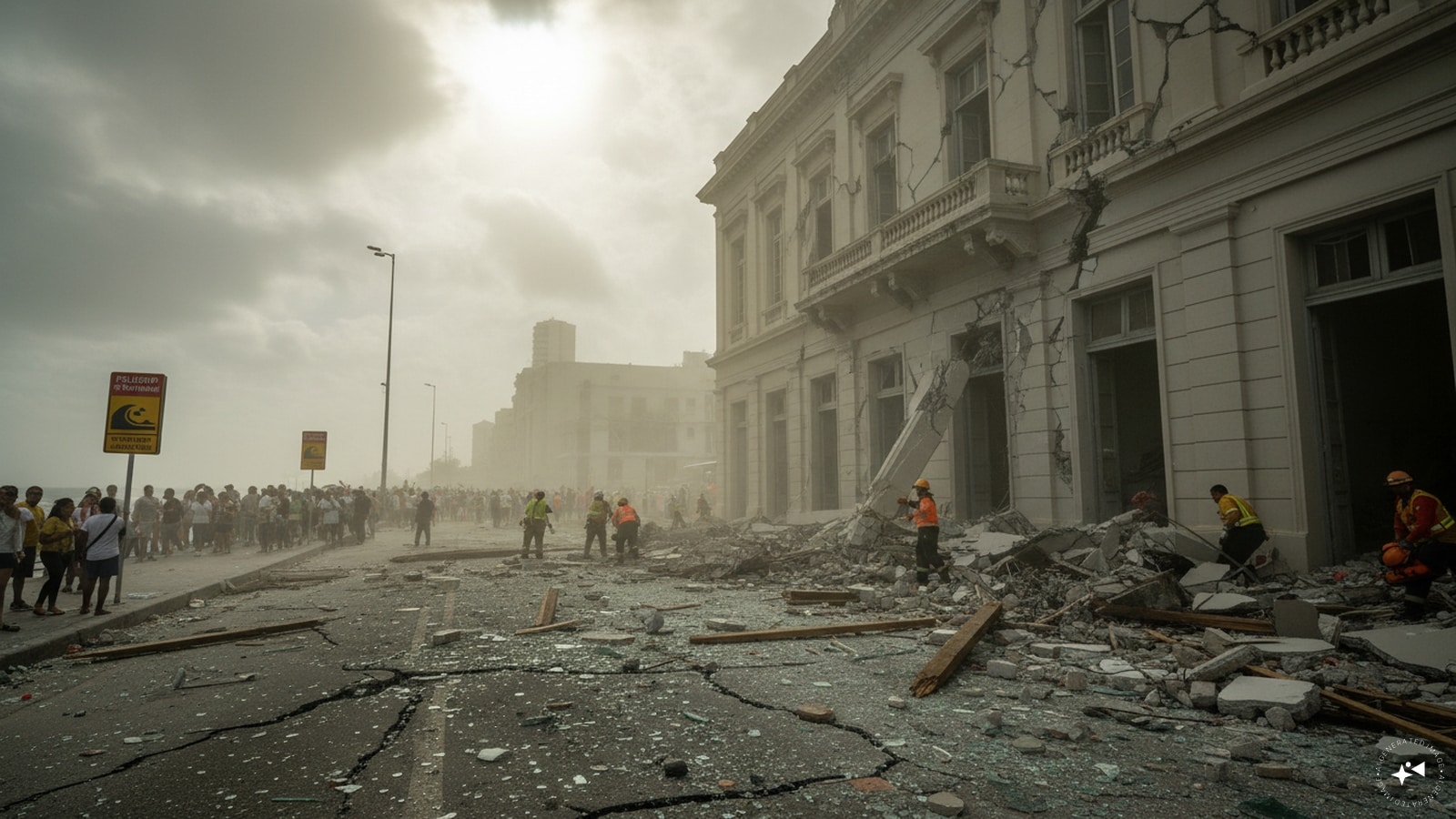
For nearly a minute, the world dissolved into violent motion. Walls cracked like dried mud. Books spilled from shelves in synchronized avalanches. In the streets, power lines whipped through the air like angry serpents, sparking brilliant blue arcs against a sudden shroud of dust. People poured out of office towers and apartment blocks, their faces pale, stumbling over buckled pavement as car alarms joined a chaotic chorus of sirens and shouting.
Panama is no stranger to the restless architecture of our planet. We build with steel and foresight here, knowing full well that we sit atop a geological jigsaw puzzle. Yet, a tremor of this magnitude tests the very edge of human engineering and psychological endurance. When the crust of the earth tears open, the immediate panic is only the first chapter of the ordeal.
Then came the silence. A heavy, suffocating quiet that precedes the water.
Farther down the coast, where the Pacific stretches out toward the horizon in deceptive calm, the ocean began to behave strangely. Harbors sucked dry, exposing the barnacle-encrusted hulls of fishing boats resting uneasily on mudflats. The sea was retreating, drawing a deep breath before the exhale.
A tsunami warning is a particular kind of psychological torture. It does not hand you an immediate catastrophe; it hands you a ticking clock and a horizon line.
Consider the family living in a coastal stilt house three hours outside the capital. The father, hearing the blare of emergency broadcasts on his radio, didn't pack photo albums or heirlooms. He grabbed his daughter’s hand and ran toward the low hills behind their village, his heart hammering against his ribs. Every step uphill felt agonizingly slow. Every glance backward toward the shimmering expanse of blue water felt like a gamble with fate.
This is what raw geological data fails to capture. It misses the wetness of the palm you are squeezing. It misses the child's silent confusion, the barking of terrified stray dogs, and the frantic scramble of an entire community seeking high ground before the ocean decides to reclaim the shore.
Geologists will spend the coming months parsing the fault lines, mapping the slip vectors, and measuring the displacement of the Nazca and Caribbean plates against the overriding Panama block. They will talk of seismic moments, focal depths, and peak ground accelerations. They will draw colorful maps of intensity contours.
Yet, numbers cannot mend a fractured foundation. They cannot rebuild a shattered storefront where a family spent twenty years pouring their life savings into a bakery. They do not measure the invisible weight that settles onto the shoulders of a population living on the edge of an active subduction zone.
As the afternoon sun finally cut through the pall of dust hanging over Panama City, the aftershocks began. Small, sharp jolts that kept everyone on edge, each one resetting the collective nervous system to zero. People stood in public squares, reluctant to return indoors, watching the skies and each other.
The earth is older than our cities, older than our ambitions, older than the borders we draw across maps. Every now and then, it reminds us of that hierarchy with a violence that humbles the proudest architecture. We patch the roads. We pour new concrete. We rebuild the walls. But we walk a little softer on the pavement afterward, acutely aware of how thin the crust really is beneath our feet, and how quickly the world can turn to liquid motion.