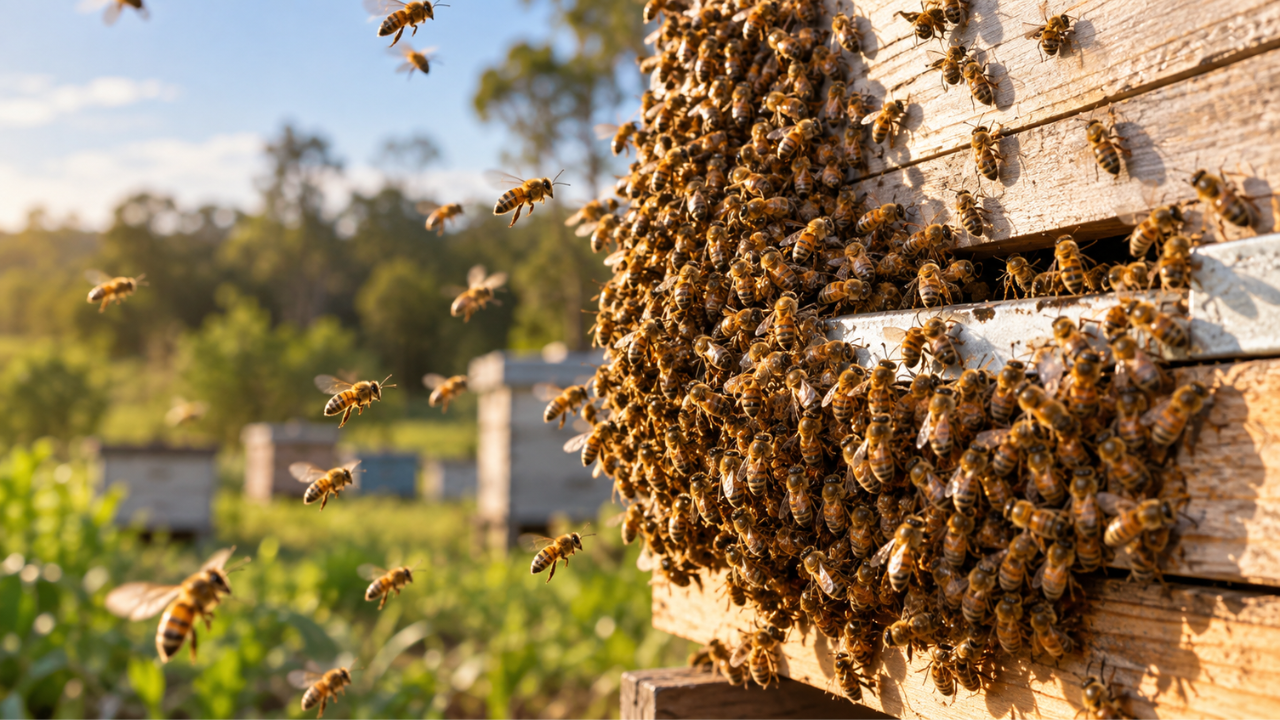
The theft of 800,000 bees across multiple commercial apiaries in Australia exposes a severe vulnerability in the agricultural supply chain. When thieves bypass stored honey to extract entire biological units—hives, brood frames, and queens—they are not committing crimes of opportunity. They are executing a high-value asset acquisition strategy that exploits systemic security gaps in rural infrastructure.
Understanding this phenomenon requires moving past sensational headlines to examine the underlying mechanics of agricultural asset valuation, the economics of pollination markets, and the structural deficiencies of apiary security.
The Valuation Model of Commercial Apiculture
To understand why honeybee colonies are targeted by organized theft rings, one must evaluate the asset value of a modern commercial hive. A standard Langstroth hive consists of wooden boxes, frames, drawn honeycomb, a laying queen, and thousands of worker bees. However, the market value of that hive extends far beyond the physical components or the immediate yield of honey.
The total economic value of a commercial colony is determined by three distinct variables:
- Genetic Stock and Queen Quality: A commercially productive queen bee bred for specific hygienic traits, gentleness, and honey yield represents a significant capital investment. Replacing a high-performing queen and her established laying patterns takes months.
- Drawn Comb Infrastructure: Bees spend substantial energy and consume roughly eight pounds of honey to secrete one pound of wax to build comb. Drawn comb is a reusable capital asset that allows incoming bees to immediately store nectar and rear brood, bypassing the most resource-intensive phase of colony establishment.
- Pollination Contracts: In modern commercial agriculture, the primary revenue driver for many beekeepers is not honey production, but migratory pollination services. Almond, canola, and orchard crops rely entirely on rented hives. A colony contracted for seasonal pollination generates guaranteed revenue that dwarfs the value of its honey output.
When thieves steal entire colonies rather than extracting honey, they are stealing a self-sustaining biological production facility complete with infrastructure and immediate utility in the agricultural economy.
The Structural Vulnerabilities of Dispersed Agriculture
Commercial beekeeping operations are decentralized by necessity. To access diverse floral resources and satisfy agricultural pollination demands, apiaries are distributed across vast geographic areas, often on private rural land, national parks, or remote agricultural leases. This dispersion creates a severe operational security challenge.
[Decentralized Apiary Network] --> [Low Surveillance Density] --> [High Asset Portability] --> [Lucrative Black Market]
This structural vulnerability stems from several compounding factors:
- Remote Location Profiles: Apiaries are routinely placed in isolated areas with low human traffic and poor cellular or camera coverage. This eliminates real-time monitoring capabilities.
- Standardized Equipment Interoperability: Beekeeping equipment is largely modular and standardized. Stolen hives, boxes, and frames can be easily integrated into another operation or sold on secondary markets without requiring specialized modification or raising suspicion.
- Lack of Unique Identifiers: Unlike livestock, which often carry ear tags, brands, or electronic identification chips, standard wooden beehives rarely feature immutable tracking mechanisms. Proving ownership of stolen bees or unmarked wooden boxes after they have been relocated is exceptionally difficult for law enforcement.
The Black Market Supply Chain Mechanics
The movement of 800,000 bees implies an organized operation with specialized knowledge, transport logistics, and ready market outlets. Transporting hundreds of hives requires heavy-duty vehicles, specialized lifting equipment, and precise timing—typically executed at night when forager bees have returned to the hive and temperatures are low enough to keep the cluster calm.
The demand side of this black market is driven by systemic industry pressures. The global apiculture sector faces continuous mortality pressures from disease, parasites like the Varroa destructor mite, environmental stressors, and pesticide exposure. When commercial operators suffer heavy colony losses ahead of high-value pollination seasons, the cost of legal restocking surges.
This creates a shadow economy where stolen colonies can be laundered back into legitimate supply chains. Once stolen hives are relocated to a new region, re-queens, and mixed with existing stock, the original provenance is effectively obscured. The thieves exploit a market where high demand for pollination units meets a constrained supply of healthy, disease-free colonies.
Strategic Defenses and Asset Protection
Mitigating the risk of coordinated apiary theft requires a transition from passive observation to active asset hardening. Traditional locks on hive straps deter casual vandals but offer zero resistance against organized theft rings equipped with flatbed trucks and hydraulic loaders.
Effective protection frameworks must incorporate multi-layered operational controls:
- Physical Anchoring and Surveillance: Deploying heavy-duty mechanical locks combined with covert, cellular-enabled trail cameras and GPS tracking units hidden within select brood frames changes the risk calculation for perpetrators. Even a single tracked hive allows law enforcement to map transport routes and recovery locations.
- Immutable Identification: Etching serial numbers into wooden components, branding plastic frames, and utilizing micro-tagging or DNA profiling of queen lineages establishes legal ownership trails that survive resale.
- Geographic Diversification and Access Control: Limiting road access to apiary sites through locked gates, natural barriers, or strategic placement within direct line-of-sight of farmhouses reduces the window of vulnerability during the high-risk night hours.
The commercial bee theft crisis demonstrates that as biological assets appreciate in economic value due to agricultural dependence, traditional security models built on rural trust are no longer sufficient. Protecting the infrastructure of modern pollination requires treating hives not as passive farming equipment, but as high-value, highly portable industrial capital.